Payday loans
Payday loans: how they work, what they cost and the rules
By the getaloannow.ca editorial team · Writing and fact-checking · updated November 26, 2026
Payday loans are small, short-term loans, usually repaid in a single payment on your next payday (in Alberta, in at least two instalments over 42 to 62 days). In Ontario, British Columbia, Alberta, Manitoba and Saskatchewan, they are allowed when the lender holds a provincial licence, and their total cost is capped at $14 for every $100 borrowed. This page explains how payday loans work, including payday loans online, what they really cost, the rules that protect you and the options that usually cost less.
One point first: getaloannow.ca is not a lender. We are a loan matching service. You can send a request; if your profile fits, it may be forwarded to lenders and financial partners who may be able to respond; a lender makes its own decision and sets its own terms. We do not lend, approve a loan or set a cost; we cannot promise a reply or a timing, and you may receive no offer at all.
- Free for you, no obligation
- No social insurance number required
- Filling in our form does not affect your credit file

Free for you
No fees, at any point.
No SIN
No social insurance number, no banking details.
Your credit file stays untouched
Our form does not pull your credit report.
You stay free
No obligation to accept an offer.
Watch
Read the transcript
How do payday loans work in Canada? They're easy to find, and easy to misunderstand. Let me explain how they work, what they really cost, the rules in each province, and what usually costs less.
A payday loan is a small, short-term loan. According to the Financial Consumer Agency of Canada, it's an expensive way to borrow money, also called a high-cost loan. You usually repay all of it, with its cost, on your next payday, often through a pre-authorized debit from your bank account. And the term can't go beyond 62 days.
Normally, the Criminal Code caps the cost of credit at 35% a year. Payday loans escape that cap under section 347.1, and only on three conditions: a short loan, of 62 days or less; a lender licensed by its province; and a province designated by the federal government. Ontario, British Columbia, Alberta, Saskatchewan and Manitoba are designated. Quebec is not.
In those provinces, the cost has its own ceiling. Since January 1, 2025, the total cost of a payday loan, every fee included, can't exceed 14% of the amount advanced. And in Ontario, a payday lender can't sell you insurance or any other product with the loan.
That sounds small. But it's charged for a couple of weeks, not a year. Over 14 days, the FCAC says it works out to an annual rate of roughly 365%.
Each province then sets limits tied to your pay. In Ontario, a loan can't be more than half of your net income. In British Columbia, half of your paycheque. In Saskatchewan, half of your take-home pay, and the lender needs a pay stub or a bank statement showing it. Manitoba goes further: 30% of your net pay. And in Alberta, a payday loan runs 42 to 62 days, repaid in at least two instalments.
There are also limits on repeat borrowing. Ontario doesn't allow rollovers: you can't get a new payday loan from the same lender before the first one is paid in full. And in British Columbia and Saskatchewan, the rule is one payday loan at a time. In British Columbia, a third loan within two months must be repaid over two or three pay periods.
If you change your mind, each of these provinces gives you a short window to cancel, by returning the money. Two business days in Ontario and British Columbia. Two days in Alberta. 48 hours in Manitoba, Sundays and holidays excluded. And in Saskatchewan, until the end of the next business day.
Before a payday loan, the FCAC sets it side by side with other options: a line of credit, overdraft protection, or a credit card cash advance. In its example, each one costs far less. A small loan from your bank or credit union, or a pay advance from your employer, may also be possible. And in British Columbia, the regulator is explicit: a payday lender must never ask you to pay upfront to borrow money.
So, to sum up: a payday loan is short, capped at 14% of what you borrow, and very expensive once you look at it over a year. What protects you is a licensed lender, a cost shown before you sign, and a short window to cancel. And just to be clear: getaloannow.ca is not a lender. We're a free loan matching service.
A payday loan of $1,500 or less, for 62 days or less, from a provincially licensed lender, can cost at most $14 per $100 borrowed. On $500 over 14 days, that is $70 in cost and $570 to repay.
Section 347.1 of the Criminal Code exempts these loans from the 35% criminal rate only in designated provinces. Since January 1, 2025, the Criminal Interest Rate Regulations cap their total cost at 14% of the amount advanced.
Find the lender's own licence number, read the total cost of borrowing and the total to repay, and note how long you have to cancel.
How a payday loan works
You borrow a small amount, usually a few hundred dollars, and repay all of it, with the cost, on a date that normally matches your next pay. The repayment is often taken from your bank account by pre-authorized debit or by cheque. Most of the rules described below follow from that design: the loan is short, its size is tied to your pay, and the whole sum falls due at once.
Payday loans online follow the same rules as loans taken in a store. In each of the five provinces, a business that offers payday loans to residents needs the provincial licence, whether it works from a storefront, a website or a phone line, and being based elsewhere does not change that. Ontario also requires an online lender to display its licence and to let you keep and print the agreement before you sign.

What a payday loan really costs
Since January 1, 2025, the total cost of borrowing on a payday loan, every fee included, cannot exceed 14% of the amount advanced: $14 for every $100 (Criminal Interest Rate Regulations, SOR/2024-114, s. 3). In dollars, that can look modest. The catch is time: the cost is charged for a few weeks of borrowing, not a year.
The approximate annual percentage rate (APR) of $14 per $100 borrowed over 14 days, according to the Financial Consumer Agency of Canada (FCAC).
The APR brings any cost back to a one-year basis, so loans of different lengths can be set side by side. Other personal loans are held to a maximum of 35% APR by the Criminal Code; a payday loan escapes that cap only because it meets the conditions of section 347.1. Our guide to the criminal interest rate in Canada explains the 35% rule and its exceptions.
The FCAC gives an example: borrowing $300 for 14 days costs $42 as a payday loan, against $5.92 on a line of credit, $7.42 with overdraft protection and $7.65 as a credit card cash advance. Those figures rest on the FCAC's own rate assumptions, but the size of the gap is the point. To see the cost and the total for your own amount and term, try the payday loan calculator.
The larger risk is repetition. A loan repaid in full on payday takes a large bite out of that same pay, which can open a new gap two weeks later. That is why provinces limit the loan to a share of your pay, restrict rollovers and, in some cases, require a longer repayment plan once loans start to repeat.
The rules: federal frame, provincial licence, cancelling
The federal government sets the frame. A payday loan is exempt from the criminal rate only if it is for $1,500 or less, lasts 62 days or less, and is made by a lender licensed under the payday loan law of a province the federal government has designated. Ontario, British Columbia, Alberta, Manitoba and Saskatchewan are all designated.
Each province then fills in the details: who needs a licence, how much of your pay a loan may represent, how many loans you may hold at once, what happens with repeat loans and what a lender may charge if a payment fails. The licence comes first, because every other protection assumes you are dealing with a lender the regulator knows.
All five provinces also give you a short window to change your mind after signing: 2 business days in Ontario and British Columbia, 2 days in Alberta, 48 hours (Sundays and holidays excluded) in Manitoba, and until the end of the next business day in Saskatchewan. In each case you give back the amount advanced; your province's page explains exactly how.
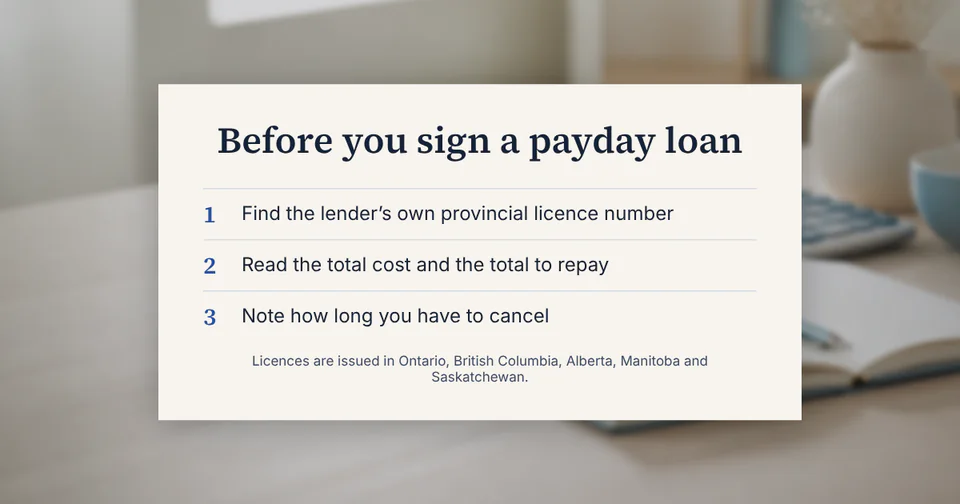
Payday loans in the five provinces
Ontario
Ontario regulates payday loans under the Payday Loans Act, 2008, through Consumer Protection Ontario. A loan cannot exceed 50% of your net income, rollovers are prohibited, and from the third loan within 63 days with the same lender, the agreement must offer an extended payment plan. The province's advice is to never take a payday loan without seeing an Ontario licence number.
British Columbia
Consumer Protection BC licenses payday lenders. You may hold one payday loan at a time, for no more than 50% of your net pay, and a third loan within two months must be repaid over two or three pay periods.
Alberta
In Alberta, a payday loan runs between 42 and 62 days and is repaid in at least two instalments, and a payment due on a payday can be no more than 50% of the total you owe. A payday lender cannot roll a loan over or give you other credit while a payday loan is outstanding.
Manitoba
Manitoba's Consumer Protection Office licenses payday lenders, Internet lenders included. A loan is limited to 30% of your calculated net pay, a tighter limit than the 50% used in Ontario, British Columbia and Saskatchewan.
Saskatchewan
In Saskatchewan, the Financial and Consumer Affairs Authority (FCAA) licenses payday lenders, including online lenders based outside the province. You may hold one payday loan at a time, for no more than 50% of your take-home pay, and the federal ceiling of $14 per $100 applies.
Quebec is not a designated province, so a payday loan offered there remains subject to the 35% criminal rate: our page on payday loans in Quebec explains what that means for Quebec residents.
Cheaper ways to cover a short gap
The FCAC and the federal Office of Consumer Affairs point to several options that usually cost less than a payday loan:
- A line of credit or overdraft protection from your bank or credit union.
- A credit card cash advance, keeping in mind that interest starts right away, on top of the advance fee.
- A small loan from a bank or credit union.
- An advance on your pay from your employer.
- Help from family or friends, with the terms written down.
- Over time, an emergency fund, even a small one.
Some apps offer small advances on your pay and work differently from a payday loan; our overview of cash advance apps sets out what each one says about its fees and limits. If you need more than one pay period to repay, an instalment loan spreads the cost over months and stays under the 35% cap: the page on personal loans explains how one works and what it costs in total.
If your income comes from government benefits, read our page on borrowing while you receive benefits before you sign.
A non-profit credit counsellor can help you weigh these options; the FCAC notes that a reputable agency should not charge for a first meeting. Credit Counselling Canada keeps a directory of non-profit credit counsellors.
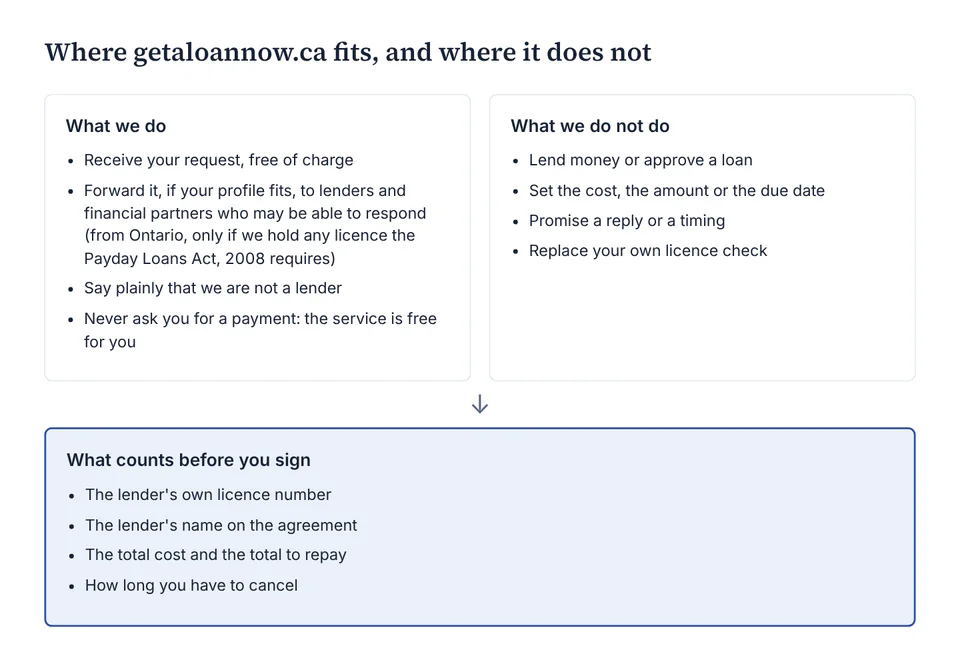
Where getaloannow.ca fits, and where it does not
Ontario warns about websites that look like online payday lenders but collect personal information and sell it to a lender. Here is exactly what we are, so you can judge for yourself.
What we do
- Receive your request, free of charge
- Forward it, if your profile fits, to lenders and financial partners who may be able to respond (from Ontario, only if we hold any licence the Payday Loans Act, 2008 requires)
- Say plainly that we are not a lender
- Never ask you for a payment: the service is free for you
What we do not do
- Lend money or approve a loan
- Set the cost, the amount or the due date
- Promise a reply or a timing
- Replace your own licence check
What counts before you sign
- The lender's own licence number
- The lender's name on the agreement
- The total cost and the total to repay
- How long you have to cancel
In plain terms: the licence and the agreement that matter are the lender's. Whatever website you start from, check both yourself before you sign.

How it works
Your request, in three steps
If your profile fits, your request may be forwarded to lenders and financial partners who may be able to respond. Read its total cost before you sign.
You answer a few questions
The amount, your province, your situation. About two minutes.
We review your request
If your profile fits, we may forward it to lenders and financial partners who may be able to respond.
You review the offer, or not
No obligation to accept. Most lenders pay out within 24 to 48 hours after approval.
Payday loans: the pages in this section
Each page goes deeper into one question: the rules in your province, the cost of a given amount, the promises found in ads, and practical guides.
Guides and tools
The calculator, the rules province by province, cancelling, getting out of payday loan debt and the cheaper alternatives.
- Payday loans: the rules in Ontario, BC, Alberta, Saskatchewan and ManitobaPayday loans follow their own rules: the federal $14 per $100 ceiling, each province's limits on cancelling and loan size, and how to check a licence.
- Payday loan calculatorEstimate the cost, the total to repay and the APR of a payday loan from the amount, the term and the fee per $100.
- Payday loan vs installment loan: how the two differHow a payday loan and an instalment loan differ: how the cost is set, the term, the legal caps and the licences.
- Alternatives to payday loans: what usually costs lessThe cheaper routes the FCAC lists before a payday loan, how cash advance apps differ, and where to find free budget help.
- How to get out of payday loan debt, step by stepStop the cycle of repeat payday loans: rollover bans, extended payment plans, default fee limits, free counselling and complaints.
- How to cancel a payday loan: your rights in each provinceThe cancellation window in each province, how to cancel a payday loan in writing, and the papers to keep.
- Payday loans in Quebec: why the rules are differentWhy the payday loan regime of other provinces does not apply in Quebec, and the options open to Quebec residents.
By province
The rules, the regulator, the licence check and free budgeting help in each of the five provinces.
- Payday loans in Ontario: your rights under the Payday Loans ActWhat Ontario's Payday Loans Act means for you: cost, cancelling, repeat loans, the licence check and where to complain.
- Payday loans in British Columbia: what the BC rules protectWhat BC's payday loan rules mean for you: one loan at a time, cancelling, repeat loans, default charges and the licence search.
- Payday loans in Alberta: instalments, cancelling and licencesWhat Alberta's payday loan rules mean for you: repayment in instalments, cancelling, no rollovers and the licence check.
- Payday loans in Manitoba: the 30% rule and 48 hours to cancelWhat Manitoba's payday loan rules mean for you: the 30% pay limit, 48 hours to cancel and how to confirm a licence.
- Payday loans in Saskatchewan: FCAA rules and what a default costsWhat Saskatchewan's payday loan rules mean for you: one loan at a time, the 50% limit, default charges and the FCAA411 check.
By amount
What a payday loan of a given amount costs at the federal maximum, and the total you repay.
- $100 payday loan: what it really costsWhat $100 costs at the federal maximum, and how repayment works.
- $300 payday loan: what it really costsWhat $300 costs at the federal maximum, and how repayment works.
- $500 payday loan: what it really costsWhat $500 costs at the federal maximum, and how repayment works.
- $750 payday loan: what it really costsWhat $750 costs at the federal maximum, and how repayment works.
- $1,000 payday loan: what it really costsWhat $1,000 costs at the federal maximum, and how repayment works.
- $1,500 payday loan: what it really costsWhat $1,500 costs at the federal maximum, and how repayment works.
The promises in the ads
What “no refusal”, e-Transfer delivery and “best” really mean when you read a payday loan ad.
- “No refusal” payday loans: what licensed lenders still checkWhy a “no refusal” payday loan ad cannot be taken at its word, what licensed lenders check and how to react.
- E-transfer payday loans: what Interac delivery changes, and what it does notWhat an e-Transfer changes in a payday loan (only the delivery) and what it does not: cost, licence, approval and timing.
- “Best” payday loans in Canada: the criteria that actually matterThe criteria to check in any payday loan offer, side by side: licence, total cost, cancelling, the agreement, fees and rollovers.
Related pages
- Loans on benefits: what lenders count and what the law protectsWhich benefits a lender may count, what federal and provincial law protects, and how a loan can change your assistance.
- “No credit check” loans: what lenders check insteadWhat lenders review when they skip a hard credit check, what stays true either way, and how to borrow without surprises.
- Cash advance apps in Canada: how they work and what they costWhat cash advance apps are, how they differ from payday loans, and what to check on fees, withdrawals and availability.
Frequently asked questions
- Are payday loans legal in Canada?
- In Ontario, British Columbia, Alberta, Manitoba and Saskatchewan, yes, when the lender holds the provincial licence and follows the provincial rules, within the federal ceiling of $14 per $100 borrowed. Quebec is not a designated province: a payday loan offered there remains subject to the 35% criminal rate.
- How much does a $500 payday loan cost?
- At the federal maximum, $70, for a total of $570 to repay. Over 14 days, that is about 365% APR. A lender may charge less than the maximum, never more. The agreement must show the cost and the total before you sign.
- Can I have two payday loans at the same time?
- Not in British Columbia or Saskatchewan, where the rule is one payday loan at a time. In Alberta, a payday lender cannot give you other credit while you have a payday loan outstanding. Check your province's page for the rules that apply to you.
- Can I cancel a payday loan after signing?
- Yes, within a short window set by your province, by returning the amount advanced. Each province page gives the exact deadline and the steps.
- Does getaloannow.ca give payday loans?
- No. We are a loan matching service, not a lender. If your profile fits, your request may be forwarded to lenders and financial partners who may be able to respond; a lender decides on its own and sets its own terms. We never ask you for a payment.
Sources
- Criminal Interest Rate Regulations (SOR/2024-114), section 3, Canada Gazette, Part II (checked on October 30, 2026)
- Criminal Code, section 347.1, Justice Canada (checked on October 30, 2026)
- Regulations Amending the Designation Regulations (SOR/2018-257), regulatory impact analysis statement, Canada Gazette, Part II (checked on October 30, 2026)
- Criminal Interest Rate Regulations, proposed (December 2023), regulatory impact analysis statement, Canada Gazette, Part I (checked on October 30, 2026)
- Payday loans, Financial Consumer Agency of Canada (checked on October 30, 2026)
- Navigating payday loans, Office of Consumer Affairs, Innovation, Science and Economic Development Canada (checked on October 30, 2026)
- Payday loans: your rights, Government of Ontario (checked on October 30, 2026)
- Guide for payday lenders, Government of Ontario (checked on October 30, 2026)
- The rules for payday lenders in BC, Consumer Protection BC (checked on October 30, 2026)
- Payday loans, Government of Alberta (checked on October 30, 2026)
- Payday loans, Manitoba Consumer Protection Office (checked on October 30, 2026)
- Borrowing from a payday lender: what you need to know, Financial and Consumer Affairs Authority of Saskatchewan (checked on October 30, 2026)
- Getting help from a credit counsellor, Financial Consumer Agency of Canada (checked on October 30, 2026)
The getaloannow.ca editorial team
Writing and fact-checking · Official sources, cited and dated · Regularly updated content
Our guides are written and checked against official sources (provincial regulators, FCAC, Canada.ca), cited and dated on every page. They explain how borrowing works in Canada and are not personalized financial advice.
Published November 26, 2026 · Updated November 26, 2026
Representative example: payday loan
- Amount
- $500
- Term
- 14 days
- Cost of borrowing
- $70.00
- Total to repay
- $570.00
- Rate
- 365% APR
In most provinces, a payday loan is repaid in one payment, usually on your next payday; in Alberta it runs 42 to 62 days, repaid in at least two instalments. In Ontario, British Columbia, Alberta, Manitoba and Saskatchewan, its total cost cannot exceed $14 per $100 borrowed (Criminal Interest Rate Regulations, since January 1, 2025). The example uses that maximum; actual terms are set by the lender.
getaloannow.ca is not a lender. We are a loan matching service: we receive your request and may forward it to lenders and financial partners who may be able to respond. We do not lend money and make no credit decisions.
Who may receive your request
To lenders and financial partners who may be able to respond, and only if your profile fits. The list of recipients will be published before any request is forwarded. Who they are, our conditions and how to check a licence