Payday loan vs installment loan: how the two differ
By the getaloannow.ca editorial team · Writing and fact-checking
Updated November 26, 2026 · Written from the sources listed at the bottom of the page
Weighing a payday loan vs an installment loan comes down to four questions: how the cost is set, how long you have to repay, which legal cap applies and who must license the lender. The two products answer each question differently, and the gap is wider than the names suggest. This guide sets them side by side for Ontario, British Columbia, Alberta, Saskatchewan and Manitoba, using the federal rules and each province's official pages.
getaloannow.ca is not a lender and decides on no loan. Whichever product you consider, what counts is the lender's provincial licence and the agreement it gives you to read before you sign.
A payday loan is priced in dollars per $100 and usually repaid in one payment on your next payday. An instalment loan is priced as an annual rate and repaid in regular payments over months.
A payday loan of $1,500 or less, for 62 days or less, from a lender licensed in a designated province, is capped at $14 per $100 since January 1, 2025. Every other personal loan is held to an APR of no more than 35% (Criminal Code, s. 347).
Ask for the total cost of borrowing and the total you will repay, in writing, and look the lender up in your province's licence search.
Two ways of pricing a loan
A payday loan carries a fee: a fixed charge for each $100 you borrow. Since January 1, 2025, section 3 of the Criminal Interest Rate Regulations (SOR/2024-114) caps the total cost of a payday loan at 14% of the amount advanced, all fees included, which is $14 for every $100. The fee does not depend on the term. Borrow $300 for one week or for eight, and the maximum cost is the same $42.
An instalment loan carries interest. Interest is charged on the balance you still owe, so each payment covers that period's interest and repays part of the principal; as the balance goes down, so does the interest. The cost is expressed as an annual percentage rate (APR), and since January 1, 2025 the APR of a personal loan cannot exceed 35% under section 347 of the Criminal Code.
The two measures do not translate easily. Brought back to an annual rate, $14 per $100 over 14 days is about 365% APR, the figure the Financial Consumer Agency of Canada (FCAC) uses. Set against the 35% cap on instalment loans, that is roughly ten times higher, over a much shorter period.
Term and repayment
A payday loan is short. Under section 347.1 of the Criminal Code, it lasts 62 days at most, and it is usually due on your next payday, in one payment, often taken by pre-authorized debit. Alberta is the exception among the five provinces: its rules require at least two instalments, and no payment due on a payday can exceed 50% of the total owed.
An instalment loan runs for months, sometimes years, with a set payment on a set schedule. A longer term lowers each payment but raises the total cost, because interest runs for longer. Our loan calculator shows that trade-off for any amount, term and rate, with the monthly payment, the total repaid and the cost of borrowing shown together.
In practice, the difference is less about the price than about the pay that follows. A payday loan asks for the whole amount plus the fee from a single pay; an instalment loan asks for a share of each pay over a longer time.
Side by side
| Point | Payday loan | Instalment personal loan |
|---|---|---|
| How the cost is set | A fee per $100 borrowed, the same whatever the term | Interest on the balance still owed, expressed as an APR |
| Legal ceiling | $14 per $100 in total, fees included (SOR/2024-114, s. 3) | 35% APR (Criminal Code, s. 347) |
| Amount | $1,500 at most (Criminal Code, s. 347.1) | Usually larger amounts, set by the lender |
| Term | 62 days at most, usually until your next payday | Months or years, set in the agreement |
| Repayment | Usually one payment; at least two instalments in Alberta | Regular payments of the same amount |
| Size limit tied to pay | 50% of net pay in Ontario, BC and Saskatchewan; 30% of calculated net pay in Manitoba | The payday limits do not apply; the lender sets its own criteria |
| Licence | A provincial payday lender licence | A high-cost credit licence above 32% in BC and Manitoba, at 32% or more in Alberta |
| Cancelling | 2 business days in Ontario, 2 days in BC and Alberta, 48 hours in Manitoba, until the end of the next business day in Saskatchewan | Depends on the province and the agreement |
Legal caps and licences
The payday regime is an exemption. Section 347.1 lets a payday loan escape the criminal rate only on three conditions: $1,500 or less, 62 days or less, and a lender licensed under the payday law of a designated province. Ontario, British Columbia, Alberta, Manitoba and Saskatchewan are all designated. In return, the federal regulation caps the total cost at $14 per $100, and each province adds its own rules on licensing, loan size, cancellation and repeat loans.
An instalment loan stays under the general rule: any APR above 35% is criminal. Some provinces also license lenders whose rates are high while still under that cap. In British Columbia, a lender charging more than 32% needs a high-cost credit grantor licence from Consumer Protection BC. In Alberta, credit at 32% or more requires a high-cost credit business licence. In Manitoba, high-cost credit above 32% requires a licence from the Consumer Protection Office. In British Columbia and Manitoba, banks and credit unions are regulated separately and do not need that licence.
Whatever the product, the licence check comes first. Our guide on how to check a lender's licence gives the search tool or the contact for each province.
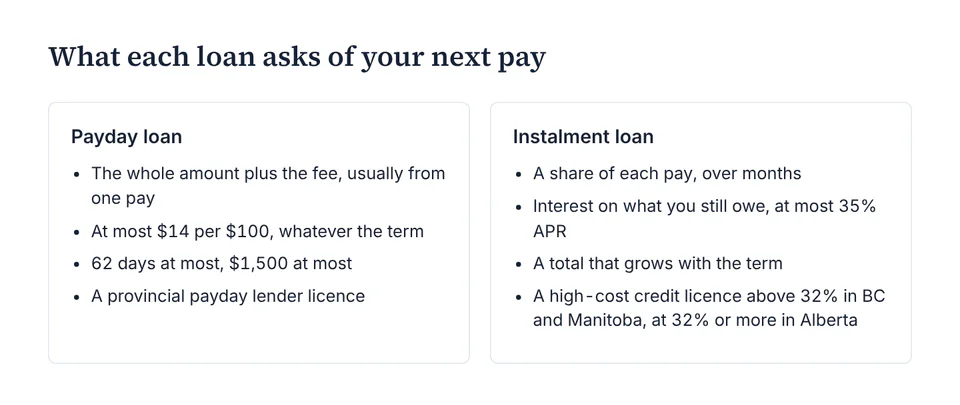
What each loan asks of your next pay
The same need, two very different repayments.
Payday loan
- The whole amount plus the fee, usually from one pay
- At most $14 per $100, whatever the term
- 62 days at most, $1,500 at most
- A provincial payday lender licence
Instalment loan
- A share of each pay, over months
- Interest on what you still owe, at most 35% APR
- A total that grows with the term
- A high-cost credit licence above 32% in BC and Manitoba, at 32% or more in Alberta
In plain terms: a payday loan costs a fixed fee for a few weeks, an instalment loan costs interest over months. The better fit is the one your budget can repay without needing a new loan.
When each one tends to fit
A payday loan can make sense only for a small, one-time gap that the next pay covers in full, with enough left for rent, food and transport. Its main risk is the repeat loan: if the repayment leaves the pay short, another loan follows and the fee is charged again. Provinces have built rules around that risk. Ontario prohibits rollovers and, from the third loan within 63 days with the same lender, requires an extended payment plan. British Columbia does not allow rollovers and spreads a third loan within two months over two or three pay periods. British Columbia and Saskatchewan allow only one payday loan at a time. In Alberta, a payday lender cannot roll over a payday loan or issue any other credit while one is outstanding.
An instalment loan fits a need that will take months to absorb. Its cost in dollars can end up higher than a single payday fee, because interest runs for longer, but each payment is smaller and planned in advance, and the annual rate is far lower. The figure to watch is the total repaid: our page on personal loans explains how that total is built and what a lender looks at.
If your credit history is weak
A low credit score does not make a payday loan cheaper or safer: the cost ceiling is the same for everyone, and the repayment still comes out of one pay. Some lenders offer instalment loans to people whose credit history is damaged, and the 35% cap applies to them as to any other lender. Our page on instalment loans when your credit is bad explains what to expect and what to check before you sign.
Free help before you decide
If you are choosing between the two because money keeps running out before payday, a non-profit credit counsellor can look at the whole budget with you. The FCAC suggests checking that the agency belongs to a provincial or national association, such as Credit Counselling Canada or the Canadian Association for Financial Empowerment, and says a reputable agency should not charge for the first meeting.
Frequently asked questions
- Is a payday loan a kind of instalment loan?
- No. A payday loan is a short-term loan of $1,500 or less, priced per $100 borrowed and usually repaid in one payment. Alberta requires at least two instalments for a payday loan, but it remains a payday loan, under the payday rules and the $14 ceiling.
- Which one costs less in dollars?
- It depends on the term. Over a few weeks, a fee of $14 per $100 is far more than the interest on other credit for the same weeks: in the FCAC's example, $300 for 14 days costs $42 as a payday loan, against $5.92 on a line of credit. Over many months, an instalment loan can cost more in dollars than one payday fee, but it is repaid in smaller payments at a much lower annual rate.
- Does the 35% cap apply to payday loans?
- Not in provinces with a designated payday loan regime, when the loan meets the conditions of section 347.1 of the Criminal Code. There, the total cost is capped at $14 per $100 instead. Quebec has not requested designation, so any payday loan offered there is held to the criminal rate.
- Can I cancel either kind of loan after signing?
- For a payday loan, each of the five provinces sets a short cancellation window, from 48 hours in Manitoba (Sundays and holidays excluded) to 2 business days in Ontario. For an instalment loan, the rules depend on the province and on the agreement: read the cancellation and prepayment clauses before you sign.
Sources
- Criminal Interest Rate Regulations (SOR/2024-114), Canada Gazette, Part II (checked on October 30, 2026)
- Criminal Code, section 347.1, Justice Canada (checked on October 28, 2026)
- Criminal Code, section 347, Justice Canada (checked on October 21, 2026)
- Payday loans, Financial Consumer Agency of Canada (checked on October 30, 2026)
- Payday loans: your rights, Government of Ontario (checked on October 30, 2026)
- The rules for payday lenders in BC, Consumer Protection BC (checked on October 30, 2026)
- High-cost credit granting, Consumer Protection BC (checked on October 21, 2026)
- Payday loans, Government of Alberta (checked on October 30, 2026)
- High-cost credit business licence, Government of Alberta (checked on October 21, 2026)
- High-cost credit: frequently asked questions, Manitoba Consumer Protection Office (checked on October 21, 2026)
- Borrowing from a payday lender: what you need to know, Financial and Consumer Affairs Authority of Saskatchewan (checked on October 30, 2026)
- Getting help from a credit counsellor, Financial Consumer Agency of Canada (checked on October 30, 2026)
If you are considering a loan
- Personal loansHow an instalment loan works, what it costs in total and what a lender looks at.
- Payday loans: how they work, what they cost and the rulesHow payday loans work, the federal $14 per $100 cost cap, the rules in five provinces and cheaper ways to cover a short gap.
Related pages
- Alternatives to payday loans: what usually costs lessThe cheaper routes the FCAC lists before a payday loan, how cash advance apps differ, and where to find free budget help.
- Payday loan calculatorEstimate the cost, the total to repay and the APR of a payday loan from the amount, the term and the fee per $100.
- How to get out of payday loan debt, step by stepStop the cycle of repeat payday loans: rollover bans, extended payment plans, default fee limits, free counselling and complaints.
Where to get help, free of charge
These organizations are non-profit or public bodies, separate from us.
- Credit Counselling CanadaFind a non-profit credit counsellor near you
- Financial Consumer Agency of Canada (FCAC)Tools to make a budget and understand your credit
- Canadian Anti-Fraud CentreReport a request for fees before a loan
The getaloannow.ca editorial team
Writing and fact-checking · Official sources, cited and dated · Regularly updated content
Our guides are written and checked against official sources (provincial regulators, FCAC, Canada.ca), cited and dated on every page. They explain how borrowing works in Canada and are not personalized financial advice.
Published November 26, 2026 · Updated November 26, 2026