“No credit check” loans: what lenders check instead
By the getaloannow.ca editorial team · Writing and fact-checking · updated November 26, 2026
People look for “no credit check” loans for understandable reasons: a low score, the fear of a refusal, or the worry that one more application will push the score lower. Here is the honest version. Some lenders put less weight on your credit file and more on your income and bank account, and some checks leave no mark on your score. But no lender lends without assessing whether you can repay, and you can ask which check it runs before you agree to anything.
getaloannow.ca is not a lender. You can send one request; if your profile fits, it may be forwarded to lenders and financial partners who may be able to respond; a lender reviews it and decides on its own terms. The loan presented on this page is an instalment loan, repaid in regular payments, with an APR that cannot exceed 35%.
getaloannow.ca is not a lender. We are a loan matching service. We do not lend money and make no credit decisions. Our role
- Two minutesAbout two minutes to fill in the request.
- No SIN requiredWe never collect your social insurance number.
- Your credit file is not affectedFilling in our form does not touch your credit file. A lender that reviews your request may check it.
- Free for youWe never charge you anything.
Watch
Read the transcript
“No credit check” loans: what really gets checked? You’ve probably seen the ads. When your score has taken a hit, the idea is appealing: nobody digs into your file, nobody judges your past. But what do these ads really promise? Let me explain what the phrase means, what gets checked instead, what these loans tend to cost, and the signs of an offer to walk away from.
First, what is a credit check? It’s a lender looking at your file with a credit bureau. In Canada, the two main bureaus are Equifax and TransUnion. Your file records your credit accounts and how you’ve repaid them. From it comes your score, which usually ranges from 300 to 900. And according to the Financial Consumer Agency of Canada, bureaus and lenders use different formulas, so the score you see may not be the one a lender sees.
So when a lender says it won’t check your credit, it’s saying one thing only: it won’t pull that file. It’s not saying it will verify nothing. And it’s not saying yes in advance. A lender still has to decide whether you can repay, and it can still say no.
So what does it look at instead? Most often, your bank account. Through an online bank verification, you log in to your bank through a third-party portal, and the lender receives your statements. It wants to see three things: your regular income, what already leaves your account every month, like rent, other loans and card payments, and what’s left once everything is paid.
Before you connect anything, there’s a warning worth knowing. In March 2018, the FCAC reminded consumers that sharing your banking login with a third-party service may breach your bank’s user agreement, and could leave you liable for losses from unauthorized transactions. Its advice: read your account agreement first.
Now, the cost. A lender that doesn’t rely on your credit history sees more risk, and its rate often reflects that. But there’s a ceiling. Since January 1, 2025, the Criminal Code makes it an offence to charge an annual percentage rate above 35%. And that rate counts all the charges for the credit, not just the interest.
Payday loans are a separate case. In provinces with their own payday loan rules, the cost is capped at 14% of the amount borrowed. That sounds small, but the FCAC gives an example: over two weeks, it works out to an annual rate of roughly 365%. So the first question to ask is simple: what kind of loan is this?
Skipping the credit bureau doesn’t mean skipping provincial law. In British Columbia, a lender charging more than 32% needs a high-cost credit licence. In Alberta, the line is 32% or more. In Manitoba, it’s above 32%. And in Ontario, payday lenders must be licensed by the province, which offers an online tool to check.
And then, the signs of an offer to walk away from. The Canadian Anti-Fraud Centre warns about companies that offer guaranteed loans even with poor or no credit, and about “instant approvals”. Above all, in most provinces, it’s illegal to ask for a fee before you receive your loan. If a company asks to be paid by e-transfer or prepaid card, the Centre’s advice is to end all contact.
So, to sum up: a lender can do without your credit report, but never without checking your situation. The rate can’t go above 35%, the licence depends on your province, and a fee before the money is the clearest warning sign there is. And just so you know: getaloannow.ca is not a lender. We’re a free loan matching service.
A lender may avoid a hard inquiry, or rely mostly on your income and bank data, but it always assesses your situation and can say no.
A personal loan to an individual cannot carry an APR above 35% anywhere in Canada (Criminal Code, s. 347, since January 1, 2025). British Columbia and Manitoba also license high-cost credit above 32%, Alberta at 32% or more.
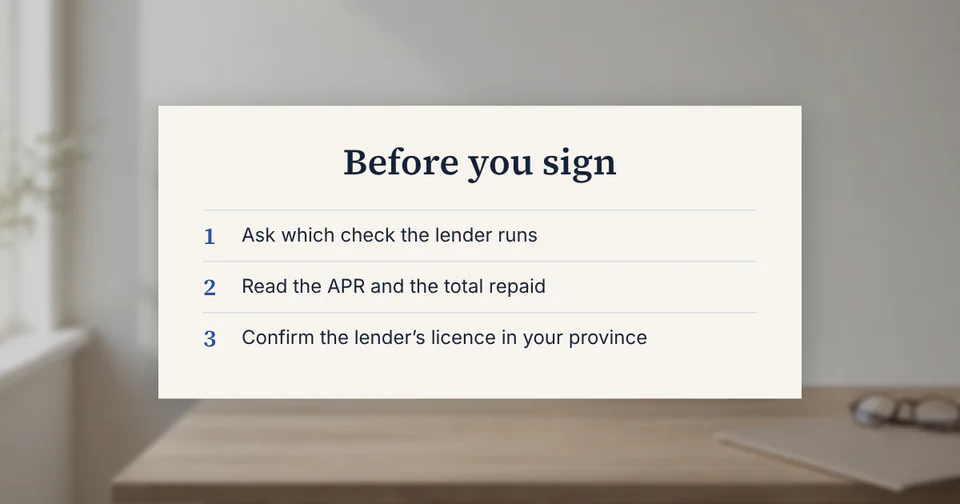
Ask which check the lender runs, read the APR and the total repaid on the agreement, and confirm the lender's licence in your province.
What is true: not every check touches your score
Behind the ad is a real distinction. The Financial Consumer Agency of Canada (FCAC) separates two kinds of credit check. A hard inquiry, also called a hard hit, appears on your credit report and affects your credit score; applications for a credit card, a mortgage or a loan are typical examples. A soft inquiry, or soft hit, only appears on the version of your report that you can see, and does not affect your score. Ordering your own credit report has no effect on your score either.
So when a lender says it will not check your credit, the most it can honestly mean is one of two things: it will not run a hard inquiry at the request stage, or it will base its decision mostly on information other than your credit file. Both happen. Neither means that nobody looks at your finances.
Some lenders rely on income and bank data
A lender that gives less weight to the credit bureaus still needs evidence that you can repay. Most often that evidence comes from your bank account: the deposits that arrive, how regular they are, the payments already leaving each month and what is left once they are made. Some lenders collect it through bank verification, where you log in to your bank through a third-party portal and the lender receives a copy of your statements. Before you agree, read your account agreement: in March 2018, FCAC warned that sharing your banking login details with a third party may breach it and leave you liable for unauthorized transactions.
Cash advance apps follow a similar logic for very small sums. Bree's website says it does not check credit and approves advances based on income and deposit history; KOHO says it does not perform a credit check when determining eligibility for Cover. What these apps offer, what they say they charge and who can use them are set out in our guide to cash advance apps that skip the credit check.

What is not true: no lender skips the assessment
A lender that does not pull your credit file has not decided to lend to everyone. It has chosen another source of information, and it can decline on that basis: income that is too irregular, too many payments already leaving the account, or a budget with no room for a new payment. Nyble's own pages show the pattern: its sign-up page says “within minutes, no credit check”, while its credit-building line remains subject to identity verification and underwriting.
Skipping the credit file also says nothing about the price. A lender that knows less about your history sees more risk, and the rate often reflects it. Whatever check is used, an instalment loan to an individual cannot exceed 35% APR. Payday loans are the exception: in provinces with a designated regime, they fall under a separate ceiling of $14 per $100 advanced, which FCAC equates to about 365% APR over 14 days. If you are weighing that route, our page on payday loans and what they cost sets out the rules before you decide.
If your score is the real worry
Often the concern is not the check itself but what it will find. A low score does not stop you from sending a request, but it can change both the answer and the rate offered. Our page on borrowing when your credit score is low explains what lenders weigh besides the three-digit number, and how to keep the amount and the term in check.
Before anything else, read your file yourself. You can get your credit report free online from both Equifax Canada and TransUnion Canada, and Equifax also provides a free score. Our guide on getting your credit score free in Canada shows where to request each one, so that nothing in your file comes as a surprise to you before it reaches a lender.

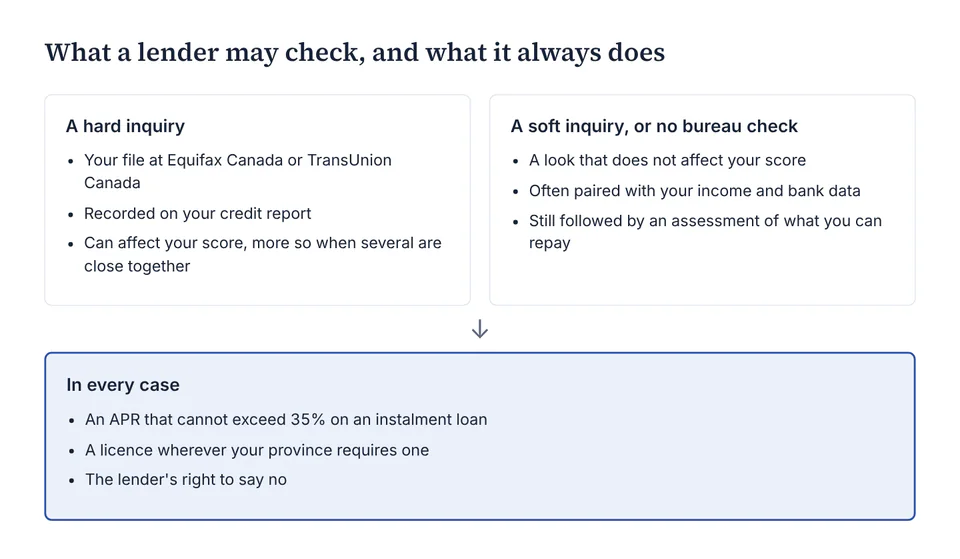
What a lender may check, and what it always does
Three situations behind the same kind of ad. In each one, the decision belongs to the lender.
A hard inquiry
- Your file at Equifax Canada or TransUnion Canada
- Recorded on your credit report
- Can affect your score, more so when several are close together
A soft inquiry, or no bureau check
- A look that does not affect your score
- Often paired with your income and bank data
- Still followed by an assessment of what you can repay
In every case
- An APR that cannot exceed 35% on an instalment loan
- A licence wherever your province requires one
- The lender's right to say no
In plain terms: the type of check changes what shows on your credit report, not the fact that someone reviews your finances before lending.
Be wary of ads that pair “no credit check” with “guaranteed approval”: no serious lender can promise an answer before reviewing your situation. Each lender sets its own criteria, assesses what you can repay, and a favourable answer is never assured.
What you can do
- Send one request rather than many. A loan application checked with a credit bureau can leave a hard inquiry, and FCAC notes that too many credit applications can hurt your score.
- Ask the lender, before you agree, which check it plans to run: a soft inquiry, a hard inquiry, a bank verification, or more than one of these.
- Read your own credit report from both bureaus first, and ask the bureau to correct anything wrong.
- Look at the APR and the total repaid on the agreement, not only the amount of each payment.
- Check the lender's licence with your provincial regulator before you share anything.
On the representative example used across the site, $2,000 over 24 months at 29.96% APR comes to $111.78 a month and $2,682.83 repaid in total, of which $682.83 is the cost of borrowing. A smaller amount or a shorter term lowers that cost, and the loan calculator shows the effect of each change before you send anything.
Warning signs
- Approval is promised before you have shared a single document.
- You are asked for a fee, a deposit or “insurance” before the loan is paid out. A legitimate lender does not ask for fees before paying out a loan; report such a request to the Canadian Anti-Fraud Centre.
- The business does not appear in your province's licence search, or the agreement shows an APR above 35% on an instalment loan.
- The website looks like a lender's site but never names a lender. Ontario warns about sites that collect personal information and sell it to a lender.
On that last point: getaloannow.ca is not a lender and does not yet name one. No request is forwarded before the list of recipients, with their licence numbers where they hold one, is published on our page on who may receive your request. It receives your request and may forward it to lenders and financial partners who may be able to respond. The licence and the agreement of the lender that makes you an offer are what count, so read both before you sign.
Go further on “no credit check” loans
The same question by type of loan, in each of the five provinces, and in two practical guides.
Guides
How soft and hard credit checks differ, and what a bank verification shares with a lender.
- Instant bank verification (IBV): what it shares and what to ask
Instant bank verification gives a lender a copy of your bank statements. What it shares, the FCAC warning on your login details and what to ask first.
- Soft vs hard credit check: what each one does to your file
Which credit checks show on your report and affect your score, which do not, and how to see your own inquiries.
By type of loan
Payday, installment and e-Transfer loans each come with their own checks, costs and rules.
- “No credit check” payday loans: what lenders still verify
What a payday lender checks when it skips your credit file, what the loan costs, and how to check the lender first.
- “No credit check” installment loans: how lenders assess you
Why a lender looks closely before an installment loan, whatever its ad says, and how the term changes what you repay.
- “No credit check” e-Transfer loans: what happens before the money moves
Why the payout method says nothing about the credit decision, and what to watch for when a loan is sent by Interac e-Transfer.
By province
Licences, high-cost credit thresholds, where to check a lender and where to find non-profit credit counselling.
- “No credit check” loans in Ontario: what lenders still check
What an Ontario lender reviews when it skips your credit file, the rules that apply, and where to get help.
- “No credit check” loans in British Columbia: licences and checks
What a BC lender reviews when it skips your credit file, the high-cost credit licence above 32%, and how to check it.
- “No credit check” loans in Alberta: what to verify first
What an Alberta lender reviews when it skips your credit file, the licence at 32% or more, and where to check a business.
- “No credit check” loans in Manitoba: the rules that still apply
What a Manitoba lender reviews when it skips your credit file, the licence above 32%, and how to confirm it with the province.
- “No credit check” loans in Saskatchewan: what lenders review
What a Saskatchewan lender reviews when it skips your credit file, the limit that applies, and how to check a lender with FCAA411.
Other loan topics
- Payday loans: how they work, what they cost and the rulesHow payday loans work, the federal $14 per $100 cost cap, the rules in five provinces and cheaper ways to cover a short gap.
- Cash advance apps in Canada: how they work and what they costWhat cash advance apps are, how they differ from payday loans, and what to check on fees, withdrawals and availability.
- Loans on benefits: what lenders count and what the law protectsWhich benefits a lender may count, what federal and provincial law protects, and how a loan can change your assistance.
Frequently asked questions
- Does sending a request on getaloannow.ca affect my credit score?
- No. Sending a request on our site does not touch your credit file. A lender that goes on to review your request may check your credit report, so ask it which kind of check it runs before you agree.
- Can a lender decline me without checking my credit?
- Yes. It can decline based on your income, your bank statements or the payments you already carry. Not pulling your credit file changes nothing about its right to say no.
- Can other lenders see a soft inquiry?
- According to FCAC, soft inquiries only appear on the version of your credit report that you can see, and they do not affect your score. Hard inquiries appear on your report and do affect it.
- Do loans that skip the credit file cost more?
- They often can, because the lender sees more risk. An instalment loan still cannot exceed 35% APR. A payday loan follows its own ceiling of $14 per $100 advanced, which FCAC equates to about 365% APR over 14 days.
Who may receive your request
To lenders and financial partners who may be able to respond, and only if your profile fits. The list of recipients will be published before any request is forwarded. Who they are, our conditions and how to check a licence
Representative example
- Amount
- $2,000
- Term
- 24 months
- Monthly payment
- $111.78
- Total repaid
- $2,682.83
- Cost of borrowing
- $682.83
- Rate
- 29.96% APR
The annual percentage rate (APR) includes the cost of borrowing. The annual rate of a personal loan cannot exceed 35% APR (Criminal Code). In British Columbia and Manitoba, a lender also needs a high-cost credit licence above 32% (32% or more in Alberta): see your province page. Actual terms are set by the lender.
Sources
- Credit report and score basics, Financial Consumer Agency of Canada (checked on October 30, 2026)
- Ordering your credit report and credit score, Financial Consumer Agency of Canada (checked on October 30, 2026)
- Payday loans, Financial Consumer Agency of Canada (checked on October 30, 2026)
- Criminal Code, section 347 (criminal interest rate), Justice Canada (checked on October 21, 2026)
- Criminal Interest Rate Regulations (SOR/2024-114), Justice Canada (checked on October 21, 2026)
- Instant cash advance, Bree (company source) (checked on October 30, 2026)
- KOHO Cover, KOHO (company source) (checked on October 30, 2026)
- Build credit, Nyble (company source) (checked on October 30, 2026)
- Sign up, Nyble (company source) (checked on October 30, 2026)
- Payday loans: your rights, Government of Ontario (checked on October 30, 2026)
- Canadian Anti-Fraud Centre, Government of Canada (checked on October 21, 2026)
The getaloannow.ca editorial team
Writing and fact-checking · Official sources, cited and dated · Regularly updated content
Our guides are written and checked against official sources (provincial regulators, FCAC, Canada.ca), cited and dated on every page. They explain how borrowing works in Canada and are not personalized financial advice.
Published November 26, 2026 · Updated November 26, 2026
Request a personal loan
Whatever check a lender runs, the terms are its to set, and yours to accept or decline.