Alternatives to payday loans: what usually costs less
By the getaloannow.ca editorial team · Writing and fact-checking
Updated November 26, 2026 · Written from the sources listed at the bottom of the page
The alternatives to payday loans are not exotic: a line of credit, overdraft protection, a cash advance on a credit card, a small loan from your bank or credit union, an arrangement with the company you owe, or an emergency fund, however small. The Financial Consumer Agency of Canada (FCAC) lists most of them on its payday loans page, because over a few weeks each one usually costs much less than $14 per $100 borrowed. This guide goes through them one by one, explains where cash advance apps fit, and points to free help.
getaloannow.ca is not a lender and does not decide on any loan. Nothing on this page is an offer: it describes options you can look into on your own.
In the FCAC's example, $300 for 14 days costs $42 as a payday loan, against $5.92 on a line of credit, $7.42 with overdraft protection and $7.65 as a credit card cash advance.
A payday loan can cost up to $14 per $100 advanced, since January 1, 2025, in provinces with a designated payday regime. Other credit is held to an APR of no more than 35% under the Criminal Code.
Before borrowing, ask the company you owe for more time or a payment arrangement. If it says yes, there is nothing to borrow and nothing to repay on top.
Why the alternatives usually cost less
A payday loan charges a fee per $100, the same whatever the term. At the federal maximum of $14 per $100, a two-week loan works out to about 365% APR, according to the FCAC. Most other credit is priced by an annual rate, so over a few weeks it costs a fraction of that. The FCAC's own example shows the gap for the same $300 over the same 14 days.
| Option | Cost of borrowing |
|---|---|
| Line of credit | $5.92 |
| Overdraft protection | $7.42 |
| Cash advance on a credit card | $7.65 |
| Payday loan at $14 per $100 | $42 |
These figures depend on the FCAC's assumptions about each product's rate; your own may be a little higher or lower. The point is the scale: the three other options cost a fraction of the payday loan in this example.
The options the FCAC lists
A line of credit
If you already have a line of credit with your bank or credit union, borrowing a few hundred dollars from it for a few weeks is usually the cheapest form of credit on this list. Interest runs only on what you use, for as long as you use it, and you can repay at your own pace above the minimum payment.
Overdraft protection
Overdraft protection lets your account go below zero up to a set limit. It comes with interest, and sometimes a fee, but for a short gap the FCAC's example still puts it far below a payday loan. Check what your institution charges before you rely on it.
A cash advance on a credit card
A cash advance on a credit card costs more than a purchase on the same card: the FCAC notes that interest starts right away, on top of the cash advance fee. Even so, over two weeks, it costs much less than a payday loan in the FCAC's example. Repay it as quickly as you can, since interest keeps running until you do.
A small loan from a bank or credit union
Banks and credit unions offer small personal loans, and the FCAC and the federal Office of Consumer Affairs mention them as alternatives. Ask your own institution first: it already knows your account history. A loan repaid over several months is a different product from a payday loan, with a lower annual rate and smaller payments; our page on personal loans explains how an instalment loan works and what it costs in total.
Help from your employer, family or friends
Some employers will advance part of a pay already earned, and the FCAC mentions this option. Borrowing from someone close costs nothing in fees, but it is still a debt: agree on an amount and a date, ideally in writing, so the arrangement does not strain the relationship.
An arrangement with the company you owe
Many shortfalls come down to one bill: hydro, phone, rent, a car payment. Before borrowing to pay it, call the company or your landlord and ask whether they accept a few days' delay or a payment arrangement. It costs nothing to ask, and if the answer is yes, there is no fee to repay on top.
An emergency fund
The FCAC recommends building an emergency fund, even a small one, so the next unexpected bill does not lead to a loan. Setting aside a modest amount from each pay, automatically if your bank allows it, adds up over a few months. Our guide to emergency loans covers what to do when the expense has already arrived.
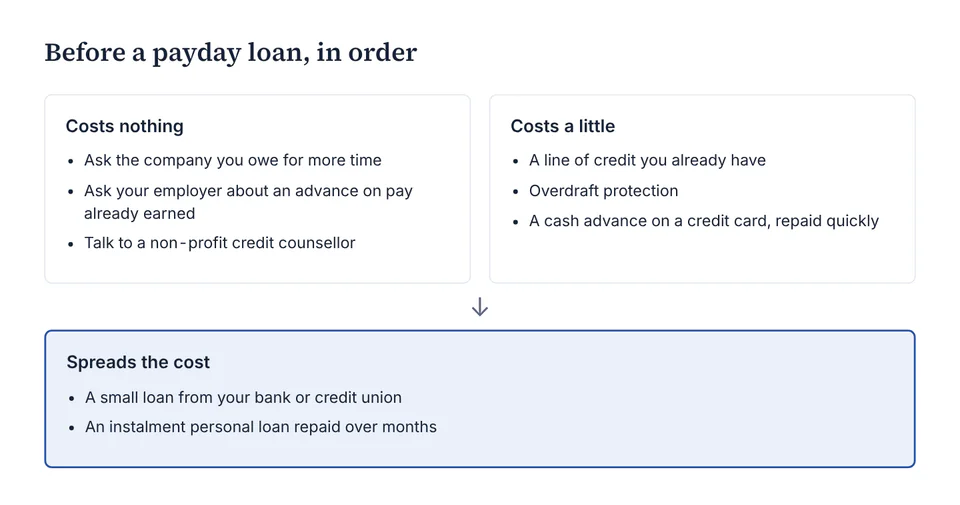
Before a payday loan, in order
The cheapest options usually come first.
Costs nothing
- Ask the company you owe for more time
- Ask your employer about an advance on pay already earned
- Talk to a non-profit credit counsellor
Costs a little
- A line of credit you already have
- Overdraft protection
- A cash advance on a credit card, repaid quickly
Spreads the cost
- A small loan from your bank or credit union
- An instalment personal loan repaid over months
In plain terms: over two weeks, almost every form of credit you may already have costs less than a payday loan at $14 per $100, and asking for more time costs nothing at all.
Cash advance apps: a different product
Cash advance apps are often presented as an alternative to payday loans, and they work differently. They advance a small sum against your next deposit, which is then taken back automatically. Bree, for instance, describes an advance of up to $750 at 0% APR on its website, and says its only costs are optional: a tip, and an express fee if you want the money faster. Bree also says first advances are often $20 to $50, with a limit that grows as you repay on time. According to KOHO's website, KOHO Cover advances up to $250 to KOHO account holders, without interest, through a monthly subscription for as little as $2.
These are company statements, and terms change: read the app's own terms before you sign up. Availability also varies: Bree's Google Play listing says it is not accepting new customers in Quebec, Saskatchewan, Nova Scotia or New Brunswick. How these apps are regulated depends on the province; ask your provincial consumer protection office if you have a doubt. Our page on cash advance apps explains how they work and what they cost, and the page on apps like Bree sets out what other apps offer, from their own published terms.
Free credit counselling
If borrowing before payday has become a habit rather than an exception, a non-profit credit counsellor can look at the whole budget with you, and help you talk to creditors. The FCAC explains that credit counselling is offered by both non-profit organizations and for-profit businesses, so check who you are dealing with before you commit. Its advice:
- Check whether the agency belongs to a provincial or national association, such as Credit Counselling Canada or the Canadian Association for Financial Empowerment.
- Ask whether the first consultation is free: a reputable agency should not charge for the first meeting.
- Ask what services it offers, whether you will receive a written plan, and whether you will get monthly statements.
- Keep in mind that credit counsellors are not required by law to have specialized training.
The FCAC can be reached at 1-866-461-3222. It does not handle individual complaints, but its website has tools to make a budget and guides on managing debt.
If a payday loan is still the only option
If none of these routes works, borrow as little as you can, and check the lender's licence in your province before you sign. Read the total cost and the due date in the agreement, and note your right to cancel: each of the five provinces gives you a short window to change your mind. Our guide to the payday loan rules by province sets out what each province requires of lenders.
Frequently asked questions
- What is the cheapest alternative to a payday loan?
- Asking the company you owe for more time costs nothing. Among forms of credit, the FCAC's example puts a line of credit lowest: $5.92 for $300 over 14 days, against $42 for a payday loan. Overdraft protection and a credit card cash advance came next, at $7.42 and $7.65.
- Are cash advance apps payday loans?
- They are a different product. A cash advance app advances a small sum against your next deposit and takes it back automatically; Bree, for example, says it charges no interest, and KOHO says the same of KOHO Cover, with costs that come from optional fees or a subscription. A payday loan carries a fee of up to $14 per $100 under a provincial licence. How the apps are regulated depends on the province.
- Do credit unions offer small loans?
- Yes. The FCAC and the federal Office of Consumer Affairs mention small loans from banks and credit unions as alternatives to payday loans. The terms depend on the institution, so ask your own first.
- Is credit counselling really free?
- Many non-profit agencies offer a free first consultation, and the FCAC says a reputable agency should not charge for the first meeting. Ask what any later service costs before you sign anything.
Sources
- Payday loans, Financial Consumer Agency of Canada (checked on October 30, 2026)
- Navigating payday loans, Office of Consumer Affairs, Innovation, Science and Economic Development Canada (checked on October 30, 2026)
- Getting help from a credit counsellor, Financial Consumer Agency of Canada (checked on October 30, 2026)
- Criminal Interest Rate Regulations (SOR/2024-114), Canada Gazette, Part II (checked on October 30, 2026)
- Bree: instant cash advance, Bree (company website) (checked on October 30, 2026)
- Bree on Google Play, Google Play (Bree's listing) (checked on October 30, 2026)
- KOHO Cover, KOHO (company website) (checked on October 30, 2026)
If you are considering a loan
- Personal loansAn instalment loan repaid over months, at an APR that cannot exceed 35%.
- Fast loansWhat speed really depends on, and what to check when the need is urgent.
- Payday loans: how they work, what they cost and the rulesHow payday loans work, the federal $14 per $100 cost cap, the rules in five provinces and cheaper ways to cover a short gap.
Related pages
- How to get out of payday loan debt, step by stepStop the cycle of repeat payday loans: rollover bans, extended payment plans, default fee limits, free counselling and complaints.
- Payday loan vs installment loan: how the two differHow a payday loan and an instalment loan differ: how the cost is set, the term, the legal caps and the licences.
- How to cancel a payday loan: your rights in each provinceThe cancellation window in each province, how to cancel a payday loan in writing, and the papers to keep.
Where to get help, free of charge
These organizations are non-profit or public bodies, separate from us.
- Credit Counselling CanadaFind a non-profit credit counsellor near you
- Financial Consumer Agency of Canada (FCAC)Tools to make a budget and understand your credit
- Canadian Anti-Fraud CentreReport a request for fees before a loan
The getaloannow.ca editorial team
Writing and fact-checking · Official sources, cited and dated · Regularly updated content
Our guides are written and checked against official sources (provincial regulators, FCAC, Canada.ca), cited and dated on every page. They explain how borrowing works in Canada and are not personalized financial advice.
Published November 26, 2026 · Updated November 26, 2026