Personal loans
Personal loans online: $1,000 to $15,000
By the getaloannow.ca editorial team · Writing and fact-checking · updated November 26, 2026
A personal loan is a sum you borrow once and repay over a set term, usually in equal monthly payments. Through getaloannow.ca, you can request between $1,000 and $15,000. We review your request and, if your profile fits, may forward it to lenders and financial partners who may be able to respond; a lender decides whether to make you an offer.
This page shows what a personal loan costs, how the term changes the total you repay, and what to read in an offer before you sign. Every figure is calculated at the representative example rate, and every monthly payment is shown next to its total.
- Free for you, no obligation
- No social insurance number required
- Filling in our form does not affect your credit file

Free for you
No fees, at any point.
No SIN
No social insurance number, no banking details.
Your credit file stays untouched
Our form does not pull your credit report.
You stay free
No obligation to accept an offer.
Watch
Read the transcript
Personal loans in Canada: how do they actually work? It’s one of the most searched money questions in the country, so let me walk you through it. No jargon, no sales pitch. Just how a personal loan works, what it really costs, and what the rules say.
So, what is a personal loan? According to the Financial Consumer Agency of Canada, it’s a fixed amount of money you borrow once and pay back over a set period, in regular payments called instalments. Each payment covers part of what you borrowed, plus interest and any fees. There are two main kinds. A secured loan is backed by an asset, like a car, which the lender may take if the payments stop. An unsecured loan has no collateral at all.
What does a lender look at? The FCAC mentions proof of regular income, a bank account and a permanent address. Lenders usually check your credit too, because your credit report, your credit score and the debts you already have may affect the options you’re offered. That’s why the rate isn’t the same for everyone: it depends on your credit history, the type of lender, and whether the loan is secured.
Now, the cost. Since January 1, 2025, the Criminal Code sets a ceiling: an annual percentage rate above 35% is a criminal rate. And that percentage isn’t just interest. It counts all the charges for the credit, whether they’re called a fee, a commission or a penalty. There are a few narrow exceptions, like small pawn loans, and payday loans, which have their own limit.
Here’s the part people often miss: the monthly payment isn’t the cost. The total is. Take a loan at about 30% a year. Paid back over 12 months, you repay roughly 117% of what you borrowed. Stretch it to 36 months, and the payment drops by more than half, but the total climbs to about 153%. Same loan, same rate. A longer term simply costs more.
And before you sign? At a bank or a federal credit union, the key terms must appear in an information box: the rate, the total of all payments, and the other charges. Other lenders are regulated by your province, and some need a licence: in British Columbia, for example, a lender charging more than 32% needs a high-cost credit licence. One last warning, from the Canadian Anti-Fraud Centre: in most provinces, it’s illegal to ask for a fee before you receive your loan.
So, to sum up: a personal loan is a fixed sum, repaid in instalments, under a legal ceiling of 35% a year. Official sources say it plainly: understand the total cost before you decide, and check who you’re dealing with. And just so you know: getaloannow.ca is not a lender. We’re a free loan matching service.
Personal loans, at a glance
Two figures frame every personal loan you will be offered: the length of the term and the legal ceiling on the rate.
- 12 to 36
months: the terms shown in the grid on this page
Lenders set the terms they offer. A longer term lowers the monthly payment and raises the total repaid.
- 35%
the maximum annual rate of a personal loan in Canada
Criminal Code, since January 1, 2025. In BC, Alberta and Manitoba, a lender also needs a high-cost credit licence above 32% (32% or more in Alberta).
Who it is for
A personal loan suits a one-time expense with a known amount, when you can see in your budget how the monthly payment will fit until the last one.
- You live in Ontario, British Columbia, Alberta, Saskatchewan or Manitoba and are of the age of majority in your province.
- You need a fixed sum, for example for a repair, a move or a purchase you have already priced.
- You have income you can show, whether from a job, self-employment, a pension or benefits.
- You would rather have a set end date than a balance that stays open, as on a credit card.
If the expense is recurring or you do not know the amount yet, a fixed loan may not be the right tool.
What to have on hand
Our request takes about two minutes and asks for none of the documents below. A lender that reviews your file may ask for some of them afterwards.
- Government-issued photo ID.
- Recent proof of income: pay stubs, a notice of assessment or benefit statements.
- A Canadian bank account where your income is deposited.
- A list of your current monthly payments (rent, car, cards), so you can check what is left.
We never ask for your social insurance number, your full date of birth or your banking details.
What a personal loan really costs
The cost of a loan is not the monthly payment: it is the difference between what you borrow and what you repay. That difference grows with the rate and with the term. Below is the representative example used across the site, then where each dollar you repay goes.
Representative example
- Amount
- $2,000
- Term
- 24 months
- Monthly payment
- $111.78
- Total repaid
- $2,682.83
- Cost of borrowing
- $682.83
- Rate
- 29.96% APR
The annual percentage rate (APR) includes the cost of borrowing. The annual rate of a personal loan cannot exceed 35% APR (Criminal Code). In British Columbia and Manitoba, a lender also needs a high-cost credit licence above 32% (32% or more in Alberta): see your province page. Actual terms are set by the lender.
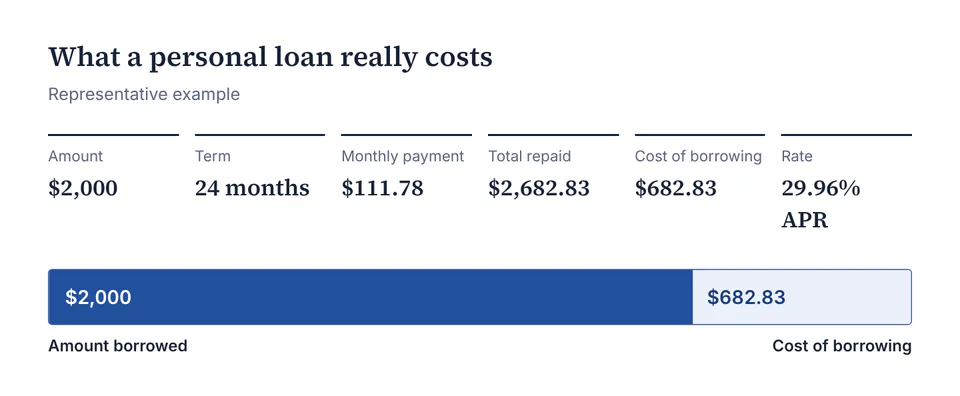
Where each dollar you repay goes
Where a rate falls in Canada
The rules change from one province to the next
The regulator, the licensing regime and the high-cost credit threshold differ by province. Only the 35% cap is federal.
How much do you want to borrow?
For each term: the monthly payment and, below it, the total repaid.
| Amount borrowed | Over 12 months | Over 24 months | Over 36 months |
|---|---|---|---|
| $1,000 | $97.47$1,169.61 in total | $55.89$1,341.41 in total | $42.43$1,527.47 in total |
| $1,500 | $146.20$1,754.41 in total | $83.84$2,012.12 in total | $63.64$2,291.20 in total |
| $2,000 | $194.93$2,339.22 in total | $111.78$2,682.83 in total | $84.86$3,054.94 in total |
| $3,000 | $292.40$3,508.83 in total | $167.68$4,024.24 in total | $127.29$4,582.40 in total |
| $5,000 | $487.34$5,848.05 in total | $279.46$6,707.07 in total | $212.15$7,637.34 in total |
| $7,500 | $731.01$8,772.07 in total | $419.19$10,060.60 in total | $318.22$11,456.01 in total |
| $10,000 | $974.67$11,696.09 in total | $558.92$13,414.14 in total | $424.30$15,274.68 in total |
| $15,000 | $1,462.01$17,544.14 in total | $838.38$20,121.20 in total | $636.45$22,912.02 in total |
Monthly payments and totals calculated at the representative example rate, 29.96% APR, for information only. The rate you are offered depends on your file and the lender. For $5,000, going from 12 to 36 months lowers the monthly payment from $487.34 to $212.15 and adds $1,789.29 to the total repaid.
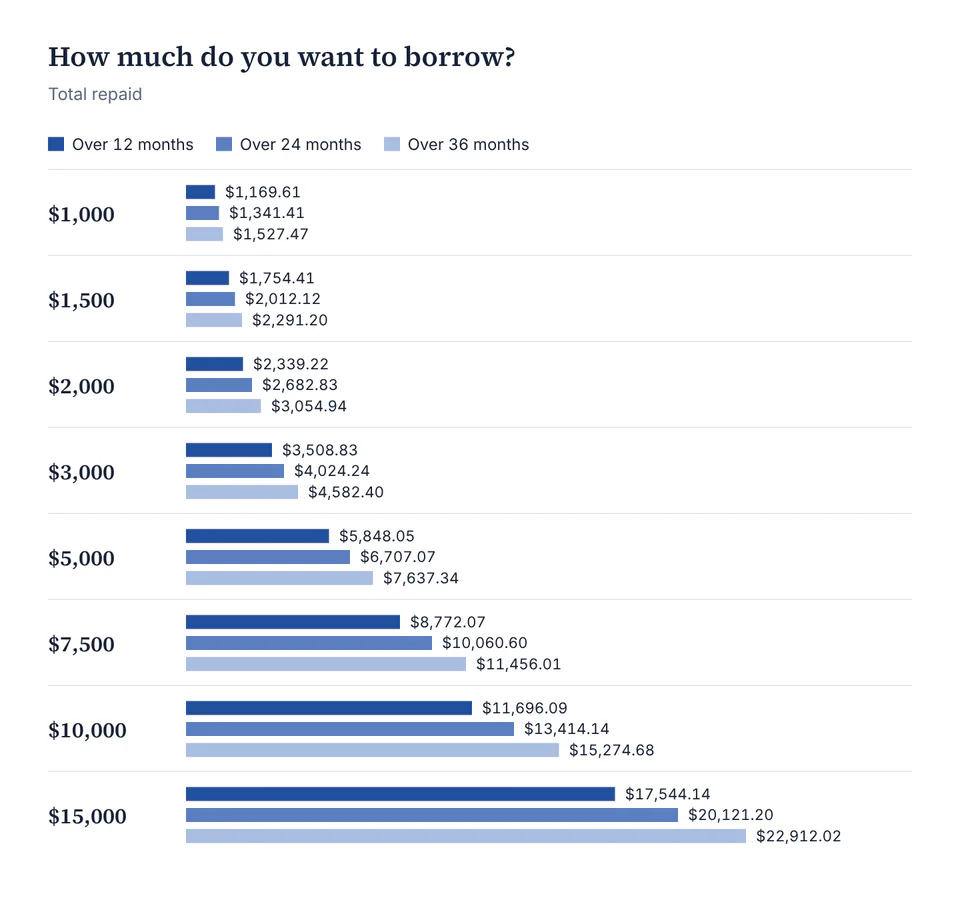
Choosing an amount and a term you can carry
Most of the cost of a personal loan is decided before you send a request, by two choices you make yourself: how much you borrow and over how long. The rate matters too, but it is set by the lender. The amount and the term are yours.
Start from the expense, not from the maximum
Borrow the amount the expense calls for, not the highest figure a lender might accept. Every extra dollar carries interest for the whole term. At the representative rate, $1,000 over 24 months comes to $55.89 a month and $1,341.41 in total: the extra $341.41 is the price of having that sum today rather than later. If you can cover part of the expense from savings, the loan and its cost both shrink.
Read the term as a trade-off
A longer term spreads the same amount over more payments. Each payment is lighter, but you pay interest for longer. On the representative amount of $2,000:
- Over 12 months: $194.93 a month, $2,339.22 in total;
- Over 24 months: $111.78 a month, $2,682.83 in total;
- Over 36 months: $84.86 a month, $3,054.94 in total.
Going from 12 to 36 months cuts the monthly payment by more than half and adds $715.72 to what you repay. Neither choice is right in itself. The question is which payment your budget can carry every month, including the months when something else goes wrong, and how much you are willing to pay for that margin.
Test the payment against a real month
Before you accept an offer, take a recent month of your own spending and add the payment to it. If the month only balances by leaving out groceries, transit or a bill you know is coming, the payment is too high, whatever the term. The FCAC budget planner can help you build that picture: Making a budget (FCAC).
What to read in the offer
Ask for the offer in writing and do not sign until you have it. Then find these five items and make sure they match what you were told:
- The annual percentage rate (APR), which includes the cost of borrowing and not just the interest;
- The total cost of borrowing, in dollars;
- The total you will repay and the number of payments;
- Any fees, including fees for a missed or returned payment;
- What the contract says about repaying early, in full or in part.
Prepayment and cancellation rights depend on your province and on the contract. Check the clause in your contract and, if anything is unclear, your province's consumer protection office before you sign. FCAC also explains your rights when you take out a personal loan: Your rights with personal loans (FCAC).
Check who is lending
The 35% APR ceiling on personal loans to individuals applies everywhere in Canada, apart from the specific exceptions in the federal regulation. Below that ceiling, the rules depend on where you live. British Columbia, Alberta and Manitoba require a high-cost credit licence for loans above 32% APR (32% or more in Alberta); Quebec sets its own high-cost credit threshold; Ontario and Saskatchewan have no high-cost credit regime. Your province page names the regulator and explains how to check a lender. The conditions every recipient must meet before we forward a request to it are on our Who may receive your request page.

How it works
Your request, in three steps
Choose an amount and a term you can carry to the last payment.
You answer a few questions
The amount, your province, your situation. About two minutes.
We review your request
If your profile fits, we may forward it to lenders and financial partners who may be able to respond.
You review the offer, or not
No obligation to accept. Most lenders pay out within 24 to 48 hours after approval.
Does your situation change anything?
Income does not have to come from a salaried job to be taken into account. What changes is what a lender will ask you to prove.
- Self-employedAn income that varies, and the proof a lender may ask for to check it.
- RetireesPensions and benefits as a steady, fixed income.
- NewcomersBorrowing without a Canadian credit history.
Frequently asked questions
- Is the rate on this page the rate I will be offered?
- No. 29.96% APR is the representative example we use to calculate every figure on the site. The rate you are offered depends on your file and on the lender, and it cannot exceed 35% APR.
- Can I repay my loan early?
- In Quebec, the law lets you repay early, in full or in part, paying only the cost of borrowing accrued to that date. Elsewhere, many contracts allow it, but the rules and any charges depend on your province and on the contract itself. Read the prepayment clause before you sign and, if in doubt, ask your province's consumer protection office.
- Why does the total repaid matter more than the monthly payment?
- Because a low payment can hide a high total. Stretching the term always lowers the payment, and it always raises the cost. The total repaid is the one figure that shows both the rate and the term at once.
- What can I use a personal loan for?
- Lenders generally leave that to you, within their own policies: a repair, a move, a purchase, or grouping existing debts into one payment. What matters is that the expense is worth what the loan will cost you.
- Do I have to accept an offer?
- No. Sending a request commits you to nothing. You read the terms each lender sends you and decide whether to accept one, or none. How our service works
- Who pays for your service?
- Our service is free for you, and we never ask you for a payment. Who may pay us, and how, is explained on our page: How we get paid
The getaloannow.ca editorial team
Writing and fact-checking · Official sources, cited and dated · Regularly updated content
Our guides are written and checked against official sources (provincial regulators, FCAC, Canada.ca), cited and dated on every page. They explain how borrowing works in Canada and are not personalized financial advice.
Published November 26, 2026 · Updated November 26, 2026
getaloannow.ca is not a lender. We are a loan matching service: we receive your request and may forward it to lenders and financial partners who may be able to respond. We do not lend money and make no credit decisions.
Who may receive your request
To lenders and financial partners who may be able to respond, and only if your profile fits. The list of recipients will be published before any request is forwarded. Who they are, our conditions and how to check a licence