Payday loans in Quebec: why the rules are different
By the getaloannow.ca editorial team · Writing and fact-checking
Updated November 26, 2026 · Written from the sources listed at the bottom of the page
If you are looking for payday loans in Quebec, you will find that the product sold in Ontario, British Columbia, Alberta, Saskatchewan and Manitoba, at up to $14 per $100 over a few weeks, does not work the same way here. Quebec has not asked to be designated under the payday loan provisions of the Criminal Code. As a result, any payday loan offered in Quebec is held to the criminal interest rate of 35% APR, and the lender needs a permit from the Office de la protection du consommateur (OPC). This guide explains what that means and what Quebec residents can do instead.
getaloannow.ca is not a lender and does not take payday loan requests from Quebec. This page is for information only.
The payday loan exemption of section 347.1 of the Criminal Code applies only in designated provinces. Quebec is not one of them, so a loan offered in Quebec stays under the 35% APR criminal rate.
In Quebec, a money lender needs an OPC permit before it starts lending, online included. A contract whose credit rate exceeds the Bank of Canada's official discount rate by more than 22 points is high-cost credit and needs a separate permit.
The lender's OPC permit, the annual credit rate written in the contract, and the total you will repay.
Why the payday loan regime stops at the Quebec border
Elsewhere in Canada, payday loans rest on an exemption. Section 347.1 of the Criminal Code lets a payday loan escape the criminal interest rate only if it is for $1,500 or less, for 62 days or less, and made by a lender licensed in a province the federal government has designated. Nine provinces have been designated, including Ontario, British Columbia, Alberta, Manitoba and Saskatchewan. Since January 1, 2025, a federal regulation caps the total cost of those loans at $14 per $100 advanced.
Quebec is not on that list. In the regulatory impact analysis statement published with the proposed Criminal Interest Rate Regulations in December 2023, the federal government wrote that the territories and Quebec have not requested designation under these provisions and that, as a result, any payday loan offering in the territories and Quebec would be subject to the criminal rate.
The criminal interest rate, as an APR, since January 1, 2025 (Criminal Code, s. 347). In Quebec, it applies to payday loans too.
The arithmetic explains the rest. At $14 per $100 over 14 days, a payday loan in another province works out to about 365% APR, according to the Financial Consumer Agency of Canada (FCAC). That is about ten times the criminal rate. A loan priced that way cannot legally be offered in Quebec, whatever it is called. Our guide to the criminal interest rate in Canada explains how the 35% cap works and how the APR is calculated.
The Quebec rules that apply instead
An OPC permit for every money lender
Under Quebec's consumer protection law, a business that lends money to consumers must hold a money lender's permit issued by the president of the OPC before it starts, and the rule also covers lending online. The OPC also states that if a lender charges a credit rate above 35%, it may refuse to issue or renew the permit. That is a condition for holding a permit, separate from the criminal rate, which applies everywhere in Canada.
High-cost credit
Quebec has its own threshold for high-cost credit. A credit contract is high-cost when its credit rate exceeds the Bank of Canada's official discount rate by more than 22 percentage points. With the discount rate at 2.75% as of October 30, 2026, the threshold stood at 24.75%; it moves whenever the Bank of Canada changes its rate. A lender that makes high-cost credit contracts needs a specific OPC permit, on top of its money lender's permit.
Your rights in the contract
The OPC tells consumers that the annual credit rate must be stated in writing, not only a monthly rate. A consumer can cancel a money loan contract within 2 days after receiving a copy of it, and the OPC's mandatory notice for high-cost credit contracts provides a 10-day period. Read the contract before signing, and keep your copy.
Enforcement
The rules are enforced. In May 2026, the Government of Quebec announced that the OPC had cancelled the money lender's permits of three businesses over the criminal interest rate.
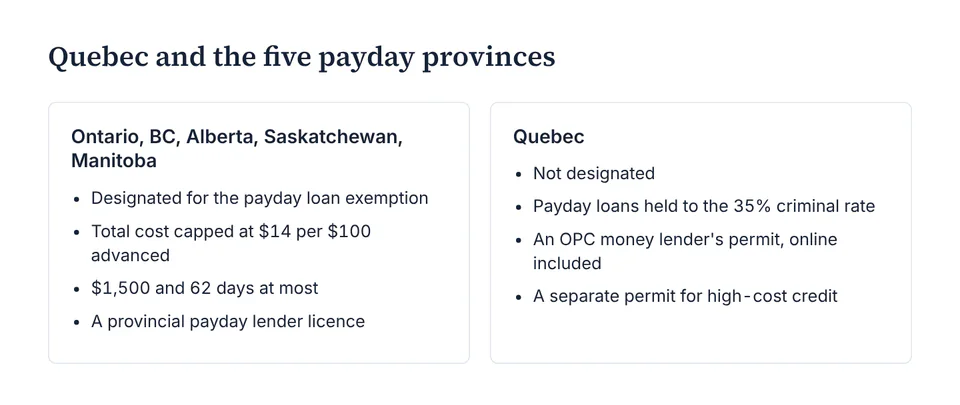
Quebec and the five payday provinces
Two frameworks for short-term borrowing.
Ontario, BC, Alberta, Saskatchewan, Manitoba
- Designated for the payday loan exemption
- Total cost capped at $14 per $100 advanced
- $1,500 and 62 days at most
- A provincial payday lender licence
Quebec
- Not designated
- Payday loans held to the 35% criminal rate
- An OPC money lender's permit, online included
- A separate permit for high-cost credit
In plain terms: in Quebec, a payday loan follows the same 35% ceiling as a personal loan, so a fee of $14 per $100 over two weeks has no legal place there.
Online offers aimed at Quebec residents
An online offer can reach you from anywhere. The rules follow you, not the website: the criminal rate applies to a payday loan offered in Quebec, and the OPC permit requirement covers lending online. Before you give any information, find the exact business name and its OPC permit. Our guide on how to check a lender's licence explains how that check works in the other provinces; in Quebec, the OPC is the authority that issues and can confirm a money lender's permit.
Be careful with any business that asks for a fee before paying out a loan. A legitimate lender does not, and you can report it to the Canadian Anti-Fraud Centre.
What Quebec residents can do instead
The cheaper options the FCAC lists apply in Quebec as anywhere else: a line of credit or overdraft protection with your bank or caisse, a cash advance on a credit card repaid quickly, a small loan from your financial institution, or an arrangement with the company you owe. In the FCAC's example of $300 over 14 days, a line of credit costs $5.92, overdraft protection $7.42 and a credit card cash advance $7.65.
If you need to spread a larger amount over several months, a personal loan repaid in instalments from a lender holding an OPC permit is the regulated route, at an APR that cannot exceed 35%. Read the annual credit rate and the total repaid in the contract before you sign.
Cash advance apps are a separate question. Bree's Google Play listing says it is not accepting new customers in Quebec. For other apps, check the app's own terms for Quebec before signing up.
Free help in Quebec
For budget help, the FCAC notes that in Quebec the Associations coopératives d'économie familiale (ACEF) often provide credit counselling services. A reputable agency should not charge for the first meeting, according to the FCAC. To read about the rules in French, our guide Prêt sur salaire au Québec : ce que dit la loi (in French) covers the same ground.
Frequently asked questions
- Are payday loans legal in Quebec?
- Quebec has no designated payday loan regime, so the exemption of section 347.1 of the Criminal Code does not apply there. A payday loan offered in Quebec is held to the criminal rate of 35% APR, and the lender needs an OPC permit.
- Is there a Quebec law that caps interest at 35%?
- The 35% cap comes from the Criminal Code and applies across Canada. In Quebec, the OPC adds that it may refuse to issue or renew a money lender's permit when the credit rate is above 35%: that is a permit condition, not a separate Quebec rate cap.
- Can I get a payday loan online from a lender in another province?
- A lender offering a payday loan to a Quebec resident is held to the criminal rate, and the OPC permit requirement covers lending online. A payday licence from another province does not change that. Check the business's OPC permit before you share any information.
- What is the high-cost credit threshold in Quebec?
- It is the Bank of Canada's official discount rate plus 22 percentage points. With the discount rate at 2.75% as of October 30, 2026, that gave 24.75%. A lender offering credit above the threshold needs a specific OPC permit.
Sources
- Proposed Criminal Interest Rate Regulations: regulatory impact analysis statement, Canada Gazette, Part I, December 23, 2023 (checked on October 30, 2026)
- SOR/2018-257: designation of Newfoundland and Labrador, with the list of designated provinces, Canada Gazette, Part II (checked on October 30, 2026)
- Criminal Code, section 347.1, Justice Canada (checked on October 28, 2026)
- Criminal Interest Rate Regulations (SOR/2024-114), Canada Gazette, Part II (checked on October 30, 2026)
- Permis de prêteur d'argent, Office de la protection du consommateur (checked on October 30, 2026)
- Interdictions (prêteurs d'argent), Office de la protection du consommateur (checked on October 30, 2026)
- High-cost credit: tips, Office de la protection du consommateur (checked on October 30, 2026)
- Money loans: advice, Office de la protection du consommateur (checked on October 30, 2026)
- Mention obligatoire : contrat de prêt d'argent, Office de la protection du consommateur (checked on October 21, 2026)
- Mention obligatoire : contrat de prêt d'argent à coût élevé, Office de la protection du consommateur (checked on October 21, 2026)
- Taux d'intérêt criminel : trois entreprises perdent leurs permis de prêteur d'argent, Government of Quebec, May 13, 2026 (checked on October 30, 2026)
- Payday loans, Financial Consumer Agency of Canada (checked on October 30, 2026)
- Getting help from a credit counsellor, Financial Consumer Agency of Canada (checked on October 30, 2026)
- Bree on Google Play, Google Play (Bree's listing) (checked on October 30, 2026)
If you are considering a loan
- Personal loansAn instalment loan repaid over months, at an APR that cannot exceed 35%.
- Payday loans: how they work, what they cost and the rulesHow payday loans work, the federal $14 per $100 cost cap, the rules in five provinces and cheaper ways to cover a short gap.
Related pages
- Payday loans: the rules in Ontario, BC, Alberta, Saskatchewan and ManitobaPayday loans follow their own rules: the federal $14 per $100 ceiling, each province's limits on cancelling and loan size, and how to check a licence.
- How to cancel a payday loan: your rights in each provinceThe cancellation window in each province, how to cancel a payday loan in writing, and the papers to keep.
- Payday loan calculatorEstimate the cost, the total to repay and the APR of a payday loan from the amount, the term and the fee per $100.
Where to get help, free of charge
These organizations are non-profit or public bodies, separate from us.
- Credit Counselling CanadaFind a non-profit credit counsellor near you
- Financial Consumer Agency of Canada (FCAC)Tools to make a budget and understand your credit
- Canadian Anti-Fraud CentreReport a request for fees before a loan
The getaloannow.ca editorial team
Writing and fact-checking · Official sources, cited and dated · Regularly updated content
Our guides are written and checked against official sources (provincial regulators, FCAC, Canada.ca), cited and dated on every page. They explain how borrowing works in Canada and are not personalized financial advice.
Published November 26, 2026 · Updated November 26, 2026