Who may receive your request
We receive your request and may forward it to lenders and financial partners who may be able to respond. This page sets out the categories of possible recipients, what each one does with your request, the conditions we set for them, and how you can check a licence yourself.
Updated November 26, 2026
The categories of recipients
Your request does not go to just anyone. It may be forwarded to three categories of recipients, and only with your consent.
- Lenders. They review your request, decide for themselves whether to make you an offer, and set their own terms: amount, annual percentage rate (APR) and term. If they follow up, they contact you directly. They must hold the licences required where they operate.
- Loan brokers. They do not lend money themselves. They may present your request to one or more lenders they work with, and contact you to complete it or to pass on an offer. The lender always makes the decision and sets the terms.
- Loan matching platforms. They receive requests and may direct them to lenders or loan brokers who may be able to respond. They do not lend money and make no credit decisions.
A loan broker or loan matching platform that forwards your request in turn does so under its own privacy policy, and remains bound by the conditions below. In every case, it is the lender that makes you an offer, if it makes one, and you are under no obligation to accept it.
The list of recipients
The list of recipients that receive requests, with their licence numbers, will be published on this page before any request is forwarded.
For each recipient, the list will show its legal name, its category (lender, loan broker or loan matching platform), the provinces where it receives requests and, where the province requires one, the number of the licence it holds there, with the issuing authority. The list will be dated and updated with every change.
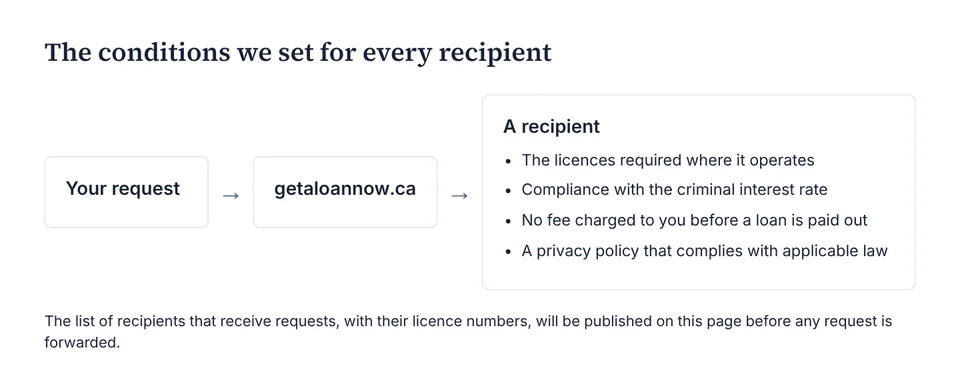
The conditions we set for every recipient
- The licences required where it operates. In Quebec, a lender must hold the money lender's licence issued by the Office de la protection du consommateur (OPC), plus the separate licence required for high-cost credit if it offers it. In the other provinces, the recipient must hold the licence the provincial authority requires for its activity, where one is required.
- No fee charged to you before a loan is paid out. Neither the recipient nor a lender it presents your request to may ask you for a payment to review it or to pay out the loan.
- Compliance with the criminal interest rate. Since January 1, 2025, the Criminal Code prohibits personal loans to individuals with an APR above 35%, apart from specific exceptions in the federal regulation. The offers made or presented must stay within that limit.
- A privacy policy that complies with applicable law, including, in Quebec, the Act respecting the protection of personal information in the private sector, as amended by Law 25. The recipient uses the information in your request only to assess it or to present it to a lender.
A recipient that stops meeting any of these conditions no longer receives requests.
How to check a lender's licence
Before you sign, check the lender's licence with the authority of your province rather than relying on what a website says about itself, including ours. Banks and credit unions fall under other regimes: what follows concerns private lenders.
Quebec
The OPC licenses money lenders, including lenders that operate online; banks, caisses and trust companies are exempt. Its merchant lookup tool, on the OPC website, tells you whether a business holds a licence and whether the OPC has taken action against it. The absence of action by the OPC does not, on its own, mean that a business is reliable.
Ontario
Ontario has no separate licence for high-cost credit; payday loans are governed by the Payday Loans Act, 2008. The Ontario government offers a search for business licences and registrations by name, city or number.
British Columbia
Since May 1, 2022, businesses that offer high-cost credit (an annual rate above 32%) need a licence from Consumer Protection BC. Use its tool to check a licence.
Alberta
Businesses that offer credit at an annual rate of 32% or more need a high-cost credit business licence from Service Alberta and Red Tape Reduction (regulation in force since January 1, 2019). See the official page for this licence; to look up a licensed business, start from the Consumer protection complaints page.
Saskatchewan
The Financial and Consumer Affairs Authority (FCAA) licenses payday lenders. Its FCAA411 tool lets you check whether a business it regulates holds a licence.
Manitoba
Since September 1, 2016, businesses that offer high-cost credit (an annual rate above 32%) need a licence from the Consumer Protection Office. To confirm that a lender holds this licence, contact the office directly.
Warning signs
- The lender asks for a fee before sending the loan. A legitimate lender does not.
- The annual rate quoted is above 35% APR.
- There is no licence number, or the authority of your province cannot confirm it.
If you suspect fraud, report it to the Canadian Anti-Fraud Centre.
What a licence does not tell you
A licence says nothing about the cost of a loan. Read the terms of each offer, the APR and the total to repay, and remember that you are under no obligation to accept. Our role and its limits are described on our How it works page, and our compensation on the How we get paid page.