How to get out of payday loan debt, step by step
By the getaloannow.ca editorial team · Writing and fact-checking
Updated November 26, 2026 · Written from the sources listed at the bottom of the page
To get out of payday loan debt, the first goal is not to repay everything at once: it is to stop taking a new loan to repay the last one. Each new payday loan adds a fee of up to $14 per $100, and the cycle, more than any single loan, is what makes payday debt so hard to leave. The provinces have rules that help: bans on rollovers, extended payment plans, limits on what a lender can charge when a payment fails. This guide sets them out for Ontario, British Columbia, Alberta, Saskatchewan and Manitoba, with the free help available and where to complain.
getaloannow.ca is not a lender, does not collect debts and has no say in your agreement. What applies to you is your province's law and the agreement you signed with your lender.
Stop adding new loans, ask your lender about the extended payment plan your province requires, and talk to a non-profit credit counsellor before the next due date.
Ontario and British Columbia prohibit rollovers. Ontario requires an extended payment plan from the third payday loan within 63 days with the same lender; British Columbia spreads a third loan within two months over two or three pay periods.
If a lender breaks the rules, contact your province's consumer protection authority: Consumer Protection Ontario, Consumer Protection BC, Service Alberta and Red Tape Reduction, the FCAA in Saskatchewan or Manitoba's Consumer Protection Office.
Step 1: stop adding new loans
The pattern is familiar: the repayment takes most of a pay, the rest of the month is short, and a new payday loan fills the gap. The provinces restrict this in different ways.
- Ontario: rollover loans are prohibited.
- British Columbia: rollovers are not allowed, and you can have only one payday loan at a time.
- Alberta: a payday lender cannot roll over a payday loan or issue any other credit to a borrower with a payday loan outstanding.
- Saskatchewan: a lender cannot charge you additional fees to roll over, refinance or extend your loan, and you can have only one payday loan at a time.
These rules do not stop you from going to another lender. That is why the most useful decision is a personal one: no new payday loan from today, even a small one, while you work out a plan for the ones you have. If you have several, write them all down with the lender, the amount due, the due date and the lender's licence number.
Step 2: use the extended payment plan where it exists
Two provinces require lenders to spread repayment once borrowing becomes repeated.
Ontario
From the third payday loan within 63 days with the same lender, the third agreement and any after it must include an extended payment plan. If you are paid monthly or less often, each instalment is capped at 50% of the total of the loan and its cost, over at least two pay periods. If you are paid weekly or more often, each instalment is capped at 35%, over at least three pay periods. You can pay the plan off early without a fee.
British Columbia
A third payday loan taken within two months must be repaid over two or three pay periods, and over at least three if you are paid every two weeks, twice a month or more often. Consumer Protection BC adds that you can repay a payday loan early, at any time, without a fee.
Alberta, Saskatchewan and Manitoba
In Alberta, every payday loan has at least two instalments, and no payment due on a payday can exceed 50% of the total owed; you can repay the full amount at any time without a penalty. For Saskatchewan and Manitoba, ask the lender directly what repayment options it offers, and get the answer in writing.
Step 3: cancel the loan you just signed
If you signed a payday loan in the last day or two and already regret it, cancelling may be the cleanest way out: you return the money and owe no fee. The window is short: 2 business days in Ontario, 2 days in British Columbia and Alberta, 48 hours in Manitoba (Sundays and holidays excluded) and until the end of the next business day in Saskatchewan. Our guide on cancelling a payday loan explains how to do it in writing.
Step 4: talk to the lender before the due date
If you know a payment will fail, call or write to the lender before the due date. Ask what repayment options it offers, and confirm any arrangement in writing. Knowing what the lender is allowed to charge on default helps you keep the conversation on firm ground.
| Province | What the rules allow |
|---|---|
| Ontario | A fee for a dishonoured payment, capped at $20 and charged only once, even if the payment is refused several times |
| British Columbia | Default interest of up to 30% a year on the unpaid principal, plus a single $20 fee for a refused cheque or pre-authorized debit |
| Saskatchewan | Default interest of up to 30% a year on the principal in default, plus an NSF charge of up to $25, once per loan; no other default fees |
| Manitoba | A penalty of 2.5% of the amount in default, calculated monthly, not compounded, once per 30-day period |
| Alberta | Ask Service Alberta and Red Tape Reduction at 1-877-427-4088 |
Your own bank may also charge a fee when a payment bounces, so a call to the lender before the due date usually costs less than a refused payment.
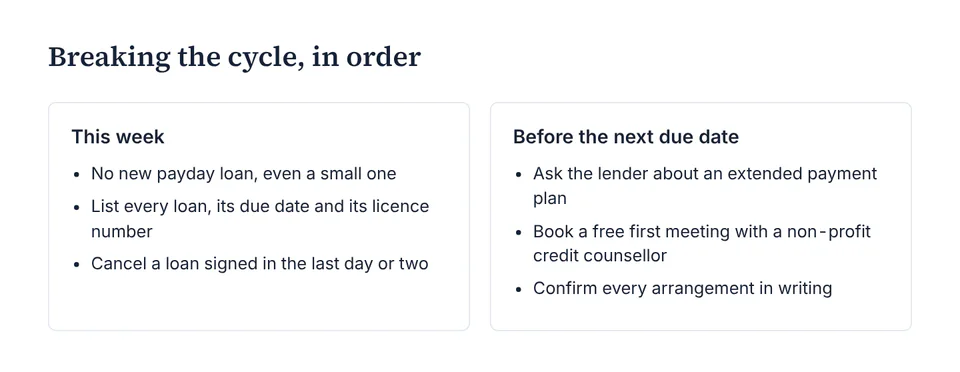
Breaking the cycle, in order
Four moves that cost nothing.
This week
- No new payday loan, even a small one
- List every loan, its due date and its licence number
- Cancel a loan signed in the last day or two
Before the next due date
- Ask the lender about an extended payment plan
- Book a free first meeting with a non-profit credit counsellor
- Confirm every arrangement in writing
In plain terms: the fee is charged again on every new loan, so the first saving comes from not borrowing again, before any repayment plan.
Get free help from a credit counsellor
A non-profit credit counsellor can look at the whole budget, including the payday loans, and help you plan the conversation with each lender. The Financial Consumer Agency of Canada (FCAC) notes that credit counselling is offered by non-profit organizations and by for-profit businesses, so check before you commit. It suggests looking for membership in a provincial or national association, such as Credit Counselling Canada or the Canadian Association for Financial Empowerment, and says a reputable agency should not charge for the first meeting. You can find a non-profit counsellor through the Credit Counselling Canada directory.
If the lender breaks the rules
The provinces back their rules with consequences. In British Columbia, if a lender breaks the payday loan rules, only the principal remains payable. In Manitoba, if a lender charges more than the regulation allows, you do not owe the amount in question. To report a lender or ask whether it is licensed:
- Ontario: file a complaint with Consumer Protection Ontario, and look the business up on the province's Consumer Beware List.
- British Columbia: contact Consumer Protection BC, which licenses payday lenders.
- Alberta: call the Consumer Contact Centre of Service Alberta and Red Tape Reduction at 1-877-427-4088.
- Saskatchewan: contact the consumer credit division of the Financial and Consumer Affairs Authority at 306-787-6700.
- Manitoba: contact the Consumer Protection Office at 204-945-3800 or 1-800-782-0067, or consumers@gov.mb.ca.
If anyone asks you for a fee to arrange a payment plan or to settle your payday loans for you, be careful: check who they are with your province's authority before paying anything.
After the cycle: one debt, then your credit
Once the payday loans are under control, some people replace several remaining debts with a single instalment loan repaid over months. Whether a lender offers one depends on your file, and the total repaid is what matters; our page on debt consolidation explains how it works and what to check.
Rebuilding your credit is a separate, slower job, and it starts once no payment is missed any more; our guide on how to improve your credit score goes through what helps and how to get your credit report for free.
If your income comes from government benefits, you may worry about what a lender can do if you fall behind. Our guide on whether a lender can take your benefits explains what to know before you borrow or fall behind.
Frequently asked questions
- Can a payday lender roll over my loan?
- Not in Ontario, where rollover loans are prohibited, or in British Columbia, where rollovers are not allowed. In Alberta, a payday lender cannot roll over a payday loan. In Saskatchewan, a lender cannot charge additional fees to roll over, refinance or extend a loan.
- Do I have a right to an extended payment plan?
- In Ontario, yes, from the third payday loan within 63 days with the same lender: the agreement must include one. In British Columbia, a third loan within two months must be repaid over two or three pay periods. In Alberta, every payday loan already has at least two instalments. In Saskatchewan and Manitoba, ask the lender what it offers.
- What happens if I miss a payday loan payment?
- The lender can add only what your province allows: in Ontario, a single $20 fee for a dishonoured payment; in British Columbia, default interest of up to 30% a year plus a single $20 fee; in Saskatchewan, default interest of up to 30% a year plus an NSF charge of up to $25, once; in Manitoba, a 2.5% penalty per 30-day period on the amount in default. Your bank may charge its own fee as well.
- Are all credit counselling services non-profit?
- Not necessarily. The FCAC notes that credit counselling is offered by non-profit organizations and by for-profit businesses, and that credit counsellors are not required by law to have specialized training. Check membership in Credit Counselling Canada or the Canadian Association for Financial Empowerment, and ask whether the first meeting is free.
Sources
- Payday loans: your rights, Government of Ontario (checked on October 30, 2026)
- File a consumer complaint, Government of Ontario (checked on October 30, 2026)
- The rules for payday lenders in BC, Consumer Protection BC (checked on October 30, 2026)
- Payday Loans Regulation (B.C. Reg. 57/2009), BC Laws (checked on October 30, 2026)
- Payday loans, Government of Alberta (checked on October 30, 2026)
- Consumer Tips: Payday Lending (October 2025), Service Alberta and Red Tape Reduction (checked on October 30, 2026)
- Borrowing from a payday lender: what you need to know, Financial and Consumer Affairs Authority of Saskatchewan (checked on October 30, 2026)
- Payday loans, Manitoba Consumer Protection Office (checked on October 30, 2026)
- Payday Loans Regulation (M.R. 99/2007), Government of Manitoba (checked on October 30, 2026)
- Getting help from a credit counsellor, Financial Consumer Agency of Canada (checked on October 30, 2026)
If you are considering a loan
- Debt consolidationReplacing several debts with one instalment loan, and what the total repaid includes.
- Payday loans: how they work, what they cost and the rulesHow payday loans work, the federal $14 per $100 cost cap, the rules in five provinces and cheaper ways to cover a short gap.
Related pages
- How to cancel a payday loan: your rights in each provinceThe cancellation window in each province, how to cancel a payday loan in writing, and the papers to keep.
- Alternatives to payday loans: what usually costs lessThe cheaper routes the FCAC lists before a payday loan, how cash advance apps differ, and where to find free budget help.
- Payday loans in Quebec: why the rules are differentWhy the payday loan regime of other provinces does not apply in Quebec, and the options open to Quebec residents.
Where to get help, free of charge
These organizations are non-profit or public bodies, separate from us.
- Credit Counselling CanadaFind a non-profit credit counsellor near you
- Financial Consumer Agency of Canada (FCAC)Tools to make a budget and understand your credit
- Canadian Anti-Fraud CentreReport a request for fees before a loan
The getaloannow.ca editorial team
Writing and fact-checking · Official sources, cited and dated · Regularly updated content
Our guides are written and checked against official sources (provincial regulators, FCAC, Canada.ca), cited and dated on every page. They explain how borrowing works in Canada and are not personalized financial advice.
Published November 26, 2026 · Updated November 26, 2026