Loans on benefits: what lenders count and what the law protects
By the getaloannow.ca editorial team · Writing and fact-checking · updated November 26, 2026
If you are looking into loans on benefits, three questions come before any request: will a lender count your benefits as income, what does the law protect from creditors, and could a loan change the assistance you receive? This page sets out what official sources establish, for readers in Ontario, British Columbia, Alberta, Saskatchewan and Manitoba.
getaloannow.ca is not a lender. You can send a request for an instalment loan from $1,000; if your profile fits, it may be forwarded to lenders and financial partners who may be able to respond, and a lender makes its own decision. Nothing on this page is a promise that a lender will say yes.
getaloannow.ca is not a lender. We are a loan matching service. We do not lend money and make no credit decisions. Our role
- Two minutesAbout two minutes to fill in the request.
- No SIN requiredWe never collect your social insurance number.
- Your credit file is not affectedFilling in our form does not touch your credit file. A lender that reviews your request may check it.
- Free for youWe never charge you anything.
A benefit is income you can declare on a loan request. Whether a lender counts it, and how much of it, is that lender's decision. getaloannow.ca is not affiliated with the Government of Canada, any provincial government or any benefit program.
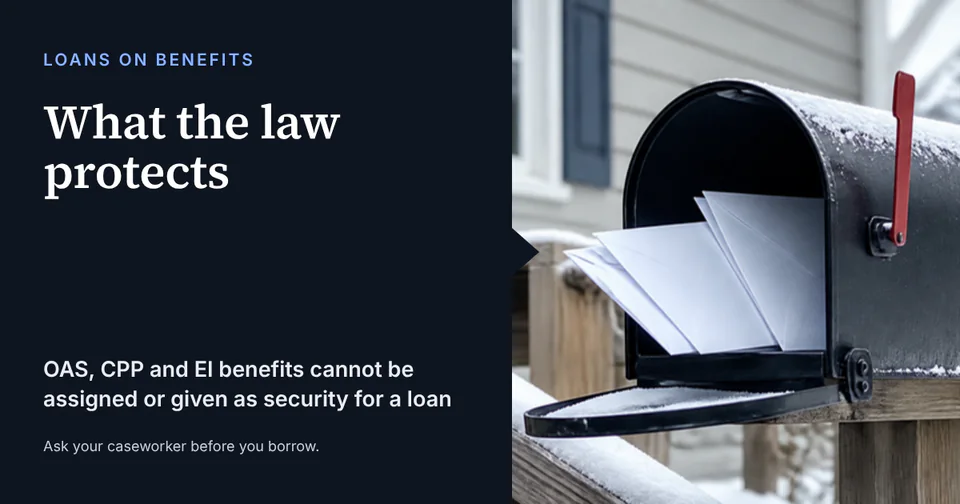
Federal law makes void any transaction that assigns Old Age Security, CPP or EI benefits or gives them as security. Ontario and British Columbia protect their assistance payments from garnishment and seizure.
In some programs, a loan counts. ODSP deducts a loan that was not authorized for an approved purpose from income support; in British Columbia, loan money you receive is an asset. Ask your caseworker first.
Which benefits a lender may count
A lender looks at one thing above all: whether you can repay over the whole term of the loan. To judge that, it may review the income you declare, and that can include benefits paid regularly by a government: the Canada Child Benefit, a CPP retirement or disability pension, Old Age Security, Employment Insurance, or provincial assistance such as ODSP, Ontario Works, AISH or BC disability assistance.
Each lender sets its own criteria. One may count a benefit in full, another only part of it, a third not at all. We cannot tell you in advance which way a lender will go.
What a lender may weigh besides the amount
- How long the benefit lasts. EI is paid for a limited period; the Canada Child Benefit is for children under 18; the CPP disability benefit is for people over 18 and under 65 who cannot work because of a disability.
- How it is paid. Most of these benefits arrive monthly; EI is paid every two weeks, after each report.
- Your expenses and the debts you already carry, set against what each payment leaves you.
- Proof: a statement or letter from the office that pays you, and recent bank statements that show the deposits.

What the law protects
Several federal benefits are protected by the statute that creates them. Under section 65 of the Canada Pension Plan and section 36 of the Old Age Security Act, a benefit “shall not be assigned, charged, attached, anticipated or given as security”, any transaction that tries to do so is void, and the benefit is exempt from seizure and execution. Section 42 of the Employment Insurance Act makes the same rule on assignment for EI benefits.
For the Canada Child Benefit, the Office of the Superintendent of Bankruptcy explains that under subsection 122.61(4) of the Income Tax Act, the benefit cannot be assigned, charged, attached or given as security, and is not subject to bankruptcy or insolvency law.
In plain terms: a lender cannot validly take one of these federal benefits as security for a loan. A protection from seizure does not cancel a debt, though: the loan remains owed, with its interest and fees.
Provincial assistance
- Ontario. ODSP income support is not subject to garnishment, attachment, execution, seizure or receivership under any other Act, and ODSP policy says this applies even once the money is in a bank account (directive 5.16). Ontario Works assistance is protected from seizure, garnishment, attachment, execution and receivership (directive 6.15).
- British Columbia. Income assistance, disability assistance, hardship assistance and supplements are exempt from garnishment, attachment, execution or seizure under any Act (Employment and Assistance Act, s. 29; Employment and Assistance for Persons with Disabilities Act, s. 20).
- Alberta, Saskatchewan and Manitoba. The official sources we rely on do not settle how AISH, Alberta Income Support, Saskatchewan Income Support or Manitoba EIA are treated by creditors. Ask the program office rather than assume.
The exceptions
- Tax debts. The Canada Revenue Agency says that if you receive money from a federal department or agency, it can ask that department to redirect the funds to pay a tax debt, which includes CPP and OAS payments.
- Family support. Federal regulations list OAS among the amounts that can be garnisheed for a family support order. In Ontario, ODSP and Ontario Works can be reduced for a support deduction order enforced by the Family Responsibility Office.
- Recoveries by the programs. CPP and OAS can be reduced to repay a province or municipality that paid an advance or social assistance for the same period, and EI can recover amounts owed to it from your benefits.
How a loan can affect your assistance
Provincial assistance depends on your income and assets. Depending on the program, loan money can count, and the result can be a smaller payment just when a new instalment starts.
- ODSP (Ontario). Directive 5.10 says: “Loans must be authorized and used for an approved purpose, otherwise they shall be treated as non-earned income and deducted from income support.” Approved purposes include first and last month's rent, exempt assets such as a vehicle or principal residence, household items, and training or education.
- Ontario Works. Under directive 5.9, the administrator may approve a loan, or part of one, as exempt income in certain circumstances, such as a vehicle purchase, first and last month's rent, necessary repairs or household items.
- British Columbia. The province's assistance policy says funds from a loan are not income, but the amount, once received, is an asset in the form of cash, and you become ineligible if your assets exceed the level set for your family.
- Alberta, Saskatchewan and Manitoba. We have no official rule to cite on how a loan is treated. Ask before you borrow.
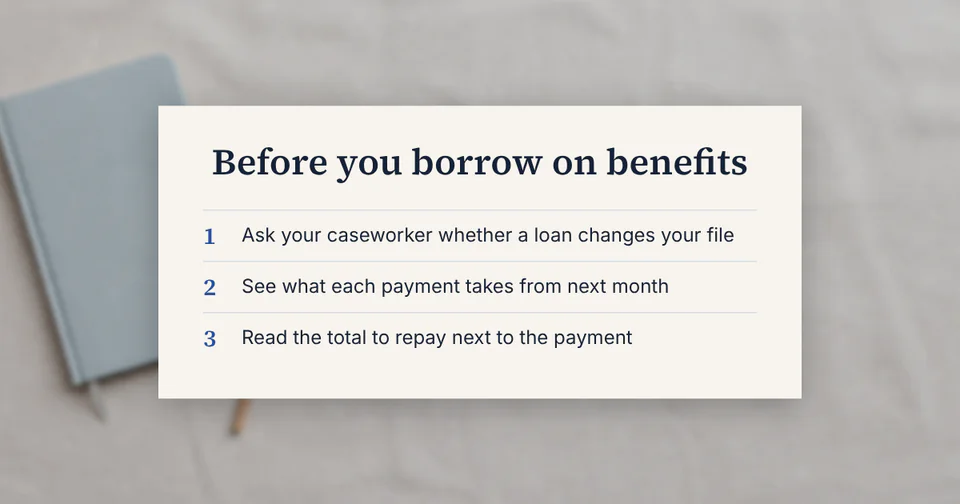
Whatever your province, ask your caseworker before you sign, in writing if you can, and keep the reply. A loan that reduced your assistance would also shrink the budget you repay it from.
The risks of borrowing on a fixed income
A benefit rarely rises during the term of a loan. Every instalment comes out of the same amount that already pays for rent, food and transportation, so the question is whether the payment still fits in month six or month eighteen. Look at the total repaid next to the monthly payment, never the payment alone.
Short-term offers deserve the closest reading. A payday loan is repaid in a single payment, often from your next deposit; at the federal maximum of $14 per $100, the FCAC calculates that a 14-day loan works out to about 365% APR. Before you consider one, read how payday loans work and what they cost. Some people also look at cash advance apps and their fees, which work differently again.
For a larger amount, an instalment personal loan spreads repayment over months, but a longer term raises the total you pay. If missed payments in the past weigh on your file, here is how lenders read a credit report with problems.
Warning signs
- A request for fees before the loan is paid out. A legitimate lender does not ask for this; report it to the Canadian Anti-Fraud Centre.
- A request to sign over a federal benefit as security. Under federal law, such a transaction is void.
- An APR above 35%, which the Criminal Code (s. 347) has prohibited since January 1, 2025.
Free help with your budget
Before you borrow, an hour with a non-profit credit counsellor can show you options you had not considered. The Financial Consumer Agency of Canada (FCAC) notes that credit counselling is offered by non-profit organizations and by for-profit businesses, and suggests checking whether an organization belongs to a provincial or national association, such as Credit Counselling Canada or the Canadian Association for Financial Empowerment (CAFE).
The FCAC suggests asking whether the first consultation is free and whether you will get a written plan; a reputable agency should not charge for the first meeting. The FCAC answers general questions at 1-866-461-3222, but does not handle individual complaints.
- Credit Counselling Canada keeps a directory of non-profit credit counsellors.
- In Ontario, Credit Canada; in British Columbia and Saskatchewan, the Credit Counselling Society; in Alberta, Money Mentors; in Manitoba, Community Financial Counselling Services.
- The FCAC publishes free guidance on making a budget.

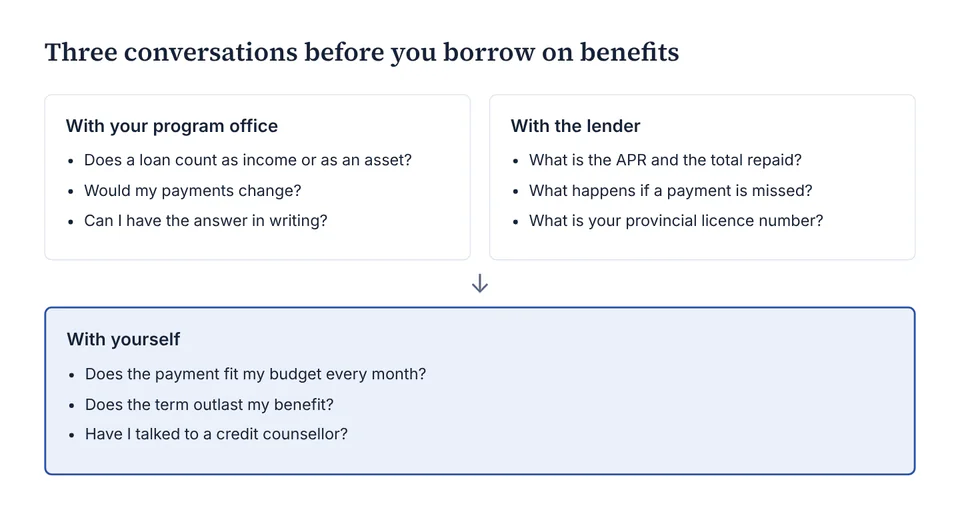
Three conversations before you borrow on benefits
Each one answers a question the others cannot.
With your program office
- Does a loan count as income or as an asset?
- Would my payments change?
- Can I have the answer in writing?
With the lender
- What is the APR and the total repaid?
- What happens if a payment is missed?
- What is your provincial licence number?
With yourself
- Does the payment fit my budget every month?
- Does the term outlast my benefit?
- Have I talked to a credit counsellor?
In plain terms: the lender decides on the loan, your program decides on your benefits, and only you can say whether the payment fits.
Be wary of ads for loans on benefits with “guaranteed approval”: no lender can promise a yes before reviewing your situation, and none can validly take a federal benefit as security.
Loans on benefits, program by program
Each page covers one benefit or one provincial program: what the official sources say about protection, what a loan can change, and who to ask.
Provincial assistance programs
Each province runs its own programs, with its own rules on income, assets and loans.
- Loans on social assistance: what a lender may look at
Thinking about loans on social assistance? What a lender may review, who to ask about your payments, and the offers that target tight budgets.
- ODSP loans: how a loan is treated on the Ontario Disability Support Program
How ODSP treats a loan under directive 5.10, how income support is protected, and what to ask your caseworker first.
- Ontario Works loans: what to know before you borrow on OW
When Ontario Works can exempt a loan, how assistance is protected from seizure, and the questions to ask first.
- AISH loans: borrowing on Alberta's disability income
What a lender may look at on AISH, when AISH is paid, and why your AISH worker should hear about a loan before you sign.
- Alberta Income Support loans: what to settle before you borrow
What a lender may review on Alberta Income Support, when it is paid, and the questions for your caseworker first.
- BC disability assistance loans: the asset rule to know first
Why BC counts loan money as an asset, how disability assistance is protected from seizure, and what to ask first.
- BC income assistance loans: what a loan changes on your file
How BC policy counts loan money, how the Employment and Assistance Act protects income assistance, and who to ask first.
- Saskatchewan Income Support loans: what to ask before you borrow
When SIS is paid, what a lender may review, how to check a lender with the FCAA, and why SIS should hear about a loan first.
- Manitoba EIA loans: borrowing on Employment and Income Assistance
How EIA is paid, what a lender may review, how to check a lender in Manitoba, and why EIA should hear about a loan first.
Federal benefits
Benefits paid by the Government of Canada, the same in every province.
- Loans on EI: borrowing while your benefits last
Considering loans on EI? What a lender may review when your income is Employment Insurance, what to prepare, and what to ask Service Canada first.
- Loans for retirees: borrowing on a pension income
Loans for retirees in Ontario, BC, Alberta, Saskatchewan and Manitoba: how pension income may be reviewed, what to prepare, and what to check first.
- Child tax benefit loans: what the Canada Child Benefit can and cannot do
Whether a lender may count the Canada Child Benefit, how federal law protects it, and what to weigh before borrowing.
- CPP disability loans: borrowing when your income is a CPP disability benefit
Whether a lender may count the CPP disability benefit, how the Canada Pension Plan protects it, and the exceptions to know.
Payment dates
The dates each program has published, taken from the official calendars.
- ODSP payment dates for 2026
The 2026 ODSP payment dates published by the Government of Ontario, and what to do if a payment does not arrive.
- Ontario Works payment dates for 2026
The 2026 Ontario Works payment dates published by the Government of Ontario, paid at the end of the month before each benefit month.
- AISH payment dates for 2026
The 2026 payment dates for AISH, ADAP and Alberta Income Support, published by the Government of Alberta on one calendar.
- BC income and disability assistance payment dates for 2026
The 2026 payment dates for BC income assistance and disability assistance, issued the month before the month they cover.
- Canada Child Benefit payment dates for 2026
The 2026 Canada Child Benefit payment dates published by the Canada Revenue Agency, and the rule of the 20th.
- EI payment dates: how Employment Insurance timing works
Why Employment Insurance has no fixed payment calendar, and how Canada.ca explains the timing of each EI payment.
- CPP and OAS payment dates for 2026
The 2026 payment dates shared by the Canada Pension Plan, CPP disability and Old Age Security, published by Service Canada.
Guides
Questions that come up for people on any benefit.
- Payday loans on benefits: what to know before you borrow
What a payday loan means when your income is a benefit: the single repayment, the cost cap, the effect on assistance and the alternatives.
- Can a lender take your benefits? What the law says
What the law says about lenders and benefits such as CPP, OAS, EI, the CCB, ODSP, Ontario Works and BC assistance, and where its limits are.
- Benefits and bank verification: what a lender sees
How a lender sees benefit deposits through bank statements or instant bank verification, and what to know about your privacy first.
Related pages
- Cash advance apps in Canada: how they work and what they costWhat cash advance apps are, how they differ from payday loans, and what to check on fees, withdrawals and availability.
- Payday loans: how they work, what they cost and the rulesHow payday loans work, the federal $14 per $100 cost cap, the rules in five provinces and cheaper ways to cover a short gap.
- “No credit check” loans: what lenders check insteadWhat lenders review when they skip a hard credit check, what stays true either way, and how to borrow without surprises.
Frequently asked questions
- Do lenders accept benefits as income?
- Some may, some may not. Each lender decides which income it counts and how it weighs it against your expenses and debts. We cannot tell you in advance what a lender will decide.
- Can a lender take my CPP, OAS or Child Benefit?
- Federal law says these benefits cannot be assigned or given as security, and CPP and OAS are exempt from seizure. There are exceptions for tax debts, family support and recoveries by the programs themselves. A protected benefit does not erase the debt: the loan is still owed.
- Will a loan reduce my provincial assistance?
- It can. On ODSP, a loan not authorized for an approved purpose is treated as income and deducted from income support. In British Columbia, the money received is counted as an asset. For other programs, ask your caseworker before you borrow.
- Is getaloannow.ca part of a government program?
- No. getaloannow.ca is a loan matching service. It has no connection with any federal or provincial benefit program, and it cannot answer questions about your benefits.
Who may receive your request
To lenders and financial partners who may be able to respond, and only if your profile fits. The list of recipients will be published before any request is forwarded. Who they are, our conditions and how to check a licence
Representative example
- Amount
- $2,000
- Term
- 24 months
- Monthly payment
- $111.78
- Total repaid
- $2,682.83
- Cost of borrowing
- $682.83
- Rate
- 29.96% APR
The annual percentage rate (APR) includes the cost of borrowing. The annual rate of a personal loan cannot exceed 35% APR (Criminal Code). In British Columbia and Manitoba, a lender also needs a high-cost credit licence above 32% (32% or more in Alberta): see your province page. Actual terms are set by the lender.
Sources
- Canada Pension Plan, section 65, Justice Canada (checked on October 30, 2026)
- Old Age Security Act, section 36, Justice Canada (checked on October 30, 2026)
- Employment Insurance Act, section 42, Justice Canada (checked on October 30, 2026)
- Canada Child Benefit (formerly Universal Child Care Benefits), position paper, Office of the Superintendent of Bankruptcy (checked on October 30, 2026)
- Garnishing wages, bank accounts and other income, Canada Revenue Agency (checked on October 30, 2026)
- Family Orders and Agreements Enforcement Assistance Regulations (SOR/88-181), Justice Canada (checked on October 30, 2026)
- ODSP directive 5.16: Income support protected from seizure or garnishment, Government of Ontario (checked on October 30, 2026)
- ODSP directive 5.10: Loans, Government of Ontario (checked on October 30, 2026)
- Ontario Works directive 6.15: Protection from seizure or garnishment, Government of Ontario (checked on October 30, 2026)
- Ontario Works directive 5.9: Loans, Government of Ontario (checked on October 30, 2026)
- Employment and Assistance Act, section 29, BC Laws (checked on October 30, 2026)
- Employment and Assistance for Persons with Disabilities Act, section 20, BC Laws (checked on October 30, 2026)
- BCEA Policy and Procedure Manual: Income treatment and exemptions, Government of British Columbia (checked on October 30, 2026)
- Getting help from a credit counsellor, Financial Consumer Agency of Canada (checked on October 30, 2026)
The getaloannow.ca editorial team
Writing and fact-checking · Official sources, cited and dated · Regularly updated content
Our guides are written and checked against official sources (provincial regulators, FCAC, Canada.ca), cited and dated on every page. They explain how borrowing works in Canada and are not personalized financial advice.
Published November 26, 2026 · Updated November 26, 2026
Request a personal loan
Two minutes, free of charge. A lender may contact you with its terms, or you may receive no reply.