Bad credit
Bad credit loans: what your credit score really changes
By the getaloannow.ca editorial team · Writing and fact-checking · updated November 26, 2026
A low credit score does not stop you from sending a request on getaloannow.ca. Our form accepts every score, including “I don't know”. We review your request and, if your profile fits, may forward it to lenders and financial partners who may be able to respond. A lender then looks at your whole file, not just a three-digit number.
What a lower score usually changes is the price: the rate you are offered tends to rise as the score falls. This page explains how scores work in Canada, what lenders weigh, and how to borrow with a low score without making your situation harder.
- Free for you, no obligation
- No social insurance number required
- Filling in our form does not affect your credit file

Free for you
No fees, at any point.
No SIN
No social insurance number, no banking details.
Your credit file stays untouched
Our form does not pull your credit report.
You stay free
No obligation to accept an offer.
Watch
Read the transcript
Bad credit loans: what does your credit score really change? If your score is low, you might expect every door to be closed. That’s not quite how it works. Let me explain how scores work in Canada, what a lender actually weighs, what a lower score usually costs, and what stays the same, whatever your score.
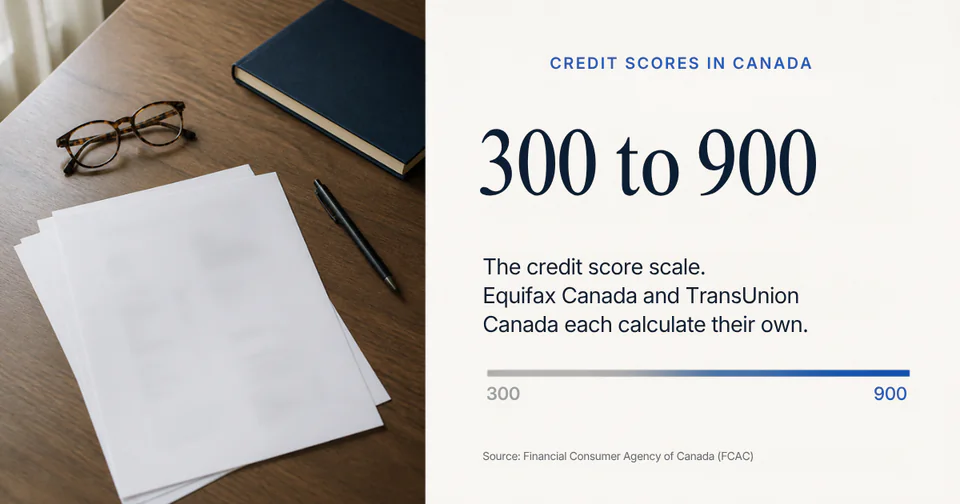
Your score comes from your credit file. In Canada, there are two main credit bureaus, Equifax and TransUnion, and scores usually range from 300 to 900. The higher, the better. But bureaus and lenders use different formulas, and they don’t share the details. So the score you see may be different from the one a lender sees.
What goes into a score? The Financial Consumer Agency of Canada names the factors. Payment history comes first: it’s the most important part of your score. Then how much of your available credit you use, how long your history is, the inquiries in your file, and the types of credit you have.
Now, a lender doesn’t stop at the number. The FCAC lists proof of regular income, a bank account and a permanent address. And it notes that your credit report, your score and the debts you already carry may affect your loan options. So the score matters, but it’s not the only thing on the table.
What a lower score usually changes is the price. According to the FCAC, the rate you’re offered depends on your credit history, the type of lender, and whether the loan is secured. A poor history may lead to higher rates. And a higher rate or a longer term both raise the total you repay. Together, they’re the combination that costs the most.
Here’s what your score doesn’t change. The 35% cap on the annual percentage rate applies whatever your score. In British Columbia, Alberta and Manitoba, a lender above 32% still needs a high-cost credit licence. And in British Columbia, you can cancel a high-cost credit agreement before the end of the next business day.
There’s also something you can do before any lender looks: read your own file. According to the FCAC, you can get your credit report online for free from both Equifax and TransUnion. And checking your own report or score won’t affect your credit rating.
Low scores also attract the wrong kind of offers. The Canadian Anti-Fraud Centre warns about companies that offer guaranteed loans even with poor credit, sometimes for a fee. In most provinces, asking for a fee before you receive your loan is illegal. And the FCAC adds one more point: applying for loans with different lenders in a short time may lower your score.
So, to sum up: a low score usually changes the price, not the rules. The cap is the same, the licences are the same, and a lender looks at more than a number. And just so you know: getaloannow.ca is not a lender. We’re a free loan matching service.
Bad credit loans, at a glance
Three figures to keep in mind before you borrow with a low score.
- 300-900
the range of credit scores in Canada
The higher the score, the lower the risk in a lender's eyes. Source: Financial Consumer Agency of Canada (FCAC).
- 2
credit bureaus: Equifax Canada and TransUnion Canada
Each one calculates its own score with its own formula, so your two scores can differ.
- 35%
the maximum annual rate, whatever your score
Criminal Code, since January 1, 2025. A lower score can mean a higher rate, never one above this cap.
Who it is for
This page is for people whose credit history is short, damaged or simply unknown to them, and who want to know where they stand before a lender tells them.
- You have missed payments in the past, or carried high balances for a long time.
- You are new to credit and have little history for a lender to read.
- You have never checked your score and are not sure what it is.
- Your situation has improved since the problems in your file, and you can show it with your current income.
If you are behind on several payments right now, speaking with a non-profit credit counsellor may help more than a new loan: see the questions below.
What to have on hand
With a low score, documents that show your current situation carry more weight. Gather them before you start.
- Your credit report from Equifax Canada or TransUnion Canada, so nothing in it surprises you.
- Recent proof of income: pay stubs, a notice of assessment or benefit statements.
- A list of your current debts and monthly payments, with their amounts.
- Government-issued photo ID.
Checking your own credit report usually has no effect on your score (FCAC).
What a loan with a low score really costs
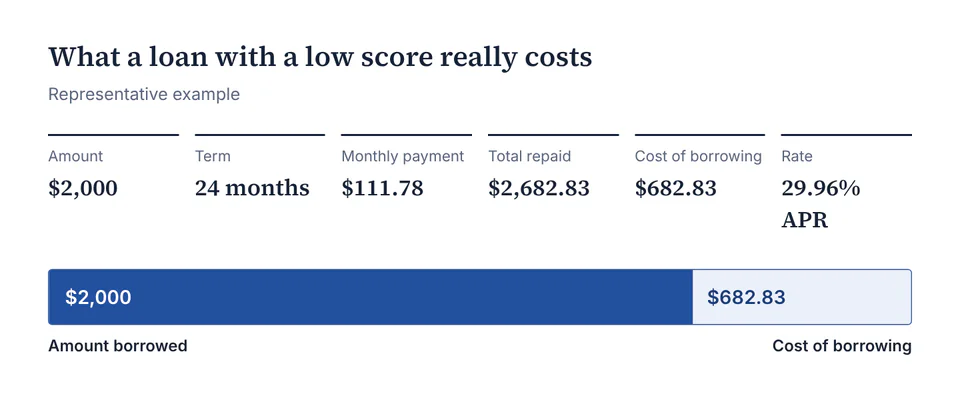
The calculation is the same for every borrower: the cost depends on the rate, the amount and the term. With a low score, the rate is the part most likely to be higher, which makes the amount and the term the parts to keep in check. Below is the representative example used across the site, then where each dollar you repay goes.
Representative example
- Amount
- $2,000
- Term
- 24 months
- Monthly payment
- $111.78
- Total repaid
- $2,682.83
- Cost of borrowing
- $682.83
- Rate
- 29.96% APR
The annual percentage rate (APR) includes the cost of borrowing. The annual rate of a personal loan cannot exceed 35% APR (Criminal Code). In British Columbia and Manitoba, a lender also needs a high-cost credit licence above 32% (32% or more in Alberta): see your province page. Actual terms are set by the lender.
Where each dollar you repay goes
Where a rate falls in Canada
The rules change from one province to the next
The regulator, the licensing regime and the high-cost credit threshold differ by province. Only the 35% cap is federal.
Your score, and what a lender does with it
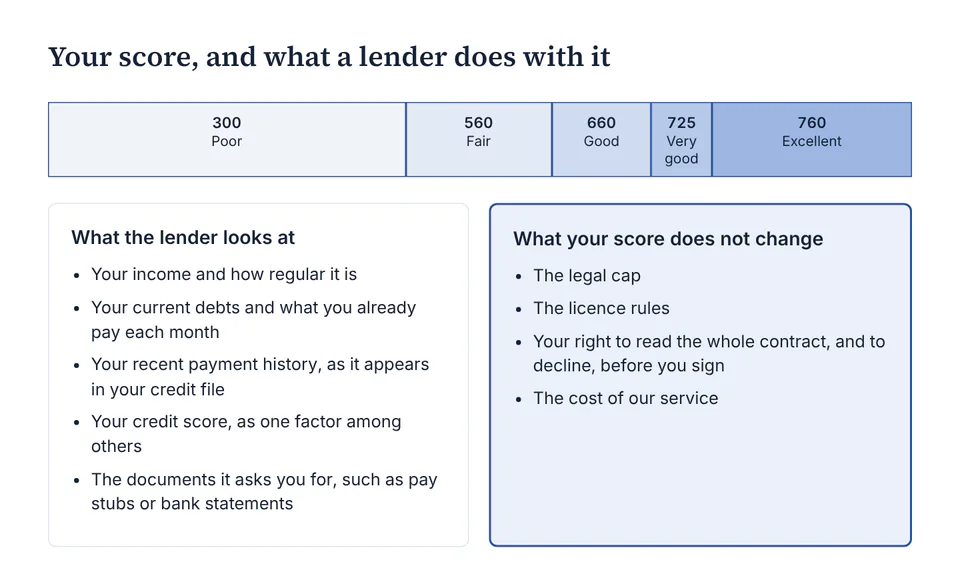
Five ranges. Each lender sets its own criteria, and the rest of your file weighs as much as the score.
What the lender looks at
- Your income and how regular it is.
- Your current debts and what you already pay each month.
- Your recent payment history, as it appears in your credit file.
- Your credit score, as one factor among others.
- The documents it asks you for, such as pay stubs or bank statements.
What your score does not change
- The legal cap: a personal loan to an individual cannot exceed 35% APR.
- The licence rules: in BC, Alberta and Manitoba, a lender still needs a high-cost credit licence above 32% (32% or more in Alberta).
- Your right to read the whole contract, and to decline, before you sign.
- The cost of our service: it stays free for you.
Be wary of ads that promise “guaranteed approval” or “no credit check”: no serious lender can promise that. Your request is reviewed whatever your credit score, each lender sets its own criteria, and no positive answer is guaranteed.
Borrowing with a low score without making it worse
A low score is a summary of the past. A loan taken now will become part of what your score says in a year. That is the reason to borrow carefully: the next loan should be one you repay on time, every time, rather than one that adds to the history you are trying to move past.
Read your own file first
Before you send any request, get your credit report. FCAC explains that you can access your report online free of charge from both Equifax Canada and TransUnion Canada, and that Equifax also gives a free score in every province. Checking your own file usually has no effect on your score. Ordering your credit report (FCAC)
Read it line by line. An account you do not recognize, a debt marked unpaid that you settled, or a payment recorded late by mistake all pull the score down. If you find an error, ask the bureau that holds the file to correct it.
Know what moves a score
Each bureau keeps its formula private. What a credit file records, above all, is whether you paid what you owed when it was due. FCAC also lists the number of credit inquiries in your file among the factors of a score, which is one more reason to send requests only when you are ready to borrow.
Keep the amount and the term in check
If the rate you are offered is higher because of your score, the two levers left to you are the amount and the term. Borrowing less, over a shorter term, keeps the cost of borrowing down even at a high rate. A long term at a high rate is the combination that costs the most in total, so look at the total repaid before you look at the monthly payment. On the representative example, $2,000 over 24 months at 29.96% APR comes to $111.78 a month and $2,682.83 in total, of which $682.83 is the cost of borrowing. Each month added to the term, at the same rate, adds to that cost.
Watch for the offers that target low scores
When you expect to be turned down, any yes comes as a relief, and fake lenders count on that. A legitimate lender does not ask you to pay a fee before sending the loan. A request for an upfront payment, a gift card or a transfer to “unlock” a loan is a sign to stop. Report it to the Canadian Anti-Fraud Centre.
Payday lenders often advertise to people with a low score, because a payday loan is assessed on your next pay more than on your file. That does not make it cheaper: its cost is capped at $14 per $100 borrowed, due in one payment. Before you go that way, read the payday loan rules in your province and what our page on “no credit check” loans says about what lenders check instead.
Check the licence too. In British Columbia, Alberta and Manitoba, a loan above 32% APR (32% or more in Alberta) can only be offered by a lender with a high-cost credit licence. Your province page explains how to check it, and the conditions every recipient must meet to receive a request are on our Who may receive your request page.
Sometimes the better step is advice
If you are already behind on several payments, a new loan can delay the problem without solving it. Non-profit credit counselling agencies can review your budget with you and explain the options available in your province. Credit Counselling Canada, a national association of non-profit agencies, keeps a directory of its members: Find a credit counsellor.

How it works
Your request, in three steps
Whatever your score, the terms are the lender's to set, and yours to accept or not.
You answer a few questions
The amount, your province, your situation. About two minutes.
We review your request
If your profile fits, we may forward it to lenders and financial partners who may be able to respond.
You review the offer, or not
No obligation to accept. Most lenders pay out within 24 to 48 hours after approval.
No income from a job?
A low score and a period without work sometimes go together. What matters then is the source and regularity of the income you can declare.
- UnemployedOther regular income, and what a lender checks about it.
- On social assistanceSocial assistance as declared income: what to know before you borrow.
Bad credit loans, in detail
The rules that apply in your province, the loan types people meet with a low score, and the promises worth checking before you believe them.
Promises to check
Why no lender can promise a yes in advance, and how to spot the scams built on that promise.
- “Guaranteed approval” loans: why no lender can promise it“Guaranteed approval” loans do not exist, even for bad credit. Where a refusal can happen, the warning signs of a scam, and what to do after a no.
- Loans that “approve anyone”: what lenders actually checkWhere the promise comes from, the upfront-fee scam it often hides, and what a real credit assessment looks at.
By province
Licences, legal limits, where to get your credit report and non-profit help, province by province.
- Bad credit loans in Ontario: rules, licences and helpWhat a low score changes for a loan in Ontario, the rules that still apply, and where to get your credit report and help.
- Bad credit loans in British Columbia: the 32% licence lineWhy the 32% licence line matters with a low score in BC, how to check a lender, and where to get your credit report and help.
- Bad credit loans in Alberta: licences, limits and helpWhat a low score changes for a loan in Alberta, the high-cost credit licence, and where to get your credit report and help.
- Bad credit loans in Manitoba: licences, limits and helpWhat a low score changes for a loan in Manitoba, the high-cost credit licence, how to check a lender, and where to get help.
- Bad credit loans in Saskatchewan: rules, FCAA411 and helpWhat a low score changes for a loan in Saskatchewan, how to check a lender on FCAA411, and where to get your credit report and help.
By type of loan
Payday loans, instalment loans and small amounts: what each costs and what a lender weighs when your score is low.
- Bad credit payday loans: what lenders look at besides your scoreWhat a payday lender weighs when your score is low, what the loan costs whatever your score, and how to avoid a cycle.
- Bad credit installment loans: the total cost and the 35% capWhat a low score does to an instalment loan, the total you repay, and the legal cap and licences that still apply.
- Small loans for bad credit: from $1,000, and what lies belowWhat a small instalment loan costs with a low score, and how payday loans and cash advance apps work below $1,000.
Frequently asked questions
- Will sending a request on your site lower my score?
- No. Sending a request on our site does not touch your credit file. A lender that goes on to review your file may check your credit report: you can ask the lender what kind of check it does.
- Where can I see my score for free?
- According to FCAC, Equifax Canada gives free online access to your credit report and score in every province. TransUnion Canada gives free access to your report; its free score is offered in Quebec and Ontario.
- Why are my Equifax and TransUnion scores different?
- Each bureau calculates its score with its own formula, which is not public. A gap between your two scores is not in itself a sign of an error, but it is a good reason to read both reports.
- Can a loan help me rebuild my credit?
- Payments made on time become part of your history, and missed payments do too. A loan can add positive history only if every payment fits your budget. Borrow for the expense, not for the score.
- A lender asks me for a fee before sending the loan. Is that normal?
- No. A legitimate lender does not ask you to pay a fee before sending the loan. Do not pay, and report it to the Canadian Anti-Fraud Centre.
- Is there an alternative to borrowing?
- Sometimes. A non-profit credit counsellor can go over your budget and your debts with you and explain the options in your province. Credit Counselling Canada lists accredited member agencies by province.
The getaloannow.ca editorial team
Writing and fact-checking · Official sources, cited and dated · Regularly updated content
Our guides are written and checked against official sources (provincial regulators, FCAC, Canada.ca), cited and dated on every page. They explain how borrowing works in Canada and are not personalized financial advice.
Published November 26, 2026 · Updated November 26, 2026
getaloannow.ca is not a lender. We are a loan matching service: we receive your request and may forward it to lenders and financial partners who may be able to respond. We do not lend money and make no credit decisions.
Who may receive your request
To lenders and financial partners who may be able to respond, and only if your profile fits. The list of recipients will be published before any request is forwarded. Who they are, our conditions and how to check a licence