“No refusal” payday loans: what licensed lenders still check
By the getaloannow.ca editorial team · Writing and fact-checking · updated November 26, 2026
Ads for “no refusal” payday loans are built to reach people who have already heard no somewhere else. The promise cannot hold: in Ontario, British Columbia, Manitoba and Saskatchewan, a licensed lender has to check the loan against your pay, and in Alberta each payment due on a payday is capped at 50% of what you owe, so a lender has to look at your income, and sometimes at your other loans, before it can lend. This page explains what a licensed payday lender checks, why those checks protect you, and what to do when you see such an ad.
getaloannow.ca is not a lender and promises no approval. We are a loan matching service: if your profile fits, your request may be forwarded to lenders and financial partners who may be able to respond, and a lender may say yes or no.
getaloannow.ca is not a lender. We are a loan matching service. We do not lend money and make no credit decisions. Our role
- Two minutesAbout two minutes to fill in the request.
- No SIN requiredWe never collect your social insurance number.
- Your credit file is not affectedFilling in our form does not touch your credit file. A lender that reviews your request may check it.
- Free for youWe never charge you anything.
Watch
Read the transcript
“No refusal” payday loans: do they really exist? No. Here's why, in under a minute.
In the provinces that license payday lenders, the loan is tied to your pay. In Ontario, British Columbia and Saskatchewan, it can't be more than half of your pay. In Manitoba, 30%. So a licensed lender needs proof of what you earn before it lends. And if the amount is above the limit, it can lend less, or say no.
So who promises a yes before seeing your file? The Canadian Anti-Fraud Centre warns about companies that offer guaranteed loans, even with bad credit, and says it's illegal in most provinces to ask for a fee before you receive your loan. getaloannow.ca is not a lender, and no outcome is guaranteed.
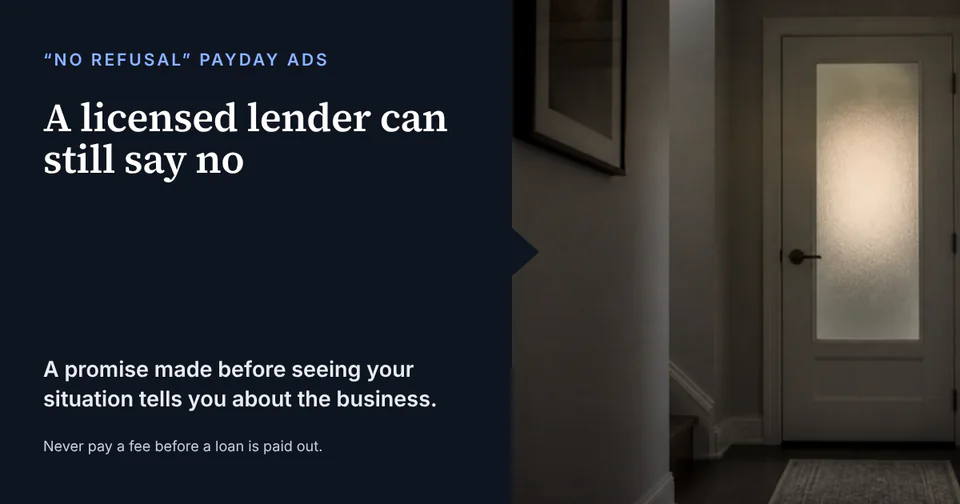
A payday lender can say no. A business that promises the opposite before seeing your situation is telling you something about itself, not about your chances.
Provincial rules cap a payday loan at a share of your pay: 50% in Ontario, British Columbia and Saskatchewan, 30% in Manitoba. A lender has to know your pay to respect that limit.
Look the lender up in your province's licence search, and never pay a fee to get a loan approved or paid out.
Why a payday lender has to check
Provincial payday loan rules are written around your pay. In Ontario, the amount advanced cannot exceed 50% of your net income; in British Columbia and Saskatchewan, 50% of your net or take-home pay; in Manitoba, 30% of your calculated net pay. A lender that follows those rules cannot set the amount without knowing what you earn, and if the amount you ask for is above the limit, it has to lend less or not at all.
Other rules work the same way. In British Columbia and Saskatchewan, you may hold only one payday loan at a time. In Alberta, a payday lender cannot give you other credit while you have a payday loan outstanding with it. A refusal in those cases is the rule doing its job.
What lenders may look at
Each lender sets its own criteria. Depending on the lender, a request may be assessed on:
- Your identity and your address in the province.
- Your income, and how often you are paid.
- Your bank account and its recent activity.
- Payday loans you already have, where the rules limit you to one.
- In some cases, your credit report.
If a lender checks your credit report, the FCAC explains the difference: a hard inquiry appears on your credit report and can affect your score, while a soft inquiry is visible only to you and does not. Ask which kind the lender uses before you agree to it. A damaged credit file does not automatically mean a refusal either; our page on payday loans with bad credit covers what changes and what does not.
How to react to an ad that promises approval
Read the ad as a question rather than an answer: who is behind it, and what do they want first? These steps take a few minutes:
- Find the business name, not just the brand, and look it up in your province's licence search. The page on checking a lender's licence lists the tool for each province.
- Refuse any request for a fee, a deposit or an insurance payment before the loan is paid out. A legitimate lender does not ask for fees before paying out a loan.
- Look for the total cost and the total to repay. A payday loan cannot cost more than $14 per $100 borrowed.
- Do not send photos of your cards or your online banking password to anyone.
If a business asked you for money up front, report it to the Canadian Anti-Fraud Centre and to your province's consumer protection regulator.
The same promise appears in other forms. Our guides on why “guaranteed approval” cannot be real and on loans said to “approve anyone” look at those versions of it.
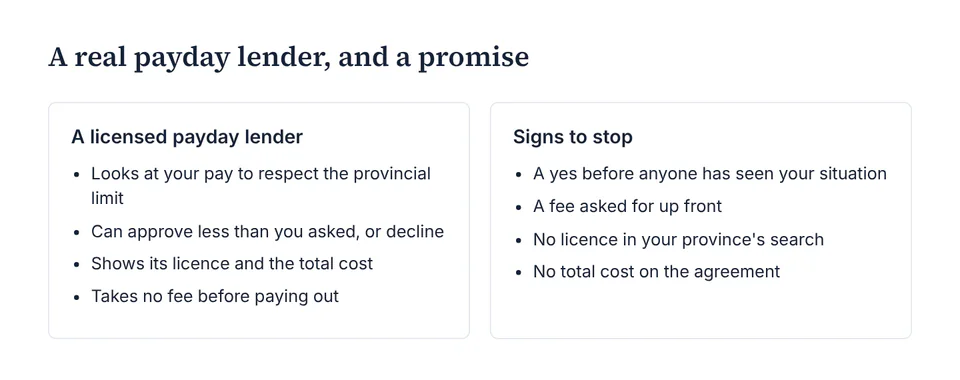
A real payday lender, and a promise
What a licensed payday lender does, set against what a promise of approval suggests.
A licensed payday lender
- Looks at your pay to respect the provincial limit
- Can approve less than you asked, or decline
- Shows its licence and the total cost
- Takes no fee before paying out
Signs to stop
- A yes before anyone has seen your situation
- A fee asked for up front
- No licence in your province's search
- No total cost on the agreement
In plain terms: a refusal can protect you from a loan your pay cannot carry. A lender that cannot refuse is not following the rules.
Be wary of payday loans advertised with “no refusal”: a licensed lender has to check your pay against the provincial limit before it lends, so no one can promise a yes before seeing your situation.
Part of: Payday loans: how they work, what they cost and the rules
Related pages
- E-transfer payday loans: what Interac delivery changes, and what it does notWhat an e-Transfer changes in a payday loan (only the delivery) and what it does not: cost, licence, approval and timing.
- “Best” payday loans in Canada: the criteria that actually matterThe criteria to check in any payday loan offer, side by side: licence, total cost, cancelling, the agreement, fees and rollovers.
Frequently asked questions
- Can a payday loan ad promise that I will be approved?
- No lender can honestly promise approval before reviewing your situation. Provincial rules tie a payday loan to your pay, so a licensed lender has to check before it lends, and it can decline.
- Why would a payday lender refuse me?
- The amount you asked for may be above the share of your pay allowed in your province, you may already have a payday loan where only one is allowed, or the lender's own criteria may not fit your situation. Each lender decides for itself.
- Does a payday loan request affect my credit score?
- It depends on the lender. A hard inquiry appears on your credit report and can affect your score; a soft inquiry does not. Sending a request on our site does not touch your credit file.
- What should I do if I paid a fee to get a loan approved?
- Stop all payments, keep every message and receipt, and report it to the Canadian Anti-Fraud Centre and to your province's consumer protection regulator. Contact your bank too if you shared account details.
Representative example: payday loan
- Amount
- $500
- Term
- 14 days
- Cost of borrowing
- $70.00
- Total to repay
- $570.00
- Rate
- 365% APR
In most provinces, a payday loan is repaid in one payment, usually on your next payday; in Alberta it runs 42 to 62 days, repaid in at least two instalments. In Ontario, British Columbia, Alberta, Manitoba and Saskatchewan, its total cost cannot exceed $14 per $100 borrowed (Criminal Interest Rate Regulations, since January 1, 2025). The example uses that maximum; actual terms are set by the lender.
Who may receive your request
To lenders and financial partners who may be able to respond, and only if your profile fits. The list of recipients will be published before any request is forwarded. Who they are, our conditions and how to check a licence
Sources
- Payday loans: your rights, Government of Ontario (checked on October 30, 2026)
- Guide for payday lenders, Government of Ontario (checked on October 30, 2026)
- Consumer information: payday loans, Consumer Protection BC (checked on October 30, 2026)
- Consumer tips: payday lending (October 2025), Service Alberta and Red Tape Reduction (checked on October 30, 2026)
- Payday loans, Manitoba Consumer Protection Office (checked on October 30, 2026)
- Borrowing from a payday lender: what you need to know, Financial and Consumer Affairs Authority of Saskatchewan (checked on October 30, 2026)
- Credit report and score basics, Financial Consumer Agency of Canada (checked on October 30, 2026)
- Criminal Interest Rate Regulations (SOR/2024-114), section 3, Canada Gazette, Part II (checked on October 30, 2026)
The getaloannow.ca editorial team
Writing and fact-checking · Official sources, cited and dated · Regularly updated content
Our guides are written and checked against official sources (provincial regulators, FCAC, Canada.ca), cited and dated on every page. They explain how borrowing works in Canada and are not personalized financial advice.
Published November 26, 2026 · Updated November 26, 2026
Request a payday loan
A request is not an approval: a licensed lender reviews it and may decline.