Cash advance apps in Canada: how they work and what they cost
By the getaloannow.ca editorial team · Writing and fact-checking · updated November 26, 2026

Cash advance apps let you draw a small amount of money and repay it automatically from your next deposit. This page explains what a cash advance from an app is, how it differs from a payday loan and from an instalment loan, what the official websites of three apps available in Canada say about their own products, and what to check before you sign up.
getaloannow.ca is not a lender and does not offer cash advances. We have no commercial relationship with any of the apps named on this page and are not paid by them. Everything we report about an app comes from that company's own website or help centre, as consulted on October 30, 2026: the company's current terms are the ones that count.
getaloannow.ca is not a lender. We are a loan matching service. We do not lend money and make no credit decisions. Our role
Watch
Read the transcript
How do cash advance apps work in Canada? They advance you a small amount before your next deposit, and they're often presented as an alternative to a payday loan. Let me explain the mechanism, what it really costs, and what the app asks for in return.
Here's how it works. You connect your bank account, or open an account with the company. The app looks at your deposits and sets a limit. Then, when your next pay or benefit deposit arrives, it takes back what it advanced, automatically. The amounts are small, and each company picks its own label: a cash advance, or an interest-free line of credit. That label matters, because it changes what you sign and whether the activity shows up on your credit report.
Many of these apps say they charge no interest. But no interest doesn't mean no cost. Depending on the app, you may pay a monthly subscription, a fee for faster delivery, or an optional tip. And a fixed fee weighs heavily on a small advance, including in months when you don't borrow. For a sense of scale, the FCAC puts a payday loan at roughly 365% a year over two weeks. An app's fees aren't expressed as a rate at all, which makes their real weight harder to judge.
The app also needs to see your account. If it asks for your online banking login, keep in mind a warning from the FCAC: sharing it with a third party may breach your bank's user agreement, and leave you liable for unauthorized transactions. And that access isn't a detail: it shows your rent, your habits and your other debts.
And when the same advance comes back every pay period, it's no longer a one-time fix: it's a permanent cost. So, three checks: the cost in dollars each month, the date the money comes back out, and whether the app serves your province, since some don't accept new customers everywhere in Canada. getaloannow.ca is not a lender, and doesn't offer cash advances.
A cash advance app gives you a small amount and takes it back from your bank or app account on your next deposit. The apps often charge no interest, but they may charge subscriptions, optional tips or fees for faster delivery.
Payday loans are regulated by the provinces, and in the provinces that regulate them the total cost is capped at $14 per $100 borrowed since January 1, 2025. Apps describe their products in their own terms; how each is supervised depends on the province.
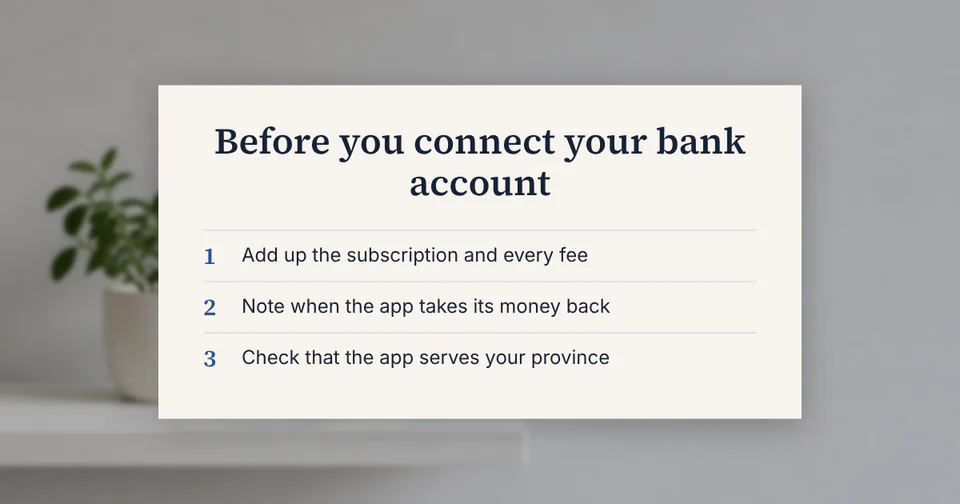
Add up every cost in dollars, find out when the app takes its money back, and check that it serves your province.
What a cash advance app is
A cash advance app is a mobile application, run by a financial technology company, that advances you a small sum against money you expect to receive: your pay, your benefits or another regular deposit. You connect a bank account or open an account with the company, the app looks at your deposits and account activity, and it sets a limit. When your next deposit arrives, the app takes back what it advanced.
The amounts are small: the highest limits stated by the apps described here are $250 and $750, and first advances are often lower. The idea is to cover a gap of a few days, not a large expense.
Each company chooses its own label: an interest-free line of credit, a cash advance tied to an account, a credit-building line of credit. The label changes what you sign, how you repay and whether the activity appears on your credit report.

How a cash advance differs from a payday loan and from a loan
A payday loan, an app advance and a personal instalment loan can all put money in your account quickly, but they are built very differently.
| Cash advance app | Payday loan | Personal instalment loan | |
|---|---|---|---|
| Who provides it | A technology company, under its own terms | A payday lender licensed by the province | A bank, credit union or lender |
| Typical size | A few dozen to a few hundred dollars, set by the app | Up to $1,500 under the federal exemption | Larger amounts, set by the lender |
| How it costs you | Often no interest; subscriptions, optional tips or fees for faster delivery, depending on the app | A fee per $100 borrowed, capped at $14 per $100 in the provinces that regulate payday loans | Interest, expressed as an annual percentage rate, capped at 35% APR under the Criminal Code |
| How you repay | Automatically, from your next deposit or the next money added to your account | In one payment on your next payday, within 62 days at most | In regular payments over several months |
| Credit check | The three apps below say they do not run a traditional credit check; they look at your deposits or account activity | Depends on the lender | Usually yes |
The cost structure is the main difference. A payday loan charges a fee on each $100, which the Financial Consumer Agency of Canada (FCAC) puts at about 365% a year for $14 per $100 over 14 days. Our page on how payday loans work and what they cost goes through those rules in detail. An app usually charges no interest at all, but a fixed monthly fee on a small advance can still be a large share of the amount: with round numbers, a fee of $3 on an advance of $50 is 6% of what you received, for a few weeks of use.
A personal loan works on a different scale: you borrow a larger amount and repay it over months, with interest. It is not a substitute for a $50 advance, but it can make more sense for a bigger, planned need. The personal loan guide explains how instalments and the total repaid are calculated.
What the three apps say about themselves
The summaries below come from each company's own pages, consulted on October 30, 2026. They are the companies' statements, not an independent assessment, and each app has its own page in this section.
- Bree: its website describes an interest-free line of credit of up to $750, with a first advance often between $20 and $50. Bree says the only costs are optional (a tip and an express fee for faster delivery), plus an optional membership at CA$2.99 a month after a one-month free trial. Repayment is taken automatically on your next payday.
- Nyble: its official pages describe a credit-building line of credit from $30 to $250 at 0% interest, with payments reported to Equifax Canada. It is presented as a way to build credit, not as a cash advance. An optional membership costs $11.99 a month.
- KOHO Cover: KOHO says Cover is a cash advance of up to $250, depending on eligibility, with no interest, available through a monthly subscription “for as little as $2 / month”. Money added to your KOHO account repays the Cover balance first.
“Cash now, pay later”: what the phrase covers
Some people search for “cash now, pay later” when they mean a cash advance app. The phrase describes the mechanism but hides the conditions: eligibility rules, a limit that may start very low, and a repayment taken automatically, sometimes before your rent or groceries are paid. Paying later is never paying nothing: count the cost in dollars, and what will be left in your account the day the advance is taken back.

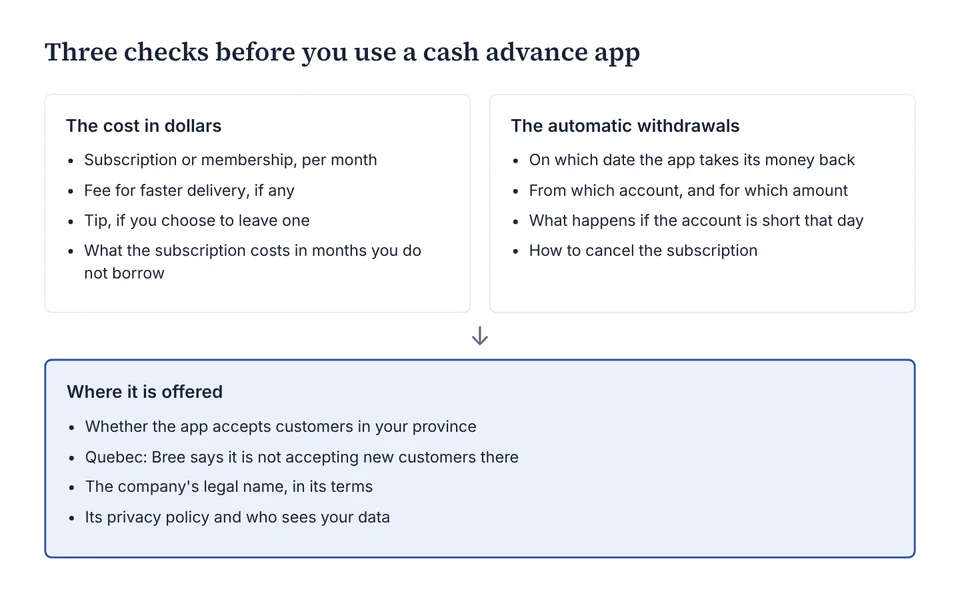
Three checks before you use a cash advance app
The home page tells you what the app offers; the terms tell you what you accept.
The cost in dollars
- Subscription or membership, per month
- Fee for faster delivery, if any
- Tip, if you choose to leave one
- What the subscription costs in months you do not borrow
The automatic withdrawals
- On which date the app takes its money back
- From which account, and for which amount
- What happens if the account is short that day
- How to cancel the subscription
Where it is offered
- Whether the app accepts customers in your province
- Quebec: Bree says it is not accepting new customers there
- The company's legal name, in its terms
- Its privacy policy and who sees your data
In plain terms: an app with no interest is not always an app with no cost. Add up the fees in dollars, know when the money comes out of your account, and confirm the app serves your province.
Be wary of any ad for “instant cash” with no conditions: every app described here sets eligibility rules, starts with a limit of its choosing, can decline you and takes its repayment automatically.
Availability and your credit file
Availability in your province. Bree's Google Play listing and blog say it is not accepting new customers in Quebec, Saskatchewan, Nova Scotia or New Brunswick, while its help centre says the app works anywhere in Canada: the app itself will tell you whether you can sign up. Nyble says its features may vary by province. If you live in Quebec, confirm availability with the company before counting on any of these apps.
Your credit file. The apps say they do not run a traditional credit check, but that does not mean nothing is recorded. Nyble reports payments to Equifax Canada, on time or late; KOHO's Cover FAQ says balances outstanding for more than three months may be reported at its discretion. You can see what is on your file through the free credit report and score options in Canada.
When another option may cost less
An app advance is not always the cheapest way to cover a short gap. The FCAC gives an example for $300 borrowed over 14 days: $42 as a payday loan, against $5.92 on a line of credit, $7.42 with overdraft protection and $7.65 as a credit card cash advance. The figures rest on the FCAC's own assumptions.
The FCAC and the federal Office of Consumer Affairs also list other options: a small loan from your bank or credit union, an advance on your pay from your employer, help from family, and building an emergency fund over time. Before borrowing at all, a free conversation with a non-profit credit counsellor can help you see where the gap comes from. Our guide to cheaper alternatives to a payday loan goes through each of these options.
Cash advance apps: every page in this section
Detailed pages on each app, how they differ, the alternatives and the practical questions: how the apps work, safety, credit checks and e-Transfer delivery.
The apps one by one
What Bree, Nyble and KOHO Cover say about their own products: limits, costs, repayment and eligibility.
- Bree review: what the app says about limits, fees and repayment
What Bree's own pages say about its limit, its optional costs, its automatic repayment and where it accepts new customers.
- Nyble review: a credit-building line of credit, not a cash advance
What Nyble's own pages describe: a small credit-building line of credit at 0%, reported to Equifax Canada, rather than a cash advance.
- KOHO Cover review: how the cash advance and its subscription work
What KOHO's own pages say about Cover: tiers up to $250, a monthly subscription, no interest and repayment from money added to your account.
How they differ
Two apps side by side, and a cash advance set against a payday loan.
- Bree vs Nyble: how the two apps differ
Bree and Nyble side by side: an interest-free cash advance line and a credit-building line of credit, from each company's own pages.
- Bree vs KOHO Cover: how the two cash advances differ
Bree and KOHO Cover side by side: two small cash advances with no interest, paid for and repaid in different ways.
- Nyble vs KOHO Cover: how the two apps differ
Nyble and KOHO Cover side by side: a credit-building line of credit and a small cash advance paid for by subscription.
- Cash advance vs payday loan: how the costs and the rules differ
How a cash advance from an app and a payday loan differ in cost structure and legal frame, and what to weigh before using either.
Other options
Other verified apps and the options outside apps: credit union loans, overdraft, line of credit.
- Apps like Bree: other options for a small advance in Canada
Other options if Bree does not fit: KOHO Cover, Nyble as a different kind of product, and the options outside apps.
- Apps like Nyble: other ways to build credit or cover a gap
If Nyble does not fit: what Bree and KOHO Cover say about credit reporting, and the options outside apps to build credit or cover a gap.
- Apps like KOHO Cover: other options for a small advance
If KOHO Cover does not fit: what Bree and Nyble describe, and the options outside apps for a short gap.
Practical guides
How the apps work, how to judge whether one is safe, what they check and how the money reaches you.
- How cash advance apps work: limits, fees and repayment
Step by step: how a cash advance app reviews your account, sets a limit, sends the money and takes its repayment.
- Are cash advance apps safe? Six checks before you sign up
Six practical checks before using a cash advance app: the company, your bank access, permissions, fees, withdrawals and your data.
- Cash advance apps with “no credit check”: what they still verify
What the apps say about credit checks, what they look at instead, and why skipping a credit check never means skipping the review.
- “Instant cash advance” by e-Transfer: what the apps actually say
How an advance reaches you by e-Transfer, the delivery times each app states, and what Interac says about timing.
Related pages
- “No credit check” loans: what lenders check insteadWhat lenders review when they skip a hard credit check, what stays true either way, and how to borrow without surprises.
- Loans on benefits: what lenders count and what the law protectsWhich benefits a lender may count, what federal and provincial law protects, and how a loan can change your assistance.
- Payday loans: how they work, what they cost and the rulesHow payday loans work, the federal $14 per $100 cost cap, the rules in five provinces and cheaper ways to cover a short gap.
Frequently asked questions
- Is a cash advance app a loan?
- The companies use their own terms: Bree speaks of an interest-free line of credit, KOHO of a cash advance, Nyble of a credit-building line of credit. In every case, you receive money you must repay, under the agreement you accept in the app.
- What does “cash now, pay later” mean?
- It is a way of describing a cash advance: you receive a small amount now and repay it from a later deposit. It does not mean the money is free or that anyone will approve you. The app sets your limit, its fees and the date it takes its money back.
- Are cash advance apps available in Quebec?
- Bree's Google Play listing and blog say it is not accepting new customers in Quebec. For Nyble and KOHO Cover, check with the company before you sign up. Payday loans are a separate matter: Quebec has not requested the payday loan exemption, so any payday loan offered there is subject to the 35% criminal rate.
- Does using a cash advance app affect my credit score?
- It depends on the app. Bree says it does not report to credit bureaus. Nyble reports payments to Equifax Canada, on time or late. KOHO's Cover FAQ says balances outstanding for more than three months may be reported to credit bureaus at its discretion.
- Can getaloannow.ca get me a cash advance?
- No. getaloannow.ca does not offer cash advances and has no relationship with any app. This section only explains how the apps work, based on what their companies publish.
Sources
- Bree: instant cash advance, Bree (company website) (checked on October 30, 2026)
- Bree app listing, Google Play (listing published by Bree) (checked on October 30, 2026)
- Build credit with Nyble, Nyble (company website) (checked on October 30, 2026)
- Nyble plans, Nyble (company website) (checked on October 30, 2026)
- KOHO Cover, KOHO (company website) (checked on October 30, 2026)
- Payday loans, Financial Consumer Agency of Canada (checked on October 30, 2026)
- Navigating payday loans, Office of Consumer Affairs, Innovation, Science and Economic Development Canada (checked on October 30, 2026)
- Criminal Interest Rate Regulations (SOR/2024-114), Canada Gazette, Part II (checked on October 30, 2026)
The getaloannow.ca editorial team
Writing and fact-checking · Official sources, cited and dated · Regularly updated content
Our guides are written and checked against official sources (provincial regulators, FCAC, Canada.ca), cited and dated on every page. They explain how borrowing works in Canada and are not personalized financial advice.
Published November 26, 2026 · Updated November 26, 2026