E-transfer payday loans: what Interac delivery changes, and what it does not
By the getaloannow.ca editorial team · Writing and fact-checking · updated November 26, 2026
E-transfer payday loans are ordinary payday loans whose money is sent to you by Interac e-Transfer rather than by direct deposit or cheque. The delivery method is the only difference. The cost is still capped at $14 per $100 borrowed, the lender still needs a licence in your province, it still decides whether to lend, and the money still moves only after approval and signature. This page explains what an e-Transfer changes in practice, what it does not, and how to read the timing honestly.
getaloannow.ca is not a lender and controls neither the decision nor the payout. We are a loan matching service: if your profile fits, your request may be forwarded to lenders and financial partners who may be able to respond; a lender chooses how and when it pays out.
getaloannow.ca is not a lender. We are a loan matching service. We do not lend money and make no credit decisions. Our role
- Two minutesAbout two minutes to fill in the request.
- No SIN requiredWe never collect your social insurance number.
- Your credit file is not affectedFilling in our form does not touch your credit file. A lender that reviews your request may check it.
- Free for youWe never charge you anything.
An e-Transfer speeds up only the last step, once the loan is approved and signed. It does not change the cost, the rules or the decision.
Funds usually arrive within minutes, sometimes up to 30 minutes, depending on the institution. Each bank or credit union sets its own limits and fees.
Check the lender's licence and the total to repay. A deposited e-Transfer cannot be cancelled, but your right to cancel the loan itself remains.
What an e-Transfer is
Interac e-Transfer is a service for moving money between accounts at participating Canadian banks and credit unions. A lender that pays out this way sends you the loan amount as an e-Transfer, and you accept it into your account, or it is deposited automatically if you have set up Autodeposit.
According to Interac, funds usually arrive within minutes, but a transfer can take up to 30 minutes depending on the institution. With Autodeposit, the transfer is deposited without a security question, after the usual fraud checks. Each institution sets its own transfer limits and its own fees. Once deposited, a transfer cannot be cancelled.
For a broader look at the mechanics, including instalment loans paid the same way, see how e-Transfer loans work.
What does not change
Everything that matters about a payday loan sits upstream of the transfer:
- The cost: no more than $14 per $100 borrowed in Ontario, British Columbia, Alberta, Manitoba and Saskatchewan, every fee included.
- The licence: a lender that offers payday loans online to residents of one of these provinces needs that province's licence, whatever payment method it uses.
- The decision: the lender still reviews your request against the provincial limits on your pay and may decline.
- Your rights: the provincial cancellation window, the limits on repeat loans and the caps on default charges all apply as usual.
- The repayment: the full amount, cost included, is still due on the date in the agreement.
One point does change slightly. Because a deposited e-Transfer cannot be reversed, cancelling the loan within your province's window means you send the money back yourself, following the lender's instructions, and keep proof that you did.
Timing, honestly
An e-Transfer is fast once it is sent. What takes time comes before: the lender reviews your request, may ask for documents, decides, and sends you an agreement to sign. Most lenders pay out within 24 to 48 hours after approval; no timing can be guaranteed, and a request sent in the evening or on a weekend may wait for the lender's business hours.
Speed also does nothing to lower the cost. On $500, the cost at the federal maximum is $70 whether the money arrives by e-Transfer or by direct deposit. If what you need is a longer repayment period, an instalment loan paid by e-Transfer is a different product, explained on our page on e-Transfer loans.
Scams that use e-Transfer
The direction of the money is the simplest test. A licensed lender sends you money; it does not ask you to send an e-Transfer first as a fee, a deposit or proof of good faith. If a business asks for that, stop, and report it to the Canadian Anti-Fraud Centre. Check that the lender is licensed in your province before you share any details, using the tools listed on how to check a lender's licence.
Some apps also send small advances by e-Transfer, under their own terms rather than payday loan rules; our page on app advances sent by e-Transfer explains what they say about fees and limits.
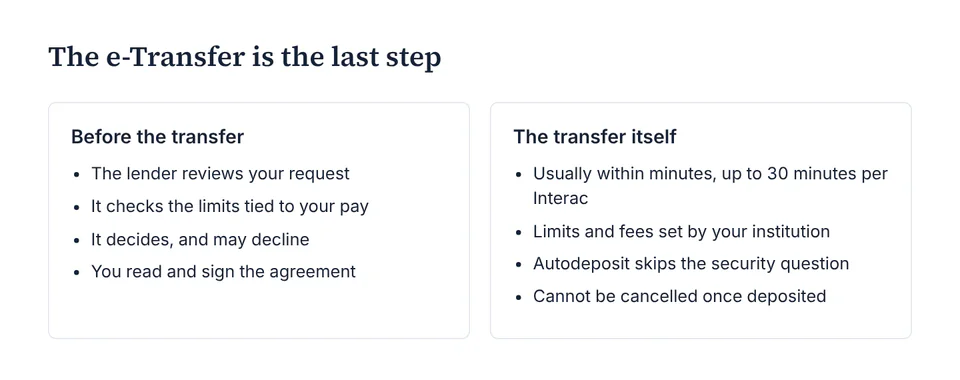
The e-Transfer is the last step
What happens before the money moves, and what the transfer itself changes.
Before the transfer
- The lender reviews your request
- It checks the limits tied to your pay
- It decides, and may decline
- You read and sign the agreement
The transfer itself
- Usually within minutes, up to 30 minutes per Interac
- Limits and fees set by your institution
- Autodeposit skips the security question
- Cannot be cancelled once deposited
In plain terms: an e-Transfer changes how the money reaches you, not what the loan costs or whether you get it.
Be wary of e-transfer payday loan ads that promise “instant funds”: the transfer only starts after a lender has approved you and you have signed, and Interac itself says a transfer can take up to 30 minutes depending on the institution.
Part of: Payday loans: how they work, what they cost and the rules
Related pages
- “Best” payday loans in Canada: the criteria that actually matterThe criteria to check in any payday loan offer, side by side: licence, total cost, cancelling, the agreement, fees and rollovers.
- “No refusal” payday loans: what licensed lenders still checkWhy a “no refusal” payday loan ad cannot be taken at its word, what licensed lenders check and how to react.
Frequently asked questions
- Is an e-transfer payday loan cheaper or more expensive?
- Neither. The payment method does not change the cost: a payday loan in Ontario, British Columbia, Alberta, Manitoba or Saskatchewan costs at most $14 per $100 borrowed, however it is paid out. Your bank may charge its own fee to receive a transfer; ask it.
- How long does an e-Transfer take to arrive?
- Interac says funds usually arrive within minutes, sometimes up to 30 minutes depending on the institution. That is only the last step: the lender must first approve your request and you must sign the agreement.
- Can I cancel a payday loan paid by e-Transfer?
- Yes, within your province's cancellation window. The e-Transfer itself cannot be reversed once deposited, so you return the money to the lender following its instructions and keep proof of the date.
- A lender asked me to send an e-Transfer before paying out my loan. Is that normal?
- No. A legitimate lender does not ask for fees before paying out a loan. Do not send anything, and report the business to the Canadian Anti-Fraud Centre.
Representative example: payday loan
- Amount
- $500
- Term
- 14 days
- Cost of borrowing
- $70.00
- Total to repay
- $570.00
- Rate
- 365% APR
In most provinces, a payday loan is repaid in one payment, usually on your next payday; in Alberta it runs 42 to 62 days, repaid in at least two instalments. In Ontario, British Columbia, Alberta, Manitoba and Saskatchewan, its total cost cannot exceed $14 per $100 borrowed (Criminal Interest Rate Regulations, since January 1, 2025). The example uses that maximum; actual terms are set by the lender.
Who may receive your request
To lenders and financial partners who may be able to respond, and only if your profile fits. The list of recipients will be published before any request is forwarded. Who they are, our conditions and how to check a licence
Sources
- Interac e-Transfer: frequently asked questions, Interac Corp. (checked on October 30, 2026)
- Interac e-Transfer 101: everything you need to know about sending and receiving money, Interac Corp. (checked on October 30, 2026)
- Criminal Interest Rate Regulations (SOR/2024-114), section 3, Canada Gazette, Part II (checked on October 30, 2026)
- Payday loans, Financial Consumer Agency of Canada (checked on October 30, 2026)
- Payday loans: your rights, Government of Ontario (checked on October 30, 2026)
The getaloannow.ca editorial team
Writing and fact-checking · Official sources, cited and dated · Regularly updated content
Our guides are written and checked against official sources (provincial regulators, FCAC, Canada.ca), cited and dated on every page. They explain how borrowing works in Canada and are not personalized financial advice.
Published November 26, 2026 · Updated November 26, 2026
Request a payday loan
Whatever the payment method, the lender decides and sets the terms. Read the total to repay before you sign.