Payday loans: the rules in Ontario, BC, Alberta, Saskatchewan and Manitoba
By the getaloannow.ca editorial team · Writing and fact-checking
Updated November 26, 2026 · Written from the sources listed at the bottom of the page
Payday loans are small, short-term loans, usually meant to be repaid on your next payday. They do not follow the same rules as other personal loans: provinces that have their own payday loan regime set the framework, within a cost ceiling set at the federal level. This guide explains that framework, sets out in one table what Ontario, British Columbia, Alberta, Saskatchewan and Manitoba require of payday lenders (including those offering payday loans online), and shows how to check a licence and where to find free help before you borrow.
In provinces with a designated payday loan regime, a payday loan is not measured against the 35% APR cap that applies to other personal loans. There, its total cost is capped at $14 per $100 advanced, the loan size is limited, and the lender needs a provincial licence.
Section 347.1 of the Criminal Code exempts a payday loan from the criminal interest rate only if it is for $1,500 or less, for 62 days or less, and made by a lender licensed in a designated province. Since January 1, 2025, its total cost cannot exceed 14% of the amount advanced.
A business offering payday loans online that you cannot find in your province's licence search, or that asks for a fee before paying out, is a reason to stop.
What a payday loan is
A payday loan is a small loan over a short term, usually due on your next payday. It is a different product from an instalment personal loan, which you repay in regular payments over months, and the law treats the two differently.
Because the term is so short, the cost of a payday loan is usually shown in dollars for each $100 borrowed rather than as an annual rate. The annual percentage rate (APR) brings any cost back to a one-year basis. Over a few weeks, a charge that looks small in dollars can amount to a very high APR. Whatever the product, the two figures to read before you sign are the total cost of borrowing and the total you will repay.
The federal framework
Section 347 of the Criminal Code sets the criminal interest rate. Since January 1, 2025, a loan with an APR above 35% is prohibited, under the Criminal Interest Rate Regulations (SOR/2024-114), with some exceptions set out in the regulations. The previous limit was a 60% effective annual rate, which the Department of Finance described as roughly 47% APR.
Payday loans are handled separately. Section 347.1 of the Criminal Code exempts a payday loan from the criminal interest rate only on three conditions: the loan is for $1,500 or less, its term is 62 days or less, and the lender is licensed under the payday loan law of a province the federal government has designated. The exemption comes with a federal ceiling: since January 1, 2025, section 3 of the Criminal Interest Rate Regulations (SOR/2024-114) caps the total cost of borrowing at 14% of the amount advanced, which is $14 for every $100.
The federal ceiling on the total cost of borrowing for each $100 of a payday loan, fees included, in provinces with a designated payday loan regime, since January 1, 2025 (Criminal Interest Rate Regulations, s. 3).
So unlike an instalment loan, which must stay at or below 35% APR, a payday loan in a province with its own regime is held to a cost per $100 borrowed. Within that federal frame, each province decides who may offer payday loans and on what terms. Quebec has its own rules for these loans; this guide covers the five other provinces.
The rules province by province
The table sets out what each province's official page says about payday loans. Where a province publishes no figure of its own, the federal ceiling applies.
| Province | Total cost | Cancelling | Loan size and repeat loans | Licence |
|---|---|---|---|---|
| Ontario | $14 per $100 borrowed, fees included | Read the cancellation terms in the agreement | No more than 50% of your net income. No rollovers, and no new loan while you still owe the same lender. From the third loan within 63 days with the same lender, that loan and the next ones come with an extended payment plan. | Payday lenders, and businesses that arrange payday loans, need a licence renewed every year (Payday Loans Act, 2008) |
| British Columbia | $14 per $100 borrowed, fees included | Within 2 business days, at no cost | No more than 50% of your pay. One loan at a time, and no rollovers. | Any lender that lends to a BC resident needs a licence from Consumer Protection BC |
| Alberta | Federal ceiling: $14 per $100 borrowed | Read the cancellation terms in the agreement | Ask Service Alberta and Red Tape Reduction before you sign | A provincial payday loan licence |
| Saskatchewan | Federal ceiling: $14 per $100 borrowed | Until the end of the next business day, by repaying the amount advanced | No more than 50% of your net pay. One loan at a time. | A licence from the FCAA, for each location, online lenders included |
| Manitoba | No more than 14% of the amount borrowed | Within 48 hours | $1,500 at most | Contact the Consumer Protection Office to check a lender |
Ontario
Payday lending in Ontario falls under the Payday Loans Act, 2008. Ontario's guide to payday lenders sets the $14 ceiling, the limit of 50% of net income, the ban on rollovers and the extended payment plan from the third loan in 63 days. You can look a business up in Ontario's business licence, registration or appointment search.
Ontario's page on payday loans and your rights also warns about businesses that present themselves as online lenders but are in fact lead generators: they collect your information and pass it on. The province also keeps a Consumer Beware List, where you can look up a business before you deal with it.
British Columbia
Consumer Protection BC's payday loan information sets out the rules in the table, including your right to cancel within 2 business days at no cost. Before you take a payday loan, search for the business in its payday lender licence search. Consumer Protection BC also licenses high-cost credit grantors, a separate licence for other loans with a rate above 32%.
Alberta
In Alberta, payday loans have their own regime, separate from the high-cost credit business licence that covers other loans at 32% or more. For the cost, the federal ceiling of $14 per $100 applies. To find out whether a business holds a provincial licence, use the “Find out if a business is licensed” search on the Government of Alberta's consumer protection page.
Saskatchewan
In Saskatchewan, payday lenders are licensed by the Financial and Consumer Affairs Authority (FCAA) under The Payday Loans Act. A licence is needed for each location, and online lenders based outside the province are included. The FCAA's page on borrowing from a payday lender explains that you can cancel until the end of the next business day by repaying the amount advanced. For the cost, refer to the federal ceiling of $14 per $100. You can look a lender up in FCAA411, the FCAA's public lookup tool.
Manitoba
Manitoba's payday loan regulations cap the cost at 14% of the amount borrowed, limit a payday loan to $1,500 and give you 48 hours to cancel. To check a payday lender, contact the Consumer Protection Office and ask whether the business is licensed, before you sign.
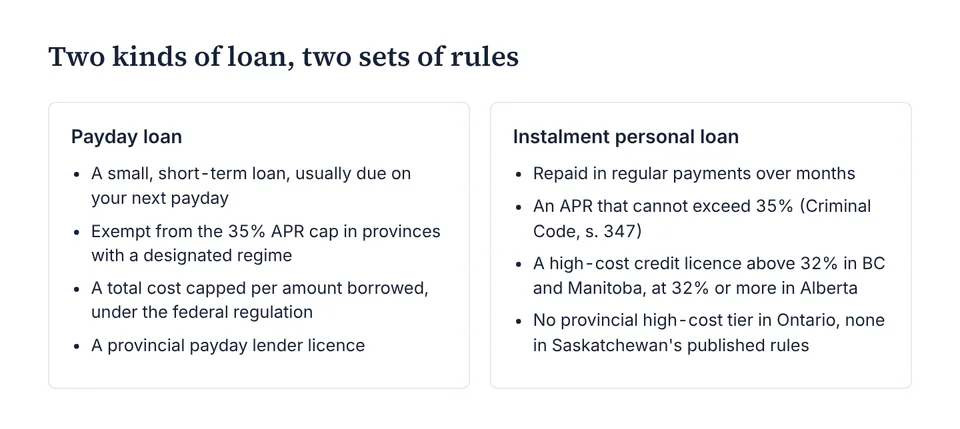
Two kinds of loan, two sets of rules
How a payday loan and an instalment personal loan are framed in Ontario, British Columbia, Alberta, Saskatchewan and Manitoba.
Payday loan
- a small, short-term loan, usually due on your next payday
- exempt from the 35% APR cap in provinces with a designated regime
- a total cost capped per amount borrowed, under the federal regulation
- a provincial payday lender licence
Instalment personal loan
- repaid in regular payments over months
- an APR that cannot exceed 35% (Criminal Code, s. 347)
- a high-cost credit licence above 32% in BC and Manitoba, at 32% or more in Alberta
- no provincial high-cost tier in Ontario, none in Saskatchewan's published rules
In plain terms: a payday loan follows its own provincial law and a cost ceiling of its own, while every other personal loan stays under the 35% APR cap of the Criminal Code.
Be wary of payday loans online advertised with “no credit check” or “money in 30 minutes”: no lender can promise approval before reviewing your situation, or a payout time (most lenders pay out within 24 to 48 hours after approval), and the first thing to check is the lender's provincial licence.
Payday loans online: who are you dealing with?
An online offer can reach you wherever you live, and the business behind it may not be where you are. Saskatchewan's rule is a useful reminder: a payday lender based outside the province still needs a Saskatchewan licence to lend there. Before you go further, write down the exact business name shown on the website or the agreement and look it up with your province's tool.
Ontario's warning about lead generators applies more broadly. A business that collects your request and passes it on is not a lender, and it should say so. We say it plainly: getaloannow.ca is a loan matching service, not a lender. We do not lend money and make no credit decision; only a payday lender licensed in your province can, and its licence is the first thing to check. Our page on payday loans explains how a request works and what it costs at most. If an instalment loan is what you have in mind, our page on personal loans explains how one works and what it costs in total.
Warning signs
- You are asked for a fee, an insurance payment or a deposit before the loan is paid out. A legitimate lender does not ask for fees before paying out a loan: government warnings about fake lenders make the same point. Do not pay, and report it to the Canadian Anti-Fraud Centre.
- You cannot find the business in your province's licence search, or the name on the agreement differs from the one you searched.
- You are promised a yes before anyone has looked at your situation.
- The offer shows a payment and a due date, but not the total cost of borrowing or the total you will repay.
Alternatives and free help
If a payday loan looks like the only way to cover a gap, a conversation with a non-profit credit counsellor costs nothing and can show you other options. These non-profit organizations can help:
- Credit Canada, in Ontario;
- The Credit Counselling Society, in British Columbia and Saskatchewan;
- Money Mentors, in Alberta;
- Community Financial Counselling Services, in Manitoba;
- And, anywhere in Canada, the Credit Counselling Canada directory of non-profit counsellors.
The Financial Consumer Agency of Canada (FCAC) also has a page on payday loans and tools to make a budget. A budget will not make a shortfall disappear, but it shows how a repayment due on your next payday fits with everything else that comes out of the same pay.
Frequently asked questions
- Are payday loans legal in Ontario, BC, Alberta, Saskatchewan and Manitoba?
- Each of these provinces regulates payday lending. A payday loan is allowed when the lender follows the provincial rules and holds the licence they require. That is why the licence check comes first: a business you cannot find in your province's search is one to avoid until the regulator confirms its status.
- Does the $14 per $100 ceiling apply to every loan?
- No. It applies to payday loans that meet the conditions of section 347.1 of the Criminal Code, in provinces with a designated payday loan regime, since January 1, 2025. Other personal loans are held to the Criminal Code cap: an APR of no more than 35%.
- Can I have two payday loans at the same time in Saskatchewan?
- No. Under The Payday Loans Act, you can have only one payday loan at a time in Saskatchewan, and a payday loan is limited to 50% of your net pay. The FCAA's FCAA411 tool lets you check that a lender is licensed.
- Can I cancel a payday loan after signing?
- In British Columbia, you can cancel within 2 business days at no cost; in Manitoba, within 48 hours; in Saskatchewan, until the end of the next business day, by repaying the amount advanced. Elsewhere, read the cancellation terms in the agreement before you sign.
Sources
- Criminal Interest Rate Regulations (SOR/2024-114), section 3, Canada Gazette, Part II (checked on October 28, 2026)
- Criminal Code, section 347.1, Justice Canada (checked on October 28, 2026)
- Criminal Code, section 347, Justice Canada (checked on October 21, 2026)
- Guide for payday lenders, Government of Ontario (checked on October 28, 2026)
- Payday loans: your rights, Government of Ontario (checked on October 21, 2026)
- Consumer information: payday loans, Consumer Protection BC (checked on October 28, 2026)
- Payday lender licence search, Consumer Protection BC (checked on October 21, 2026)
- Borrowing from a payday lender: what you need to know, Financial and Consumer Affairs Authority of Saskatchewan (checked on October 28, 2026)
- FCAA411, Financial and Consumer Affairs Authority of Saskatchewan (checked on October 21, 2026)
- Payday loan regulations, Government of Manitoba (checked on October 28, 2026)
- Payday loans, Financial Consumer Agency of Canada (checked on October 21, 2026)
If you are considering a loan
- Personal loansHow an instalment loan works and what it costs in total.
- Payday loans: how they work, what they cost and the rulesHow payday loans work, the federal $14 per $100 cost cap, the rules in five provinces and cheaper ways to cover a short gap.
Related pages
- Payday loan calculatorEstimate the cost, the total to repay and the APR of a payday loan from the amount, the term and the fee per $100.
- Payday loans in Quebec: why the rules are differentWhy the payday loan regime of other provinces does not apply in Quebec, and the options open to Quebec residents.
- Payday loan vs installment loan: how the two differHow a payday loan and an instalment loan differ: how the cost is set, the term, the legal caps and the licences.
Where to get help, free of charge
These organizations are non-profit or public bodies, separate from us.
- Credit Counselling CanadaFind a non-profit credit counsellor near you
- Financial Consumer Agency of Canada (FCAC)Tools to make a budget and understand your credit
- Canadian Anti-Fraud CentreReport a request for fees before a loan
The getaloannow.ca editorial team
Writing and fact-checking · Official sources, cited and dated · Regularly updated content
Our guides are written and checked against official sources (provincial regulators, FCAC, Canada.ca), cited and dated on every page. They explain how borrowing works in Canada and are not personalized financial advice.
Published November 26, 2026 · Updated November 26, 2026