Criminal interest rate in Canada: the 35% cap since 2025
By the getaloannow.ca editorial team · Writing and fact-checking
Updated November 26, 2026 · Written from the sources listed at the bottom of the page
Since January 1, 2025, the criminal interest rate in Canada has been an annual percentage rate (APR) above 35%: a loan to an individual that charges more is prohibited by the Criminal Code, apart from some exceptions set by federal regulation. Before that date, the limit was considerably higher. This guide explains what the 35% interest cap covers, what it replaced, how payday loans are treated, and how British Columbia, Alberta and Manitoba add their own high-cost tier below it while Ontario and Saskatchewan do not.
Read the transcript
What’s the highest rate a lender can charge you in Canada? Since January 1, 2025: 35% a year. Here’s the rule, in one minute.
It’s in section 347 of the Criminal Code. Above an annual percentage rate of 35%, it’s a criminal rate. And that rate isn’t just interest: it counts all the charges for the credit, whether they’re called a fee, a commission or a penalty.
Before 2025, the line was higher: the Department of Finance described the change as going from 47% to 35%. A few loans are treated differently, like some small pawn loans, and payday loans, which have their own cap of 14% of the amount borrowed.
Some provinces also draw a line below it. In British Columbia and Manitoba, above 32%, and in Alberta, at 32% or more, a lender needs a high-cost credit licence. getaloannow.ca is not a lender.
Section 347 of the Criminal Code prohibits a loan whose APR exceeds 35%. The rule has applied everywhere in Canada since January 1, 2025, with some exceptions set out in the Criminal Interest Rate Regulations.
The old limit was a 60% effective annual rate, which the Department of Finance described as roughly 47% APR. Loans priced between 35% and that old line are now prohibited.
In British Columbia and Manitoba above 32%, and in Alberta at 32% or more, a loan is high-cost credit and the lender needs a provincial licence. Ontario has no such tier, and the rules published in Saskatchewan set none either.
What the Criminal Code says
Section 347 of the Criminal Code sets the rate above which lending becomes an offence. Since January 1, 2025, that criminal rate is an APR above 35%. The federal government also adopted the Criminal Interest Rate Regulations (SOR/2024-114), which came into force on the same date and set out how certain kinds of loans are treated.
The cap is expressed as an APR, and that detail matters. The APR reflects the cost of credit charges, not only the interest: a loan that advertises a modest interest rate but adds large fees can still go past 35% APR. That is why the APR, and not the advertised interest rate, is the figure to read on an agreement. It is also the rate we show in the representative example on our loan pages, currently 29.96% APR.
The rule is federal, so it applies in every province and territory, to every lender, whether it operates from a storefront or entirely online. Outside the exceptions described below, a provincial licence does not allow a lender to go above it.
Before 2025: a 60% effective annual rate
Until December 31, 2024, the Criminal Code set the limit at a 60% effective annual rate. An effective annual rate and an APR are not calculated the same way. The Department of Finance described it as the equivalent of roughly 47% APR.
In practice, the change closed the band between 35% and about 47% APR. A loan in that range, allowed by the Criminal Code until the end of 2024, is prohibited today. Nothing changed, on the other hand, for a loan whose APR was already below 35%.
The exceptions in the regulations
The regulations treat a few kinds of loans differently. They concern specific situations:
- Some commercial loans, made to a business rather than to an individual, follow other rules;
- Some small pawn loans, secured by an item you leave with the lender, are treated separately;
- Payday loans can be exempt from section 347 in provinces that have their own payday loan regime (s. 347.1), as explained below.
We do not go into the detail of the first two: their exact scope is set out in the regulations themselves, and they do not concern an ordinary personal loan to an individual. For that kind of loan, keep the general rule in mind: no more than 35% APR, charges included.
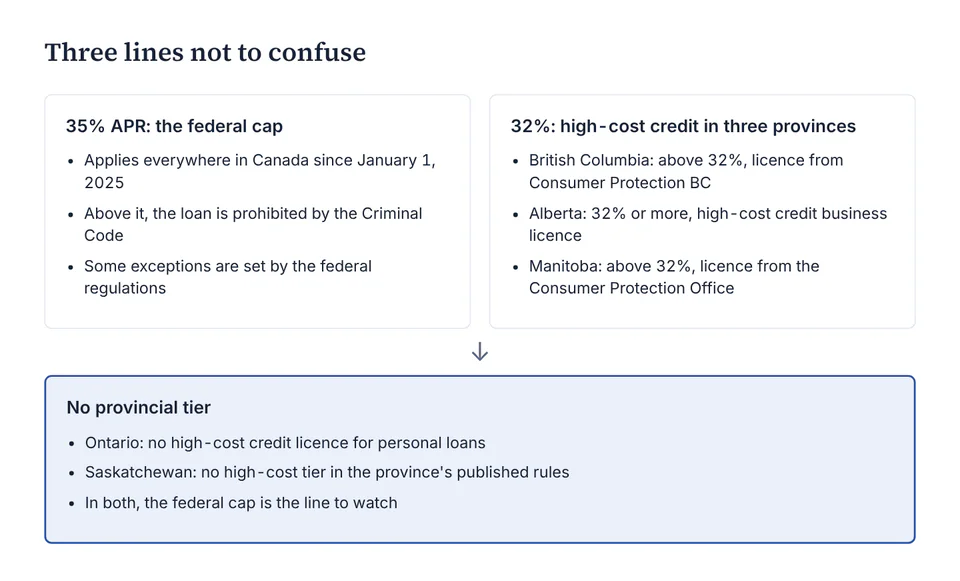
Three lines not to confuse
The criminal rate is not the only threshold that matters. Depending on your province, a loan can stay below the federal cap and still fall under stricter provincial rules.
35% APR: the federal cap
- applies everywhere in Canada since January 1, 2025
- above it, the loan is prohibited by the Criminal Code
- some exceptions are set by the federal regulations
32%: high-cost credit in three provinces
- British Columbia: above 32%, licence from Consumer Protection BC
- Alberta: 32% or more, high-cost credit business licence
- Manitoba: above 32%, licence from the Consumer Protection Office
No provincial tier
- Ontario: no high-cost credit licence for personal loans
- Saskatchewan: no high-cost tier in the province's published rules
- in both, the federal cap is the line to watch
In plain terms: a loan at 33% APR is legal under the Criminal Code everywhere in Canada. In British Columbia, Alberta and Manitoba, it is also high-cost credit, so the lender must hold a provincial licence. In Ontario and Saskatchewan, no provincial licence is tied to that rate.
The highest APR a personal loan to an individual can carry in Canada since January 1, 2025. Above it, the loan is prohibited by the Criminal Code.
Payday loans: a separate ceiling
Payday loans follow their own logic. Under section 347.1 of the Criminal Code, they can be exempt from the 35% cap in provinces that have their own payday loan regime. The exemption comes with a federal ceiling: a payday loan cannot cost more than $14 per $100 borrowed, counting the total cost of borrowing, under the federal regulation in force since January 1, 2025.
Because a payday loan is repaid over a short period, a cost per $100 can look small. It is still a costly way to borrow. Ontario licenses payday lenders under the Payday Loans Act, 2008; Consumer Protection BC licenses them in British Columbia; Alberta has a separate regime for them; and in Saskatchewan, The Payday Loans Act requires a licence for each location and limits a payday loan to 50% of net pay, one loan at a time. The FCAC's page on payday loans explains the costs. We do not handle payday loans.
How each province adds to the federal cap
British Columbia
Since May 1, 2022, a lender offering credit at an APR or annual interest rate above 32% needs a high-cost credit grantor licence from Consumer Protection BC (B.C. Reg. 290/2021), and the licence must be displayed on its website. Banks, credit unions and extraprovincial trust corporations are exempt. You can check a licence on the regulator's site.
Alberta
Alberta's High-Cost Credit Regulation, in force since January 1, 2019, treats a rate of 32% or more as high-cost credit. The line includes 32% itself, unlike British Columbia and Manitoba. The business needs a high-cost credit business licence from Service Alberta and Red Tape Reduction.
Manitoba
Manitoba has licensed high-cost credit since September 1, 2016 (Manitoba Regulation 7/2016). Above 32%, a lender needs a licence from the Consumer Protection Office, one for each location. To check whether a lender holds one, contact the office.
Ontario and Saskatchewan
Ontario has no high-cost credit licence for personal loans, and Saskatchewan's published rules set none. In Ontario, the Consumer Protection Act, 2002 is the consumer protection law in force, and payday lenders need a licence under the Payday Loans Act, 2008. In Saskatchewan, the Financial and Consumer Affairs Authority (FCAA) licenses payday lenders. In both provinces, the 35% federal cap is the limit for an instalment loan.
Quebec has its own high-cost threshold and its own rules, which are not covered in this guide.
Reading an offer against the cap
Before you sign, find the APR on the agreement itself and check it against 35% and, in British Columbia, Alberta or Manitoba, against 32%. Then look at the total you will repay, not only the monthly payment: two loans at the same APR can cost very different totals depending on the term. Our personal loans page shows what the term does to the total repaid.
If an offer goes above 35% APR, do not sign it: the loan is prohibited, whoever the lender is. If it sits above your province's high-cost line, check the lender's licence first. And if anyone asks you for a fee before paying out a loan, stop there and report it to the Canadian Anti-Fraud Centre.
Frequently asked questions
- Does the 35% cap include fees, or only interest?
- The cap is expressed as an APR, which reflects the cost of credit charges and not only the interest. A loan with a low advertised interest rate but large fees can still exceed 35% APR, and it is then prohibited.
- Is a loan at 33% APR legal?
- Under the Criminal Code, yes: it is below 35%. In British Columbia, Alberta and Manitoba, it is also high-cost credit, so the lender must hold a provincial high-cost credit licence (banks and credit unions are exempt in British Columbia and Manitoba). In Ontario and Saskatchewan, no provincial licence is tied to that rate.
- Why can a payday loan cost more than 35%?
- Section 347.1 of the Criminal Code allows payday loans to be exempt from the 35% cap in provinces with their own payday loan regime. A federal ceiling still applies: no more than $14 per $100 borrowed, under the federal regulation in force since January 1, 2025.
Sources
- Criminal Code (R.S.C. 1985, c. C-46), section 347, Justice Laws Website (checked on October 21, 2026)
- Criminal Interest Rate Regulations (SOR/2024-114), Justice Laws Website (checked on October 21, 2026)
- Payday loans, Financial Consumer Agency of Canada (checked on October 21, 2026)
- Check a licence, Consumer Protection BC (checked on October 21, 2026)
- High-cost credit business licence, Government of Alberta (checked on October 21, 2026)
- Consumer Protection Office, Government of Manitoba (checked on October 21, 2026)
- Search for a business licence, registration or appointment, Government of Ontario (checked on October 21, 2026)
- Financial and Consumer Affairs Authority of Saskatchewan, Financial and Consumer Affairs Authority of Saskatchewan (checked on October 21, 2026)
If you are considering a loan
- Personal loansWhat a loan really costs: the APR, the term and the total repaid.
- Bad credit loansWhat a lower credit score changes, within the same legal limits.
- All our guidesPlain-English guides to borrowing in Ontario, BC, Alberta, Saskatchewan and Manitoba: the 35% cap, credit scores, payday loan rules, licence checks.
Related pages
- How to check a lender's licence: a step-by-step guide by provinceHow to check a lender's licence in Ontario, BC, Alberta, Saskatchewan and Manitoba: the official tools, step by step, and the red flags to watch for.
- How to increase your credit score in CanadaHow to increase your credit score in Canada: the four factors FCAC names, habits that help, building credit from scratch and repair offers to avoid.
- Free credit score in Canada: how to get yoursHow to get a free credit score and credit report in Canada from Equifax and TransUnion, what each shows, and why checking your own file is safe.
Where to get help, free of charge
These organizations are non-profit or public bodies, separate from us.
- Credit Counselling CanadaFind a non-profit credit counsellor near you
- Financial Consumer Agency of Canada (FCAC)Tools to make a budget and understand your credit
- Canadian Anti-Fraud CentreReport a request for fees before a loan
The getaloannow.ca editorial team
Writing and fact-checking · Official sources, cited and dated · Regularly updated content
Our guides are written and checked against official sources (provincial regulators, FCAC, Canada.ca), cited and dated on every page. They explain how borrowing works in Canada and are not personalized financial advice.
Published November 26, 2026 · Updated November 26, 2026