Your situation
Loans on social assistance: what a lender may look at
By the getaloannow.ca editorial team · Writing and fact-checking · updated November 26, 2026
If you are looking into loans on social assistance, start with one fact: provincial social assistance is income you can declare on a loan request, nothing more. Whether a lender takes it into account is that lender's decision. Each one sets its own criteria, and we cannot tell you in advance what it will decide.
This page is written for readers in Ontario, British Columbia, Alberta, Saskatchewan and Manitoba. It explains who to ask before you borrow, what a lender may review, what to have ready, and how to read the ads for “e-transfer loans” that target people on assistance.
- Free for you, no obligation
- No social insurance number required
- Filling in our form does not affect your credit file

Free for you
No fees, at any point.
No SIN
No social insurance number, no banking details.
Your credit file stays untouched
Our form does not pull your credit report.
You stay free
No obligation to accept an offer.
Ask your caseworker before you borrow
The rules of social assistance belong to the province that pays it. Each province runs its own program, with its own rules on what you must report and what can change your payments. We do not know what effect a loan could have on your file, and we cannot answer that question for you.
Before you borrow, ask your caseworker or your provincial social assistance office. Put the question in writing if you can, and keep the reply. The answer matters twice: a loan that changed your payments would also change the budget you repay it from.
What a lender may review
A lender looks at whether you can repay over the whole term of the loan. To judge that, it may review the income you declare, your regular expenses and the debts you already carry. Social assistance is declared income like any other: one lender may count it, another may not, a third may count only part of it. We cannot tell you in advance which way a lender will go.
Your expenses weigh as much as your income. When rent, food and transportation already take most of each payment, there is little room left for a new instalment, and a lender that does its job will see it.
What to have ready
- Proof of your assistance payments, such as a recent statement or letter from the office that pays them.
- Recent bank statements that show the deposits.
- A list of your current debts, with balances and monthly payments.
- Photo ID and proof of address.
A lender may offer to check your deposits by connecting to your bank account through a third-party portal. In March 2018, the Financial Consumer Agency of Canada (FCAC) warned that sharing your banking login with a third-party service may breach your account agreement and leave you liable for unauthorized transactions. Read your agreement first, and ask whether you can send statements another way.
About “e-transfer loans”
Many ads for e-transfer loans on social assistance focus on how the money is sent. The payment method varies by lender, and Interac e-Transfer is only one of them. It tells you nothing about the cost of the loan, and it does not make the money arrive sooner. Most lenders pay out within 24 to 48 hours after approval, but no timing is guaranteed.
What counts is in the agreement: the annual percentage rate (APR), the total you will repay and the fees if a payment is missed. A monthly payment means little until you see the total repaid next to it.
Traps that target tight budgets
- Fees before payout. Government warnings on fake lenders are clear: a legitimate lender does not ask for fees before paying out a loan. If someone asks, do not pay, and report it to the Canadian Anti-Fraud Centre.
- Promises. No one can promise that a lender will say yes. An ad that presents the loan as a sure thing whatever your situation is a reason to walk away.
- Rates above the legal cap. Since January 1, 2025, a loan with an APR above 35% is prohibited by the Criminal Code (s. 347). In British Columbia and Manitoba, a lender charging more than 32% needs a high-cost credit licence; in Alberta, the threshold is 32% or more.
- Unlicensed lenders. Check the lender with your province before you sign: Consumer Protection BC, Alberta's licence lookup, Saskatchewan's FCAA411, Ontario's business licence search, or by contacting Manitoba's Consumer Protection Office.
- Loan chains. Borrowing to cover the payments of another loan adds a second cost of borrowing on top of the first, from the same budget.
Free help with your budget
Before you borrow, sitting down with a non-profit credit counsellor can show you options you might not have considered.
- Credit Counselling Canada keeps a directory of non-profit credit counsellors across the country.
- In Ontario, Credit Canada; in British Columbia and Saskatchewan, the Credit Counselling Society; in Alberta, Money Mentors; in Manitoba, Community Financial Counselling Services.
- Talk to your creditors before you fall behind: a deferral or a payment arrangement can cost less than a new loan.
- The FCAC publishes free guidance on making a budget.
If your credit report is part of the picture, here is how lenders read it: Bad credit loans: what your credit score really changes.
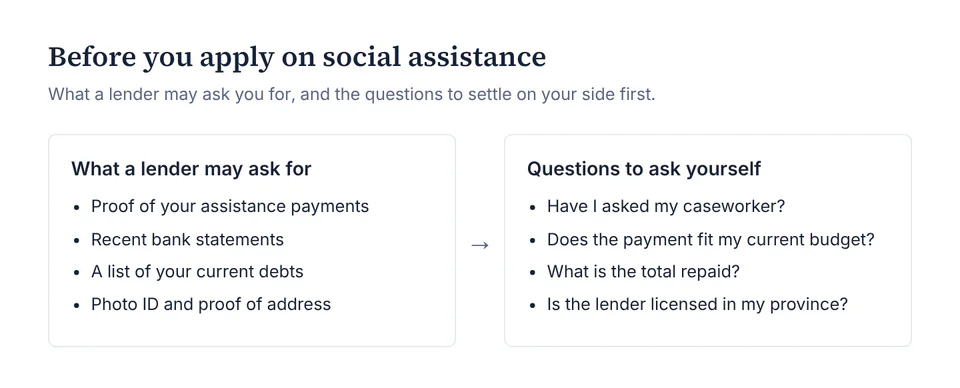
Before you apply on social assistance
What a lender may ask you for, and the questions to settle on your side first.
What a lender may ask for
- Proof of your assistance payments
- Recent bank statements
- A list of your current debts
- Photo ID and proof of address
Questions to ask yourself
- Have I asked my caseworker?
- Does the payment fit my current budget?
- What is the total repaid?
- Is the lender licensed in my province?
We have no connection with any provincial social assistance program or the offices that run them.

How it works
Your request, in three steps
You answer a few questions
The amount, your province, your situation. About two minutes.
We review your request
If your profile fits, we may forward it to lenders and financial partners who may be able to respond.
You review the offer, or not
No obligation to accept. Most lenders pay out within 24 to 48 hours after approval.
Part of: Loans on benefits: what lenders count and what the law protects
Other situations
- ODSP loans: how a loan is treated on the Ontario Disability Support ProgramHow ODSP treats a loan under directive 5.10, how income support is protected, and what to ask your caseworker first.
- Manitoba EIA loans: borrowing on Employment and Income AssistanceHow EIA is paid, what a lender may review, how to check a lender in Manitoba, and why EIA should hear about a loan first.
- Ontario Works loans: what to know before you borrow on OWWhen Ontario Works can exempt a loan, how assistance is protected from seizure, and the questions to ask first.
Frequently asked questions
- Can a loan reduce my social assistance payments?
- We cannot answer that question. Each province sets its own social assistance rules. Ask your caseworker or your provincial social assistance office before you borrow, and keep their answer in writing.
- Do lenders count social assistance as income?
- It depends on the lender. Each one decides which income it counts and how it weighs it against your expenses and debts. We cannot tell you in advance what a lender will decide.
- Will the money come by e-transfer?
- The payment method varies by lender. Most lenders pay out within 24 to 48 hours after approval, but no timing is guaranteed, and the way the money is sent does not change the cost of the loan.
- Does your service cost me anything?
- No. Our service is free for you, and we will never ask you for a payment. The details: How we get paid.
The getaloannow.ca editorial team
Writing and fact-checking · Official sources, cited and dated · Regularly updated content
Our guides are written and checked against official sources (provincial regulators, FCAC, Canada.ca), cited and dated on every page. They explain how borrowing works in Canada and are not personalized financial advice.
Published November 26, 2026 · Updated November 26, 2026
Representative example
- Amount
- $2,000
- Term
- 24 months
- Monthly payment
- $111.78
- Total repaid
- $2,682.83
- Cost of borrowing
- $682.83
- Rate
- 29.96% APR
The annual percentage rate (APR) includes the cost of borrowing. The annual rate of a personal loan cannot exceed 35% APR (Criminal Code). In British Columbia and Manitoba, a lender also needs a high-cost credit licence above 32% (32% or more in Alberta): see your province page. Actual terms are set by the lender.
getaloannow.ca is not a lender. We are a loan matching service: we receive your request and may forward it to lenders and financial partners who may be able to respond. We do not lend money and make no credit decisions.
Who may receive your request
To lenders and financial partners who may be able to respond, and only if your profile fits. The list of recipients will be published before any request is forwarded. Who they are, our conditions and how to check a licence