Payday loans on benefits: what to know before you borrow
By the getaloannow.ca editorial team · Writing and fact-checking
Updated November 26, 2026 · Written from the sources listed at the bottom of the page
Payday loans on benefits are often marketed to people whose income is ODSP, Ontario Works, AISH, BC assistance, CPP, EI or the Canada Child Benefit. The loan itself is the same product as for anyone else: a small, short-term loan, usually repaid in one payment on your next deposit. What changes is what that repayment can do to a fixed monthly income, and, for provincial assistance, to your eligibility. This guide sets out the cost rules, the effect a loan can have on assistance, what the law protects, and the cheaper options to look at first.
getaloannow.ca is not affiliated with any government or benefit program, and is not a lender: it makes no lending decisions. With a payday loan, what counts is the lender's own provincial licence and its written agreement.
In Ontario, British Columbia, Alberta, Saskatchewan and Manitoba, the total cost of a payday loan is capped at $14 per $100 advanced since January 1, 2025 (Criminal Interest Rate Regulations, s. 3). The FCAC notes that this is about 365% on an annual basis over 14 days.
On some provincial programs, a loan can be counted as income or as an asset. Ask your caseworker or the program before you sign.
How a payday loan works when you are paid once a month
A payday loan is designed to be repaid on your next payday. When your income is a benefit, the next payday is your next deposit. If your benefit arrives once a month, the lender usually expects the whole amount, plus the cost of borrowing, out of that single deposit. That deposit also has to cover rent, food and bills for the month ahead.
This is the core problem. A loan taken to cover a gap this month takes a large share of next month's income, which can create a new gap. The Financial Consumer Agency of Canada (FCAC) describes payday loans as a very expensive way to borrow, and that cost weighs more heavily on a fixed income that cannot rise to absorb it.
Before going further, read our overview of how payday loans work and what they cost, and the payday loan rules in each province, which sets out licences, limits and cancellation rights.
What a payday loan costs
Section 347.1 of the Criminal Code exempts a payday loan from the 35% criminal rate only if it is for $1,500 or less, for 62 days or less, and made by a lender licensed in a designated province. In those provinces, the total cost of borrowing is capped at $14 for every $100 advanced, fees included, since January 1, 2025.
The FCAC's example of the cost of borrowing $300 for 14 days with a payday loan, against $5.92 on a line of credit, $7.42 with overdraft protection and $7.65 as a credit card cash advance (FCAC example, based on its own rate assumptions).
A missed repayment adds its own costs. In Ontario, a lender can charge at most $20 for a dishonoured payment, once. In British Columbia, the regulation allows default interest of 30% a year on the unpaid principal and a single $20 fee for a returned cheque or pre-authorized debit. In Saskatchewan, the FCAA allows default interest of up to 30% a year and one NSF charge of up to $25. Your bank may charge its own fee on top.
The risk to your assistance
For provincial assistance, the question is not only whether you can repay. A loan can also change the support you receive. What the official policies say:
- ODSP: under directive 5.10, a loan that is not authorized and used for an approved purpose is treated as non-earned income and deducted from your income support.
- Ontario Works: under directive 5.9, an administrator may approve a loan, or part of one, as exempt income for listed purposes, such as first and last month's rent or necessary household items. Ask before you borrow.
- BC income and disability assistance: the ministry's manual says loan funds are not income, but once received they are a cash asset, and you can become ineligible if your assets go above your family's asset level.
- AISH, ADAP and Alberta Income Support, Saskatchewan Income Support, Manitoba EIA: ask the program how a loan would be treated, before you sign.
What the law protects
Several benefits are protected by law. CPP, OAS and EI cannot be assigned or given as security, and such a transaction is void. ODSP and Ontario Works are protected from seizure and garnishment, and BC law exempts income and disability assistance from garnishment and seizure. These protections have limits and exceptions, explained in our guide on whether a lender can take your benefits.
In practice, the main risk is not a seizure. It is the repayment you agreed to, often by pre-authorized debit, coming out of the account where your benefit lands, on the day it lands.
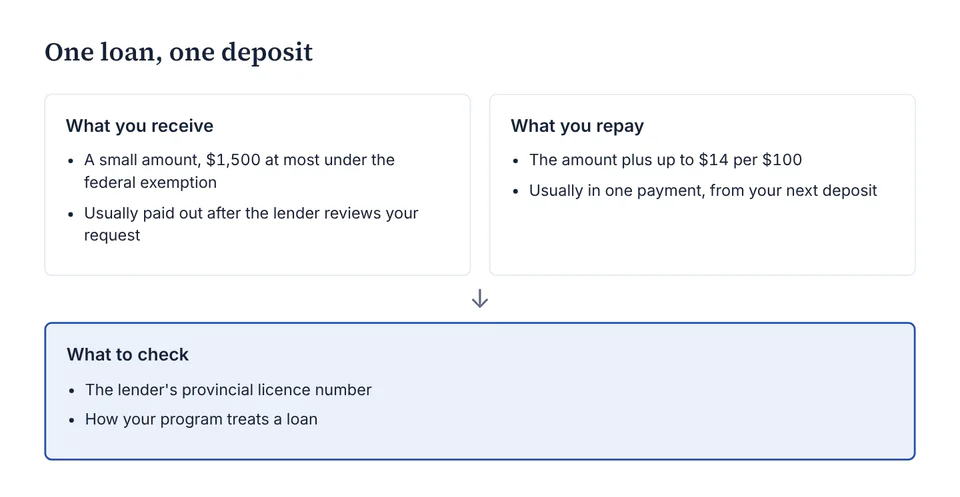
One loan, one deposit
What a payday loan looks like when your income is a monthly benefit.
What you receive
- A small amount, $1,500 at most under the federal exemption
- Usually paid out after the lender reviews your request
What you repay
- The amount plus up to $14 per $100
- Usually in one payment, from your next deposit
What to check
- The lender's provincial licence number
- How your program treats a loan
In plain terms: a payday loan repaid from a monthly benefit takes a large share of next month's money, and on provincial assistance it can also affect your support.
Be wary of offers of payday loans for people on benefits with “instant approval” or “no credit check”: no lender can promise a yes before reviewing your situation, and the first thing to check is the lender's provincial licence.
Who you are dealing with
Ontario warns about websites that present themselves as online payday lenders but collect personal information and sell it to a lender, with a risk of identity theft. Ontario also tells borrowers not to take a payday loan without seeing an Ontario licence number, even online. That advice applies everywhere: whatever website you start from, check the licence of the lender that actually makes the loan, in your province's public search, and read its agreement before you sign.
We say it plainly: getaloannow.ca is a loan matching service. It does not lend, does not approve or decline anyone, and does not set any cost. The lender's licence and its written agreement are what count.
Cheaper options to look at first
The FCAC lists several options that usually cost less than a payday loan: a line of credit, overdraft protection, a credit card cash advance (interest starts right away, on top of the advance fee), a small loan from a bank or credit union, an advance from family, or an advance on pay from an employer. Our guide to alternatives to payday loans goes through each one.
Some apps also offer small advances. Bree's help centre says it can count government benefits such as ODSP, Ontario Works, CPP, the Canada Child Benefit and EI as income. These apps have their own fees and conditions, and their rules depend on the province: our page on cash advance apps sets out what their own sites say.
Free help
A non-profit credit counsellor can look at your situation at no cost, including before you borrow. The Credit Counselling Canada directory lists accredited non-profit agencies in each province, such as Credit Canada in Ontario, the Credit Counselling Society in British Columbia and Saskatchewan, Money Mentors in Alberta and Community Financial Counselling Services in Manitoba. The FCAC also has a free budget planner.
Frequently asked questions
- Can I get a payday loan if my only income is a benefit?
- Each lender sets its own criteria and decides on its own whether a benefit counts as income. Before you apply, ask the program how a loan would affect your support, and work out how much of your next deposit the repayment would take.
- Will a payday loan reduce my ODSP?
- It can. Under ODSP directive 5.10, a loan that is not authorized and used for an approved purpose is treated as non-earned income and deducted from income support. Talk to your caseworker first.
- Can I cancel a payday loan after signing?
- Yes, within a short period that depends on the province: in Ontario, two business days without penalty; in British Columbia, within 2 days at no cost; in Alberta, a two-day cancellation period; in Manitoba, 48 hours, Sundays and holidays excluded; in Saskatchewan, until the end of the next business day, by repaying the amount advanced.
- Does the $14 per $100 cap apply in every province?
- It applies to payday loans made by licensed lenders in the provinces with a designated payday loan regime, which include Ontario, British Columbia, Alberta, Saskatchewan and Manitoba. Outside that exemption, a loan remains subject to the 35% criminal rate.
Sources
- Payday loans, Financial Consumer Agency of Canada (checked on October 30, 2026)
- Criminal Interest Rate Regulations (SOR/2024-114), section 3, Canada Gazette, Part II (checked on October 28, 2026)
- Criminal Code, section 347.1, Justice Canada (checked on October 28, 2026)
- Payday loans: your rights, Government of Ontario (checked on October 30, 2026)
- Payday Loans Regulation, B.C. Reg. 57/2009, Government of British Columbia (checked on October 30, 2026)
- Payday loans, Government of Alberta (checked on October 30, 2026)
- Borrowing from a payday lender: what you need to know, Financial and Consumer Affairs Authority of Saskatchewan (checked on October 30, 2026)
- Payday loans, Government of Manitoba, Consumer Protection Office (checked on October 30, 2026)
- ODSP policy directive 5.10: Loans, Government of Ontario (checked on October 30, 2026)
- Ontario Works policy directive 5.9: Loans, Government of Ontario (checked on October 30, 2026)
- BCEA policy and procedure manual: income treatment and exemptions, Government of British Columbia (checked on October 30, 2026)
- Bree help centre: eligibility, Bree (checked on October 30, 2026)
If you are considering a loan
- Personal loansHow an instalment loan works, repaid over months rather than from one deposit, and what it costs in total.
- Loans on benefits: what lenders count and what the law protectsWhich benefits a lender may count, what federal and provincial law protects, and how a loan can change your assistance.
Related pages
- Can a lender take your benefits? What the law saysWhat the law says about lenders and benefits such as CPP, OAS, EI, the CCB, ODSP, Ontario Works and BC assistance, and where its limits are.
- Benefits and bank verification: what a lender seesHow a lender sees benefit deposits through bank statements or instant bank verification, and what to know about your privacy first.
Where to get help, free of charge
These organizations are non-profit or public bodies, separate from us.
- Credit Counselling CanadaFind a non-profit credit counsellor near you
- Financial Consumer Agency of Canada (FCAC)Tools to make a budget and understand your credit
- Canadian Anti-Fraud CentreReport a request for fees before a loan
The getaloannow.ca editorial team
Writing and fact-checking · Official sources, cited and dated · Regularly updated content
Our guides are written and checked against official sources (provincial regulators, FCAC, Canada.ca), cited and dated on every page. They explain how borrowing works in Canada and are not personalized financial advice.
Published November 26, 2026 · Updated November 26, 2026