EI payment dates: how Employment Insurance timing works
By the getaloannow.ca editorial team · Writing and fact-checking
Updated November 26, 2026 · Written from the sources listed at the bottom of the page
People looking for EI payment dates often expect a calendar like the one for pensions or child benefits. Employment Insurance works differently: Canada.ca does not publish fixed payment dates for EI. Each payment follows the report you complete every two weeks. This page explains, from Canada.ca's own pages, how that timing works, when the first payment usually comes, and what to do if a payment is late.
getaloannow.ca is not affiliated with the Government of Canada or Service Canada. What follows comes from Canada.ca's Employment Insurance reporting pages, checked on October 30, 2026.
EI is paid every two weeks, after each biweekly report. A report must be submitted at the end of the period it covers before payment can be issued, so your dates depend on your own reporting cycle.
Canada.ca says the first payment usually arrives about 28 days after you apply, if you are eligible and have provided all the required information.
How EI payment timing works
There is no single EI payment date for everyone. Your payments follow the two-week periods of your own claim, and each one is released only once you have completed the report for that period. The table brings together what Canada.ca says about each step.
| Step | What Canada.ca says |
|---|---|
| First payment | About 28 days after you apply, if you are eligible and have provided all required information |
| Reports | Every two weeks; a report must be submitted at the end of the period it covers before payment can be issued |
| Processing | Each evening from Sunday to Thursday; a report filed on a Friday or Saturday shows payment information on Monday |
| Direct deposit | Generally 2 to 3 business days after you complete your report |
On the delay after a report, Canada.ca's pages do not all use the same words: the reporting page mentions 2 to 3 business days for a direct deposit, while other pages mention two business days after an Internet or telephone report. The safe reading is that a direct deposit generally arrives 2 to 3 business days after you complete your report, and that it can take longer.
Because the timing depends on your reporting cycle, no general table of EI dates for 2026 or 2027 can be accurate for your claim. The dates that apply to you appear in your My Service Canada Account, once each report is processed.
If your EI payment is late
First check that your last report was completed and accepted, and note the day you filed it: a report filed on a Friday or Saturday is processed on Monday. Then check your payment information in My Service Canada Account. If a payment is still missing after the usual delay, contact Service Canada using the contact options on Canada.ca. Only Service Canada can tell you whether a payment is on hold and why.
Free help with your budget
A gap between your last pay and your first EI payment is one of the hardest stretches to plan. The Financial Consumer Agency of Canada (FCAC) has a free budget planner to work out which bills can wait and which cannot. A non-profit credit counsellor can also look at your situation with you at no cost: the Credit Counselling Canada directory lists accredited non-profit agencies across the country. The FCAC suggests checking whether the first meeting is free before you commit.
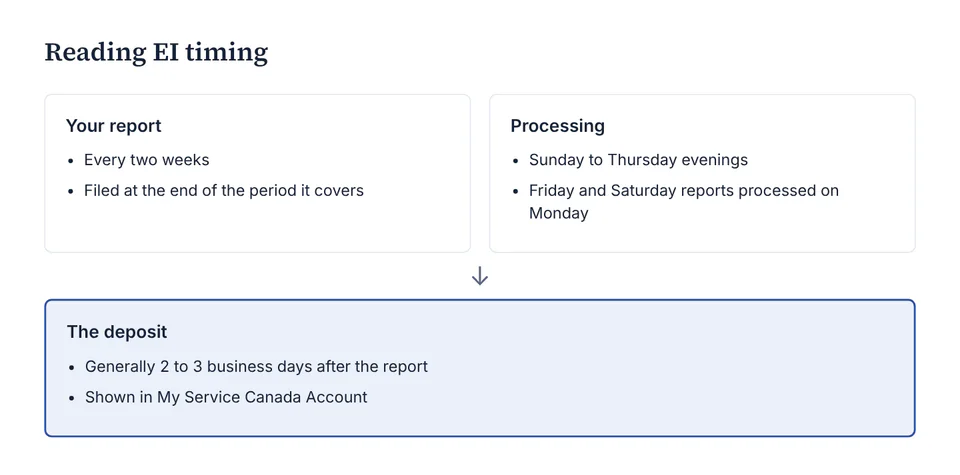
Reading EI timing
Three things set the date of an EI payment.
Your report
- Every two weeks
- Filed at the end of the period it covers
Processing
- Sunday to Thursday evenings
- Friday and Saturday reports processed on Monday
The deposit
- Generally 2 to 3 business days after the report
- Shown in My Service Canada Account
In plain terms: file your report as soon as the period ends, and count on a few business days before the money is in your account.
Before you borrow while waiting for EI
Section 42(1) of the Employment Insurance Act says EI benefits cannot be assigned, charged, attached, anticipated or given as security, and that any transaction appearing to do so is void. Amounts owed to the EI Operating Account can still be recovered from your benefits. Our guide on whether a lender can take your benefits explains these rules.
If you have lost your job and your EI has not started yet, our page on loans when you are unemployed explains how lenders view a gap in income, and what to weigh before taking on a repayment.
If you still need to borrow once your budget is clear, our page on borrowing while on EI explains how lenders view Employment Insurance as income and what an instalment loan costs in total.
Frequently asked questions
- Is there a 2026 EI payment calendar?
- No. Canada.ca does not publish fixed EI payment dates. Payments follow your biweekly reports, so the dates are specific to each claim and appear in My Service Canada Account.
- How long after my EI report will I be paid?
- Canada.ca says a direct deposit generally arrives 2 to 3 business days after you complete your report; some of its pages say two business days. A report filed on a Friday or Saturday is processed on Monday.
- When will I get my first EI payment?
- According to Canada.ca, about 28 days after you apply, if you are eligible and have provided all the required information. Missing information can delay it.
Sources
- Employment Insurance reporting, Government of Canada (checked on October 30, 2026)
- EI regular benefits: after applying, Government of Canada (checked on October 30, 2026)
- Digest of Benefit Entitlement Principles, chapter 1: payment of benefit, Employment and Social Development Canada (checked on October 30, 2026)
- My Service Canada Account: Employment Insurance, Employment and Social Development Canada (checked on October 30, 2026)
- Employment Insurance Act, section 42, Justice Canada (checked on October 30, 2026)
- Making a budget, Financial Consumer Agency of Canada (checked on October 30, 2026)
If you are considering a loan
- Loans on EIHow lenders view Employment Insurance as income, and the total cost of a loan.
- Loans on benefits: what lenders count and what the law protectsWhich benefits a lender may count, what federal and provincial law protects, and how a loan can change your assistance.
Related pages
- CPP and OAS payment dates for 2026The 2026 payment dates shared by the Canada Pension Plan, CPP disability and Old Age Security, published by Service Canada.
- Canada Child Benefit payment dates for 2026The 2026 Canada Child Benefit payment dates published by the Canada Revenue Agency, and the rule of the 20th.
- ODSP payment dates for 2026The 2026 ODSP payment dates published by the Government of Ontario, and what to do if a payment does not arrive.
Where to get help, free of charge
These organizations are non-profit or public bodies, separate from us.
- Credit Counselling CanadaFind a non-profit credit counsellor near you
- Financial Consumer Agency of Canada (FCAC)Tools to make a budget and understand your credit
- Canadian Anti-Fraud CentreReport a request for fees before a loan
The getaloannow.ca editorial team
Writing and fact-checking · Official sources, cited and dated · Regularly updated content
Our guides are written and checked against official sources (provincial regulators, FCAC, Canada.ca), cited and dated on every page. They explain how borrowing works in Canada and are not personalized financial advice.
Published November 26, 2026 · Updated November 26, 2026