Can a lender take your benefits? What the law says
By the getaloannow.ca editorial team · Writing and fact-checking
Updated November 26, 2026 · Written from the sources listed at the bottom of the page
Can a lender take your benefits? For several federal and provincial benefits, the law gives a clear answer: they cannot be seized by a private creditor, and an agreement that hands them over as security is void. But the protection is not the same for every program, it has exceptions, and it does not cover everything that can happen to the money once it reaches your bank account. This guide sets out what the texts say, program by program, what they do not settle, and where to get help.
getaloannow.ca is not affiliated with any government or benefit program and does not give legal advice. This guide quotes the official texts; for your own situation, ask a legal clinic or the program.
CPP and OAS cannot be assigned or given as security, any such transaction is void, and they are exempt from seizure. EI cannot be assigned or given as security. ODSP, Ontario Works and BC assistance are protected from seizure and garnishment.
Most loan repayments are not seizures: they are payments you authorized, often by pre-authorized debit, from the account your benefit is deposited into.
Federal benefits
Canada Pension Plan and Old Age Security
Section 65(1) of the Canada Pension Plan says a benefit “shall not be assigned, charged, attached, anticipated or given as security”, and that any transaction purporting to do so is void. Section 65(1.1) adds that a benefit is exempt from seizure and execution, either at law or in equity. Section 36 of the Old Age Security Act uses the same wording for OAS.
Both sections allow one exception: the minister can withhold an amount for a provincial or municipal authority that paid an advance or social assistance for the same period.
These protections are aimed at private creditors, and they have limits beyond the texts themselves:
- The Canada Revenue Agency can ask a federal department to redirect money it owes you, CPP and OAS included, to pay a tax debt.
- The federal regulation on garnishment for family support orders lists OAS among the amounts that can be garnished for support.
Employment Insurance
Section 42(1) of the Employment Insurance Act says benefits cannot be assigned, charged, attached, anticipated or given as security, and that any transaction appearing to do so is void. Section 42(2) allows amounts owed to the EI Operating Account to be recovered from your benefits. The other limits of this protection, including family support, are not set out here: ask a legal clinic or Service Canada.
Canada Child Benefit
According to the Office of the Superintendent of Bankruptcy, subsection 122.61(4) of the Income Tax Act says the CCB is not subject to any law relating to bankruptcy or insolvency, cannot be assigned, charged, attached or given as security, cannot be retained by way of deduction or set-off under the Financial Administration Act, and is not garnishable for the purposes of the Family Orders and Agreements Enforcement Assistance Act.
Provincial assistance
Ontario: ODSP and Ontario Works
ODSP policy directive 5.16 cites section 18 of the ODSP Act: income support is not subject to garnishment, attachment, execution, seizure or receivership under any other Act. The directive adds that this applies even if the income support has been paid into an account at a financial institution, and that the recipient cannot assign or transfer income support. The exceptions are support deduction orders enforced by the Family Responsibility Office and the recovery of overpayments.
Ontario Works policy directive 6.15 says assistance is protected from seizure, garnishment, attachment, execution and receivership, unless a support deduction order is being enforced by the Family Responsibility Office.
British Columbia
Section 29(1) of the Employment and Assistance Act says income assistance, hardship assistance and supplements are exempt from garnishment, attachment, execution or seizure under any Act. Section 20 of the Employment and Assistance for Persons with Disabilities Act says the same of disability assistance. Section 29(2) of the first Act still allows the province to deduct or set off amounts under that Act, the Financial Administration Act or another prescribed enactment.
Alberta, Saskatchewan and Manitoba
For AISH, ADAP, Alberta Income Support, Saskatchewan Income Support and Manitoba EIA, this guide does not state a rule on seizure or assignment. Do not assume the Ontario or BC rule applies: ask a legal clinic or the program directly.
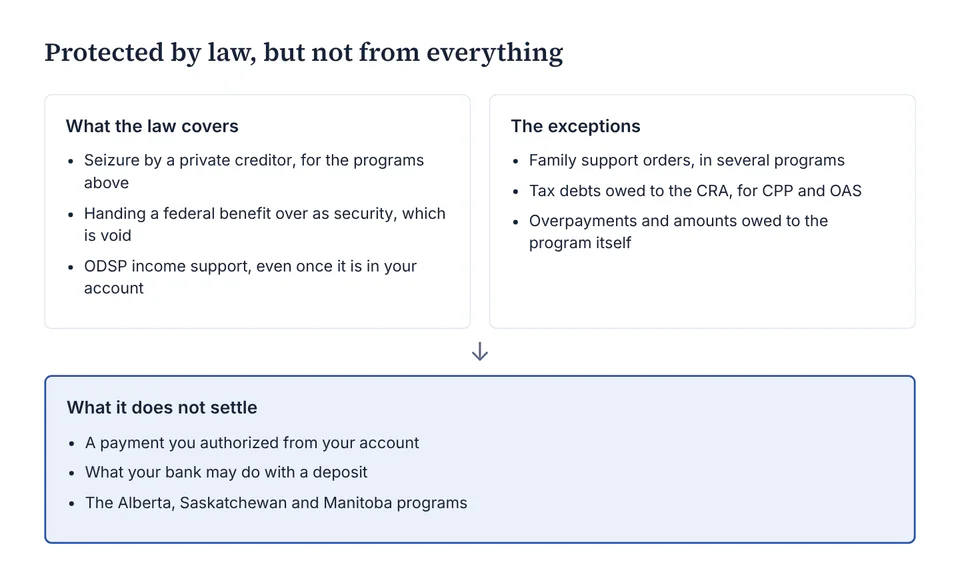
Protected by law, but not from everything
What the texts above cover, and what they leave open.
What the law covers
- Seizure by a private creditor, for the programs above
- Handing a federal benefit over as security, which is void
- ODSP income support, even once it is in your account
The exceptions
- Family support orders, in several programs
- Tax debts owed to the CRA, for CPP and OAS
- Overpayments and amounts owed to the program itself
What it does not settle
- A payment you authorized from your account
- What your bank may do with a deposit
- The Alberta, Saskatchewan and Manitoba programs
In plain terms: a lender cannot seize these benefits through the courts, but money you agreed to pay can still leave your account on the due date.
Pre-authorized debits: the practical risk
Many loan agreements include a pre-authorized debit: you authorize the lender to withdraw each payment from your bank account on the due date. That is not a seizure; it is a payment you agreed to. If your benefit is deposited into the same account, the debit can take a large share of it on the day it arrives, before rent and bills are paid.
If the account does not hold enough money, the payment can be refused, and fees can follow: in Ontario, a payday lender can charge at most $20 for a dishonoured payment, and your bank may add its own fee. How to stop or dispute a pre-authorized debit depends on your agreement and your bank: read the agreement before you sign, and ask your bank what applies.
Whether a bank can use a deposited benefit to pay a debt you owe that same bank is not set out in a general official statement. The one point established in this guide is ODSP directive 5.16, which keeps the protection after the money is deposited. If it happens to you, contact a legal clinic.
If you already owe more than your benefit can carry
If repayments are taking most of each deposit, there are steps that do not involve a new short-term loan. Our guide on getting out of payday loan debt sets out the steps to take, one repayment at a time. Our page on consolidating debts into one loan explains when a single instalment loan can replace several repayments, and what it costs in total.
If your credit has suffered from missed payments, our page on loans when you have bad credit explains what lenders look at and what to check before you sign. On provincial assistance, ask the program first how a loan would be treated: ODSP directive 5.10, for example, treats an unauthorized loan as non-earned income.
Where to get help
- A community legal clinic or legal aid office in your province, for a question about your rights.
- Your caseworker or the program itself, for how a loan or a debit affects your benefit.
- A non-profit credit counsellor, at no cost: the Credit Counselling Canada directory lists accredited agencies in each province.
- The FCAC's free budget planner, to see what your benefit can carry.
Frequently asked questions
- Can a payday lender take my CPP or OAS?
- A private creditor cannot seize CPP or OAS: sections 65 and 36 of the federal Acts exempt them from seizure and make any assignment or security void. But a repayment you authorized by pre-authorized debit can still be withdrawn from your account.
- Is ODSP protected once it is in my bank account?
- Yes, according to ODSP directive 5.16: the protection from seizure and garnishment applies even if the income support has been paid into an account at a financial institution. Support deduction orders are an exception.
- Can I give my benefit to a lender as security for a loan?
- For CPP, OAS and EI, federal law says any transaction that gives a benefit as security is void. For the CCB, the OSB states that it cannot be given as security. ODSP income support cannot be assigned or transferred.
- What about AISH or Saskatchewan Income Support?
- This guide does not state a rule for AISH, ADAP, Alberta Income Support, Saskatchewan Income Support or Manitoba EIA. Ask a legal clinic or the program.
Sources
- Canada Pension Plan, section 65, Justice Canada (checked on October 30, 2026)
- Old Age Security Act, section 36, Justice Canada (checked on October 30, 2026)
- Employment Insurance Act, section 42, Justice Canada (checked on October 30, 2026)
- Canada Child Benefit (formerly Universal Child Care Benefits), Office of the Superintendent of Bankruptcy (checked on October 30, 2026)
- Garnishing: when you owe money to the CRA, Canada Revenue Agency (checked on October 30, 2026)
- Family Support Orders and Agreements Garnishment Regulations (SOR/88-181), Justice Canada (checked on October 30, 2026)
- ODSP policy directive 5.16: Income support protected from seizure or garnishment, Government of Ontario (checked on October 30, 2026)
- Ontario Works policy directive 6.15: Protection from seizure or garnishment, Government of Ontario (checked on October 30, 2026)
- Employment and Assistance Act, Government of British Columbia (checked on October 30, 2026)
- Employment and Assistance for Persons with Disabilities Act, Government of British Columbia (checked on October 30, 2026)
- Payday loans: your rights, Government of Ontario (checked on October 30, 2026)
- Getting help from a credit counsellor, Financial Consumer Agency of Canada (checked on October 30, 2026)
If you are considering a loan
- Debt consolidationReplacing several repayments with one instalment loan, and what it costs in total.
- Loans on benefits: what lenders count and what the law protectsWhich benefits a lender may count, what federal and provincial law protects, and how a loan can change your assistance.
Related pages
- Benefits and bank verification: what a lender seesHow a lender sees benefit deposits through bank statements or instant bank verification, and what to know about your privacy first.
- Payday loans on benefits: what to know before you borrowWhat a payday loan means when your income is a benefit: the single repayment, the cost cap, the effect on assistance and the alternatives.
Where to get help, free of charge
These organizations are non-profit or public bodies, separate from us.
- Credit Counselling CanadaFind a non-profit credit counsellor near you
- Financial Consumer Agency of Canada (FCAC)Tools to make a budget and understand your credit
- Canadian Anti-Fraud CentreReport a request for fees before a loan
The getaloannow.ca editorial team
Writing and fact-checking · Official sources, cited and dated · Regularly updated content
Our guides are written and checked against official sources (provincial regulators, FCAC, Canada.ca), cited and dated on every page. They explain how borrowing works in Canada and are not personalized financial advice.
Published November 26, 2026 · Updated November 26, 2026