Child tax benefit loans: what the Canada Child Benefit can and cannot do
By the getaloannow.ca editorial team · Writing and fact-checking · updated November 26, 2026
People who search for child tax benefit loans usually mean one thing: borrowing when the Canada Child Benefit (CCB) is a large part of the household's income. The CCB can be declared as income on a loan request, but it cannot be signed over to a lender, and whether a lender takes it into account is that lender's own decision.
This page explains what the CCB is, how federal law protects it, what a lender may look at, and why a loan should be measured against the years your children will still receive it.
getaloannow.ca is not a lender. We are a loan matching service. We do not lend money and make no credit decisions. Our role
- Two minutesAbout two minutes to fill in the request.
- No SIN requiredWe never collect your social insurance number.
- Your credit file is not affectedFilling in our form does not touch your credit file. A lender that reviews your request may check it.
- Free for youWe never charge you anything.
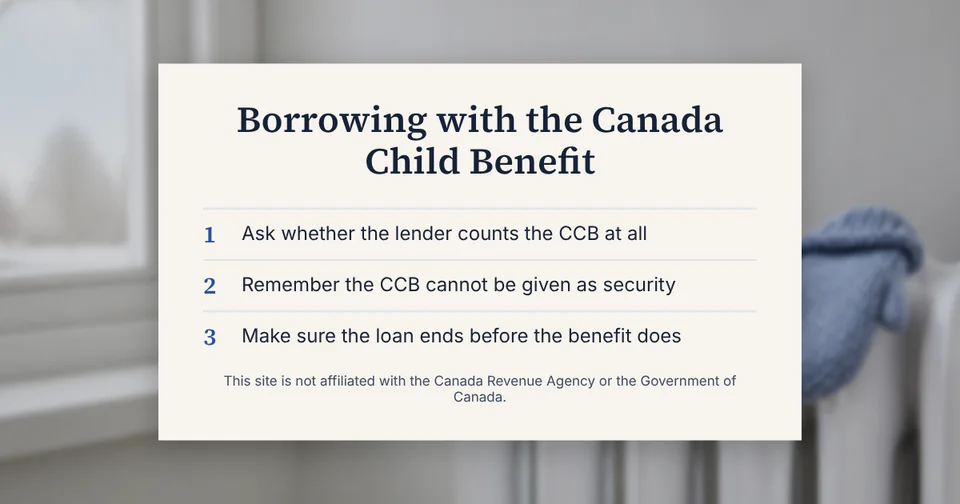
The CCB is income you can declare. A lender may count it, count part of it or leave it out. getaloannow.ca is not affiliated with the Canada Revenue Agency or the Government of Canada.
According to the Office of the Superintendent of Bankruptcy, the CCB cannot be assigned, charged, attached or given as security (Income Tax Act, s. 122.61(4)).
The CCB is for children under 18. A loan that runs past a child's 18th birthday relies, for its last months, on income your household will no longer have.
What the Canada Child Benefit is
The Canada Revenue Agency (CRA) describes the CCB as “a tax-free monthly payment for eligible families to help with the cost of raising children under 18 years of age.” The CRA generally pays it on the 20th of each month; when the 20th falls on a weekend or a federal holiday, the payment is made on the last business day before. In 2026, the November payment is on November 20 and the December payment on December 11.
The CRA recommends direct deposit, which it calls “the fastest and most secure way to get your benefit payments.” The full year of dates is on our page of Canada Child Benefit payment dates.
How the law protects the CCB
The Office of the Superintendent of Bankruptcy, a federal body, summarizes the protection set out in subsection 122.61(4) of the Income Tax Act. The CCB:
- Is not subject to any law relating to bankruptcy or insolvency.
- Cannot be assigned, charged, attached or given as security.
- Cannot be retained by way of deduction or set-off under the Financial Administration Act.
- Is not garnishable moneys under the Family Orders and Agreements Enforcement Assistance Act.
In practice, a lender cannot validly ask you to pledge your CCB as security for a loan. That protection does not make a debt disappear, though: a loan you sign remains owed, with its interest and fees. To understand what creditors can and cannot reach across federal and provincial benefits, read whether a lender can take your benefits.
Whether a lender may consider it
A lender looks at whether you can repay over the whole term of the loan. It may review all the income you declare, including the CCB, along with your rent, your other expenses and the debts you already carry. Some lenders may count the CCB, others may count only part of it, others may not count it at all. We cannot tell you in advance how a lender will treat it.
What a lender may ask for
- Your CCB notice or a recent statement from the CRA.
- Recent bank statements that show the deposits.
- Proof of any other income in the household.
- A list of your current debts, with balances and monthly payments.
The risks for a household budget
The CCB is meant for the cost of raising children: food, clothing, school, child care. When a loan payment takes part of it, those costs do not go away. Before you borrow, set the monthly payment and the total repaid against a full month of family spending, not against the deposit alone. A loan calculator shows how the payment and the total change with the term.
- Children grow up. The CCB stops for a child who turns 18. Check whether the loan term ends before that date for each child whose benefit you count on.
- A longer term costs more. A smaller payment over more months means a higher total repaid.
- One loan to pay another. Borrowing to cover an existing debt adds a second cost of borrowing. If several debts already weigh on the budget, debt consolidation works differently, and a credit counsellor can help you weigh it.
If you raise your children alone, the pressure on a single income is real, and so are the options. Our page on loans for single parents covers what a lender may review when one income carries the household.
Free help before you borrow
A non-profit credit counsellor can look at the whole budget with you, at no cost for a first meeting with a reputable agency, according to the Financial Consumer Agency of Canada (FCAC). Credit Counselling Canada keeps a directory of non-profit credit counsellors, and the FCAC publishes free guidance on making a budget.
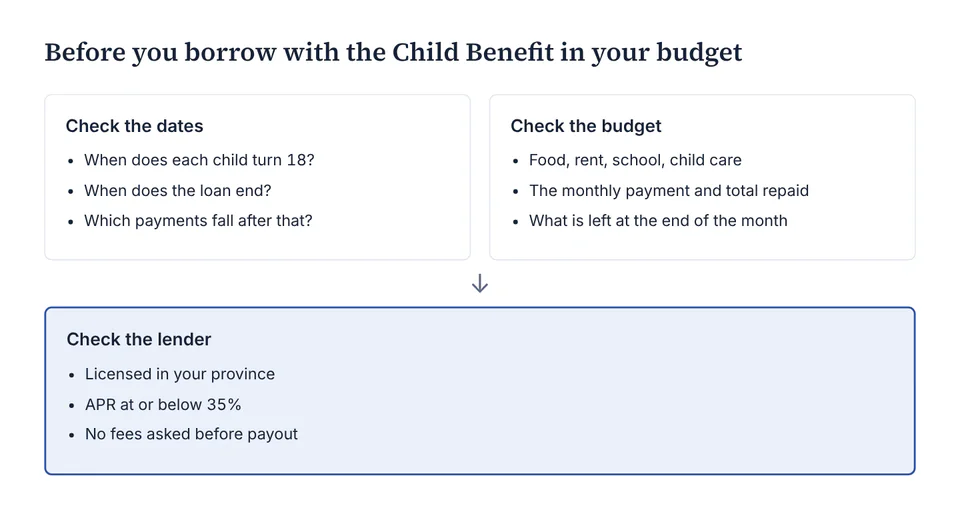
Before you borrow with the Child Benefit in your budget
Three checks that take ten minutes and can save a year of tight months.
Check the dates
- When does each child turn 18?
- When does the loan end?
- Which payments fall after that?
Check the budget
- Food, rent, school, child care
- The monthly payment and total repaid
- What is left at the end of the month
Check the lender
- Licensed in your province
- APR at or below 35%
- No fees asked before payout
In plain terms: the CCB can be part of the income you declare, but it cannot be pledged, and the loan must still fit the family budget after the payment.
Part of: Loans on benefits: what lenders count and what the law protects
Other federal benefits
- CPP disability loans: borrowing when your income is a CPP disability benefitWhether a lender may count the CPP disability benefit, how the Canada Pension Plan protects it, and the exceptions to know.
- Loans for retirees: borrowing on a pension incomeLoans for retirees in Ontario, BC, Alberta, Saskatchewan and Manitoba: how pension income may be reviewed, what to prepare, and what to check first.
- Loans on EI: borrowing while your benefits lastConsidering loans on EI? What a lender may review when your income is Employment Insurance, what to prepare, and what to ask Service Canada first.
Frequently asked questions
- Can I get a loan using my child tax benefit?
- You can declare the Canada Child Benefit as income on a loan request. Whether a lender counts it is that lender's decision. The CCB itself cannot be assigned or given as security for the loan.
- Can a lender take my Canada Child Benefit if I miss payments?
- According to the Office of the Superintendent of Bankruptcy, the CCB cannot be attached and is not garnishable moneys under the federal family orders law. The debt itself remains, with its interest and fees, so talk to the lender or a credit counsellor before you fall behind.
- When is the next CCB payment?
- The CRA generally pays the CCB on the 20th. In 2026, the remaining payments are on November 20 and December 11. The CRA has not yet published its 2027 dates.
- Is getaloannow.ca connected to the Canada Revenue Agency?
- No. getaloannow.ca is a loan matching service and has no connection with the CRA or any benefit program. Questions about your CCB go to the CRA.
Who may receive your request
To lenders and financial partners who may be able to respond, and only if your profile fits. The list of recipients will be published before any request is forwarded. Who they are, our conditions and how to check a licence
Representative example
- Amount
- $2,000
- Term
- 24 months
- Monthly payment
- $111.78
- Total repaid
- $2,682.83
- Cost of borrowing
- $682.83
- Rate
- 29.96% APR
The annual percentage rate (APR) includes the cost of borrowing. The annual rate of a personal loan cannot exceed 35% APR (Criminal Code). In British Columbia and Manitoba, a lender also needs a high-cost credit licence above 32% (32% or more in Alberta): see your province page. Actual terms are set by the lender.
Sources
- Canada Child Benefit: overview, Canada Revenue Agency (checked on October 30, 2026)
- Canada Child Benefit payment dates, Canada Revenue Agency (checked on October 30, 2026)
- Canada Child Benefit (formerly Universal Child Care Benefits), position paper, Office of the Superintendent of Bankruptcy (checked on October 30, 2026)
- Getting help from a credit counsellor, Financial Consumer Agency of Canada (checked on October 30, 2026)
The getaloannow.ca editorial team
Writing and fact-checking · Official sources, cited and dated · Regularly updated content
Our guides are written and checked against official sources (provincial regulators, FCAC, Canada.ca), cited and dated on every page. They explain how borrowing works in Canada and are not personalized financial advice.
Published November 26, 2026 · Updated November 26, 2026
Request a personal loan
Two minutes, free of charge. A lender may contact you with its terms, or you may receive no reply.