Benefits and bank verification: what a lender sees
By the getaloannow.ca editorial team · Writing and fact-checking
Updated November 26, 2026 · Written from the sources listed at the bottom of the page
When your income is a benefit, bank verification is often how a lender confirms it. The ODSP, CPP, EI, CCB or other deposits that reach your account each month show up in your bank statements, and some lenders ask to read those statements directly, through a third-party service. This guide explains how lenders see benefit deposits, what instant bank verification shares, what the Financial Consumer Agency of Canada (FCAC) has said about your banking login details, and what to ask before you agree.
getaloannow.ca is not affiliated with any government or benefit program, and does not ask for your online banking login details, your account numbers or your social insurance number.
In March 2018, the FCAC warned that giving your banking login details to a third-party service may breach your account agreement and could leave you liable for losses from unauthorized transactions.
Bank verification is the lender's request, on its own terms. You can ask what will be shared, for how long, and whether other documents are accepted.
How a lender sees a benefit deposit
A benefit paid by direct deposit appears in your account like any other income: a dated deposit, with a description from the payer. Federal and provincial programs encourage direct deposit, and Saskatchewan Income Support requires it unless there is an exceptional circumstance. As a result, your bank statements show the amount and the regular date of each payment, and often the payer.
A lender can see those deposits in two main ways:
- Statements you provide: you download or print your statements and send them to the lender yourself. You choose the period and the account.
- Instant bank verification (IBV): you log in to your bank through a third-party portal, and the lender receives a copy of your statements and transactions.
Either way, the lender sees more than your benefit. Statements also show your other deposits, your regular bills, your other loan repayments and any refused payments. A lender can use them to see what is left after your fixed costs, not only what comes in.
Instant bank verification
With IBV, a provider connects to your online banking with the login details you enter, reads your account history and sends a copy to the lender. How much history is sent depends on the provider and the lender. Our guide to how instant bank verification works explains each step and the questions to ask.
If an offer is advertised as requiring no credit report, ask what the lender reviews instead: our guide on loans advertised with “no credit check” explains what lenders still look at. A lender may also check your credit report; our guide on soft and hard credit checks explains which inquiries affect your score: according to the FCAC, hard inquiries appear on your credit report and affect your score, while soft inquiries do not.
What the FCAC says about your login details
In March 2018, the FCAC reminded consumers of the risks of sharing their banking information with third-party online services:
- Giving your banking login details to a third party may breach your agreement with your financial institution.
- If it does, you could be liable for losses from unauthorized transactions.
- Your data may be stored outside Canada.
- It is prudent to read your account agreement before you agree.
Canada is setting up a framework for sharing banking data at the customer's request, known as consumer-driven banking. Bill C-15, which received royal assent on March 26, 2026, gives oversight and accreditation to the Bank of Canada. Until that framework is in place in practice, the FCAC warning remains the safest guide.
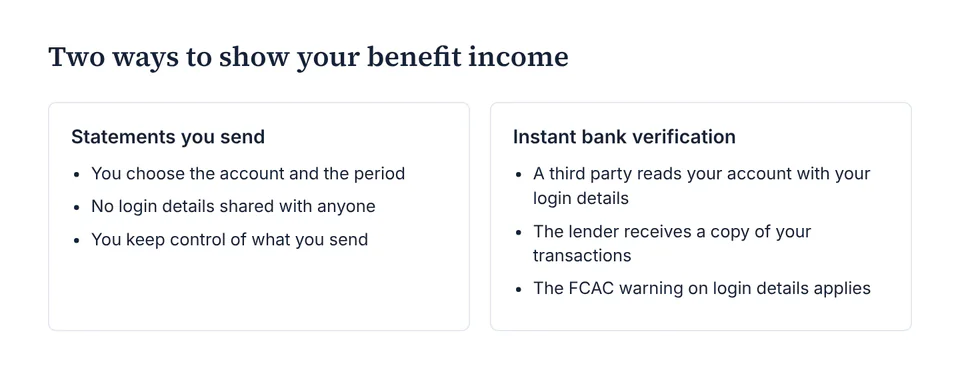
Two ways to show your benefit income
What each option shares with a lender.
Statements you send
- You choose the account and the period
- No login details shared with anyone
- You keep control of what you send
Instant bank verification
- A third party reads your account with your login details
- The lender receives a copy of your transactions
- The FCAC warning on login details applies
In plain terms: both options show the lender your benefit and everything else in the account; IBV adds a third party with access to your online banking.
Be wary of a lender that promises “guaranteed approval” because your benefit is deposited every month: a regular deposit is something a lender looks at, not a promise that it will say yes.
What a lender may ask for
Each lender sets its own requirements. When your income is a benefit, expect questions about the program that pays you, the amount and how often it is paid, and expect to show it, through statements or verification. Before you send anything, ask:
- Which account, and how many months of history, does the lender need?
- Who is the verification provider, and where is the data stored?
- How long will the lender and the provider keep the copy of your statements?
- Does access to your account end once the verification is done?
- Will statements you download yourself be accepted instead?
Stop if a lender asks for a fee before paying out a loan. A legitimate lender does not do that, as government warnings about fake lenders point out. Report it to the Canadian Anti-Fraud Centre.
What the deposits also tell the program
A loan paid into your account shows up in the same statements as your benefit, and it can matter to the program as well as to the lender. On ODSP, directive 5.10 treats a loan that is not authorized for an approved purpose as non-earned income, deducted from income support. In British Columbia, the ministry's manual treats loan funds as a cash asset once received. Ask your caseworker before you borrow.
Free help
A non-profit credit counsellor can review your budget at no cost before you share anything with a lender. The Credit Counselling Canada directory lists accredited non-profit agencies in each province, and the FCAC has a free budget planner.
Frequently asked questions
- Can a lender see that my income is ODSP or CPP?
- Often, yes. A benefit paid by direct deposit appears in your statements, often with the payer's name, so a lender that reads your statements, whether you send them or it uses bank verification, can see where the deposit comes from.
- Do I have to accept instant bank verification?
- No. You can decline. The lender may then ask for other documents, review your request another way or decline it: that decision is its own.
- Does bank verification affect my credit score?
- Bank verification reads your accounts, not your credit report. A lender may also check your credit report. According to the FCAC, a hard inquiry appears on your credit report and affects your score, while a soft inquiry does not.
- Does getaloannow.ca ask for my banking login?
- No. getaloannow.ca does not ask for your online banking login details, your account numbers or your social insurance number, and does not work with any bank verification provider.
Sources
- The FCAC reminds consumers of the risks of sharing banking information with third-party online services (March 2018, French version), Financial Consumer Agency of Canada (checked on October 30, 2026)
- Credit report and score basics, Financial Consumer Agency of Canada (checked on October 30, 2026)
- Saskatchewan Income Support, Government of Saskatchewan (checked on October 30, 2026)
- ODSP policy directive 5.10: Loans, Government of Ontario (checked on October 30, 2026)
- BCEA policy and procedure manual: income treatment and exemptions, Government of British Columbia (checked on October 30, 2026)
- Canadian Anti-Fraud Centre, Government of Canada (checked on October 30, 2026)
- Making a budget, Financial Consumer Agency of Canada (checked on October 30, 2026)
If you are considering a loan
- Personal loansHow an instalment loan works and what it costs in total.
- Loans on benefits: what lenders count and what the law protectsWhich benefits a lender may count, what federal and provincial law protects, and how a loan can change your assistance.
Related pages
- Payday loans on benefits: what to know before you borrowWhat a payday loan means when your income is a benefit: the single repayment, the cost cap, the effect on assistance and the alternatives.
- Can a lender take your benefits? What the law saysWhat the law says about lenders and benefits such as CPP, OAS, EI, the CCB, ODSP, Ontario Works and BC assistance, and where its limits are.
Where to get help, free of charge
These organizations are non-profit or public bodies, separate from us.
- Credit Counselling CanadaFind a non-profit credit counsellor near you
- Financial Consumer Agency of Canada (FCAC)Tools to make a budget and understand your credit
- Canadian Anti-Fraud CentreReport a request for fees before a loan
The getaloannow.ca editorial team
Writing and fact-checking · Official sources, cited and dated · Regularly updated content
Our guides are written and checked against official sources (provincial regulators, FCAC, Canada.ca), cited and dated on every page. They explain how borrowing works in Canada and are not personalized financial advice.
Published November 26, 2026 · Updated November 26, 2026