BC income assistance loans: what a loan changes on your file
By the getaloannow.ca editorial team · Writing and fact-checking · updated November 26, 2026
If you are researching BC income assistance loans, two rules from British Columbia shape everything else. The money from a loan is not counted as income, but once received it is an asset in cash, and too many assets can end your eligibility. And income assistance itself is exempt from garnishment and seizure under the Employment and Assistance Act.
This page explains both rules, the deductions the Act still allows, when assistance is paid, what a lender may look at, and how to check a lender in British Columbia before you sign.
getaloannow.ca is not a lender. We are a loan matching service. We do not lend money and make no credit decisions. Our role
- Two minutesAbout two minutes to fill in the request.
- No SIN requiredWe never collect your social insurance number.
- Your credit file is not affectedFilling in our form does not touch your credit file. A lender that reviews your request may check it.
- Free for youWe never charge you anything.
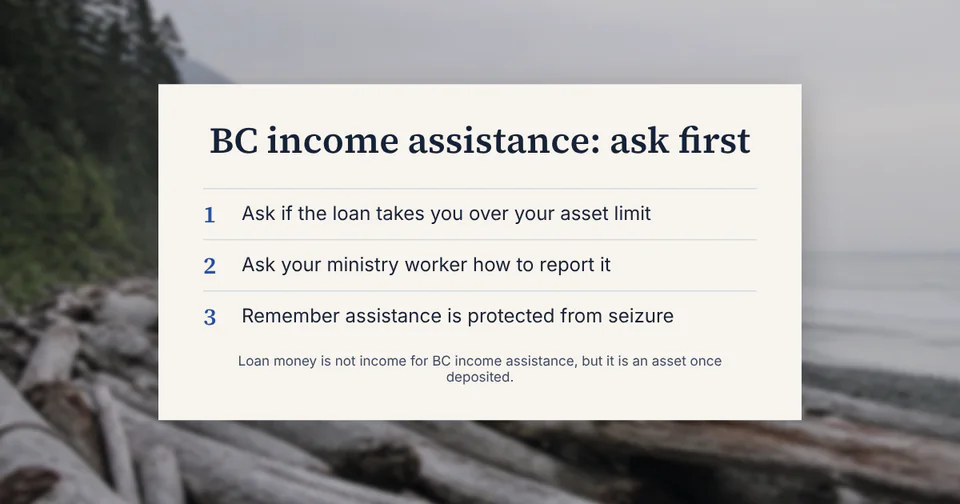
Loan money is not income for BC income assistance, but it is an asset once deposited. getaloannow.ca is not affiliated with the Government of British Columbia or its income assistance program.
Income assistance, hardship assistance and supplements are exempt from garnishment, attachment, execution or seizure under any Act (Employment and Assistance Act, s. 29(1)).
Ask your ministry worker whether the loan would take your assets above your family's limit, and how to report it.
Loan money and the asset limit
The BC Employment and Assistance policy manual says that “funds received from a loan, credit card, line of credit or reverse mortgage are not considered income.” It goes on: “The amount, when received, is an asset in the form of cash and the recipient becomes ineligible if the asset exceeds the asset level for the family.”
So the risk does not come from the monthly payments. It comes from the deposit. A loan that lands in your account in full can push your cash above the level that applies to your family, and the policy ties eligibility to that level. The larger the loan, the more this matters.
The manual adds that, to be considered a loan, “repayment terms must exist prior to acceptance.” Keep the signed agreement that sets out the terms.
Before you send a request
- Ask your ministry worker what the asset level is for your family.
- Ask whether the loan amount, once deposited, would exceed it.
- Ask how and when to report the loan.
- Write down the answer, the date and the name of the person you spoke with.
What the Employment and Assistance Act protects
Section 29(1) of the Act states: “Income assistance, hardship assistance and supplements are exempt from garnishment, attachment, execution or seizure under any Act.” A private lender cannot have your assistance seized to collect a debt.
Section 29(2) sets the limit of that protection: it does not prevent amounts being withheld by way of a deduction or set-off under the Act itself, the Financial Administration Act or a prescribed enactment. In other words, the province can still recover what is owed to it under those laws. And the protection never cancels a loan: what you sign is still owed, with its interest and fees.
When income assistance is paid
BC issues income assistance once a month, in the month before the month it covers, and direct deposit is available. The next issue dates are November 18, 2026 (December assistance) and December 16, 2026 (January 2027 assistance). Our page of BC assistance payment dates has the whole year.
What a lender may look at
A lender reviews whether you can repay over the whole term. It may count income assistance as declared income, count part of it or not count it. Each lender sets its own criteria, and we cannot tell you in advance what it will decide. If you are on assistance while you look for work, a lender may also ask about your plans and any expected income. Our page on loans on social assistance sets out what to have ready and the offers that target tight budgets.
Short-term loans and licences in BC
A payday loan is repaid in one payment, usually from your next deposit, and since January 1, 2025 its total cost is capped federally at $14 per $100 advanced. On income assistance, that single payment comes out of the money meant for the month ahead. Read how payday loans are regulated in British Columbia before you consider one.
Since May 1, 2022, a BC lender charging more than 32% needs a high-cost credit grantor licence, and no personal loan may exceed 35% APR under the Criminal Code. Search a business with Consumer Protection BC's licence check, or read our guide on how to check a lender's licence.
Free help in British Columbia
The Credit Counselling Society is a non-profit credit counselling organization in British Columbia, and Credit Counselling Canada keeps a directory of non-profit credit counsellors. The Financial Consumer Agency of Canada suggests asking whether the first meeting is free and whether you will get a written plan, and publishes free guidance on making a budget.
The rules at a glance
- Regulator: Consumer Protection BC, which licenses payday lenders and high-cost credit grantors and handles complaints.
- Licence: above 32%, the lender needs a high-cost credit grantor licence (since May 1, 2022).
- Limits: no personal loan above 35% APR (Criminal Code); above 32%, the loan is high-cost credit.
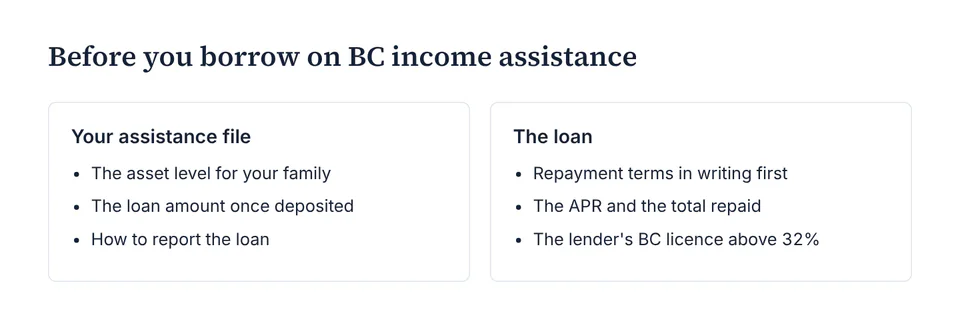
Before you borrow on BC income assistance
What to check on each side.
Your assistance file
- The asset level for your family
- The loan amount once deposited
- How to report the loan
The loan
- Repayment terms in writing first
- The APR and the total repaid
- The lender's BC licence above 32%
In plain terms: on BC income assistance, ask about the deposit before you ask about the payment.
Part of: Loans on benefits: what lenders count and what the law protects
Other provincial assistance programs
- Saskatchewan Income Support loans: what to ask before you borrowWhen SIS is paid, what a lender may review, how to check a lender with the FCAA, and why SIS should hear about a loan first.
- BC disability assistance loans: the asset rule to know firstWhy BC counts loan money as an asset, how disability assistance is protected from seizure, and what to ask first.
- Manitoba EIA loans: borrowing on Employment and Income AssistanceHow EIA is paid, what a lender may review, how to check a lender in Manitoba, and why EIA should hear about a loan first.
Frequently asked questions
- Can I get a loan on BC income assistance?
- You can declare income assistance as income on a loan request. Each lender decides whether it counts it. Ask your ministry worker about the asset limit before you borrow.
- Is a loan counted as income on BC income assistance?
- No. BC's policy manual says funds from a loan are not income. The amount, once received, is an asset in cash, and you become ineligible if your assets exceed the level for your family.
- Can a lender seize my income assistance?
- No. Section 29(1) of the Employment and Assistance Act exempts income assistance, hardship assistance and supplements from garnishment, attachment, execution or seizure. Deductions or set-off under that Act, the Financial Administration Act or a prescribed enactment remain possible.
- Is getaloannow.ca linked to the BC government?
- No. getaloannow.ca is a loan matching service with no connection to the Government of British Columbia or its assistance programs.
Who may receive your request
To lenders and financial partners who may be able to respond, and only if your profile fits. The list of recipients will be published before any request is forwarded. Who they are, our conditions and how to check a licence
Representative example
- Amount
- $2,000
- Term
- 24 months
- Monthly payment
- $111.78
- Total repaid
- $2,682.83
- Cost of borrowing
- $682.83
- Rate
- 29.96% APR
The annual percentage rate (APR) includes the cost of borrowing. The annual rate of a personal loan cannot exceed 35% APR (Criminal Code). In British Columbia and Manitoba, a lender also needs a high-cost credit licence above 32% (32% or more in Alberta): see your province page. Actual terms are set by the lender.
Sources
- Employment and Assistance Act, section 29, BC Laws (checked on October 30, 2026)
- BCEA Policy and Procedure Manual: Income treatment and exemptions, Government of British Columbia (checked on October 30, 2026)
- Income assistance and disability assistance payment dates, Government of British Columbia (checked on October 30, 2026)
- Check a licence, Consumer Protection BC (checked on October 30, 2026)
- Getting help from a credit counsellor, Financial Consumer Agency of Canada (checked on October 30, 2026)
The getaloannow.ca editorial team
Writing and fact-checking · Official sources, cited and dated · Regularly updated content
Our guides are written and checked against official sources (provincial regulators, FCAC, Canada.ca), cited and dated on every page. They explain how borrowing works in Canada and are not personalized financial advice.
Published November 26, 2026 · Updated November 26, 2026
Request a personal loan in British Columbia
Two minutes, free of charge. A lender may contact you with its terms, or you may receive no reply.