“Instant cash advance” by e-Transfer: what the apps actually say
By the getaloannow.ca editorial team · Writing and fact-checking
Updated November 26, 2026 · Written from the sources listed at the bottom of the page
An “instant cash advance” by e-Transfer is what many people hope for when money is short before payday. This guide explains how Interac e-Transfer works according to Interac, what Bree, KOHO and Nyble say about how and when their money reaches you, on their own pages consulted on October 30, 2026, and why a delivery time stated by an app is a description, not a promise.
getaloannow.ca is not a lender, does not offer advances and has no commercial relationship with any app.
Interac says funds sent by e-Transfer usually arrive within minutes, sometimes up to 30 minutes, depending on the institution. The app's own processing comes before that.
Bree describes a free standard transfer in 1 to 3 business days and an express transfer “in under 5 minutes” for a fee. KOHO describes Cover as a balance used inside your KOHO account.
Faster delivery can cost extra. Check the fee in the app and decide whether the speed is worth it.
How Interac e-Transfer works
Interac e-Transfer is a service for sending money between accounts at participating Canadian banks and credit unions. According to Interac's own pages:
- Funds usually arrive within minutes, but it can take up to 30 minutes depending on the institution.
- Each financial institution sets its own limits and its own fees for e-Transfers.
- With Autodeposit, a transfer is deposited without a security question, after the usual fraud checks.
- Once a transfer has been deposited, it cannot be cancelled.
Those timings concern the transfer itself. Before a transfer is sent, the company sending it has to process your request, and that step is not covered by Interac's timing. Our page on how e-Transfer payouts work goes through the bank side in more detail.
What each app says about delivery
Bree
Bree's help centre says advances are sent by direct deposit or e-Transfer. Its website describes two speeds: a standard transfer, free, in 1 to 3 business days, and an express transfer “in under 5 minutes”, for a fee that Bree calls a “small fee” without stating the amount on the pages consulted. The app shows the fee before you choose.
KOHO Cover
KOHO's Cover page uses the words “instant cash advance”. According to KOHO's help centre, the Cover balance is used inside your KOHO account when your available balance reaches zero; it is not described as a transfer to an outside bank. Interac e-Transfer comes into play the other way: money you add to your KOHO account, by direct deposit or Interac e-Transfer, repays the Cover balance first.
Nyble
Nyble's official pages describe a credit-building line of credit of $30 to $250 at 0%, not a cash advance. They do not set out the method or the time it takes for a withdrawal to reach you. Its optional membership includes “Instant Pay”, which Nyble describes as the real-time processing of your payments to Nyble, “subject to your institution's acceptance of real-time payments”: it concerns repayments, not the money you receive.
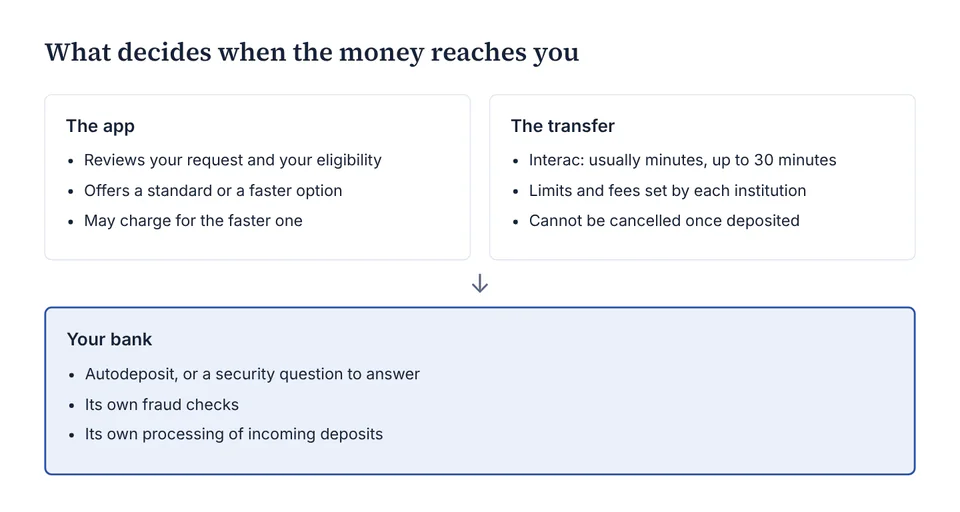
What decides when the money reaches you
Three steps, each with its own timing.
The app
- Reviews your request and your eligibility
- Offers a standard or a faster option
- May charge for the faster one
The transfer
- Interac: usually minutes, up to 30 minutes
- Limits and fees set by each institution
- Cannot be cancelled once deposited
Your bank
- Autodeposit, or a security question to answer
- Its own fraud checks
- Its own processing of incoming deposits
In plain terms: an app can describe how fast it usually sends money, but the time it takes depends on the app, the transfer and your bank. Treat any stated time as an estimate.
Be wary of any ad that presents an “instant” advance or loan as certain: the apps state their own delivery times, Interac says a transfer can take up to 30 minutes depending on the institution, and every company can decline a request.
Is paying for speed worth it?
On a small advance, a fee for faster delivery can be a large share of the amount. Ask yourself whether the expense really cannot wait one to three business days. If it can, the standard option Bree describes is free. If it cannot, check the fee in dollars before you accept, and set it against what you are borrowing.
For a broader look at what decides how long borrowing takes, including loans from licensed lenders, see our guide to how quickly a loan can be paid out.
Before you count on a delivery time
- Check that the app serves your province: Bree's Google Play listing and blog say it is not accepting new customers in Quebec, Saskatchewan, Nova Scotia or New Brunswick.
- Check where the money goes: your bank account for Bree, your KOHO account for Cover.
- Check your e-Transfer settings with your bank, including Autodeposit.
- Check the repayment date: the advance will be taken back automatically.
When an advance is not enough
App advances are small: up to $750 at Bree and up to $250 for KOHO Cover, according to their pages, with first limits often lower. If the expense is larger or truly urgent, our page on options for an urgent expense covers what else exists, and our page on loans paid out by e-Transfer explains how licensed lenders use the same method.
Frequently asked questions
- Can I get a cash advance by e-Transfer?
- Bree's help centre says its advances are sent by direct deposit or e-Transfer. KOHO Cover is used inside your KOHO account rather than sent elsewhere. Eligibility and limits are set by each company.
- How long does an e-Transfer take?
- Interac says funds usually arrive within minutes, sometimes up to 30 minutes depending on the institution. The app's own processing time comes before that.
- Can an e-Transfer be cancelled?
- According to Interac, once a transfer has been deposited, it cannot be cancelled.
- How fast does an app send the money?
- Each app states its own times. Bree describes a free standard transfer in 1 to 3 business days and an express transfer “in under 5 minutes” for a fee. The transfer and your bank's own checks also play a part.
Sources
- Interac e-Transfer 101 and consumer FAQ, Interac (company website) (checked on October 30, 2026)
- Bree home page, Bree (company website) (checked on October 30, 2026)
- Bree help centre: eligibility and how Bree works, Bree (company help centre) (checked on October 30, 2026)
- KOHO Cover, KOHO (company website) (checked on October 30, 2026)
- What is Cover?, KOHO (company help centre) (checked on October 30, 2026)
- Plans, Nyble (company website) (checked on October 30, 2026)
If you are considering a loan
- Fast loansWhat decides how long a loan takes, and what no one can promise.
- Payday loansHow payday loans work, what they cost and the rules in each province.
- Cash advance apps in Canada: how they work and what they costWhat cash advance apps are, how they differ from payday loans, and what to check on fees, withdrawals and availability.
Related pages
- How cash advance apps work: limits, fees and repaymentStep by step: how a cash advance app reviews your account, sets a limit, sends the money and takes its repayment.
- Cash advance apps with “no credit check”: what they still verifyWhat the apps say about credit checks, what they look at instead, and why skipping a credit check never means skipping the review.
- Are cash advance apps safe? Six checks before you sign upSix practical checks before using a cash advance app: the company, your bank access, permissions, fees, withdrawals and your data.
Where to get help, free of charge
These organizations are non-profit or public bodies, separate from us.
- Credit Counselling CanadaFind a non-profit credit counsellor near you
- Financial Consumer Agency of Canada (FCAC)Tools to make a budget and understand your credit
- Canadian Anti-Fraud CentreReport a request for fees before a loan
The getaloannow.ca editorial team
Writing and fact-checking · Official sources, cited and dated · Regularly updated content
Our guides are written and checked against official sources (provincial regulators, FCAC, Canada.ca), cited and dated on every page. They explain how borrowing works in Canada and are not personalized financial advice.
Published November 26, 2026 · Updated November 26, 2026