Free credit score in Canada: how to get yours
By the getaloannow.ca editorial team · Writing and fact-checking
Updated November 26, 2026 · Written from the sources listed at the bottom of the page
You can get a free credit score in Canada without paying for a service. The two credit bureaus, Equifax Canada and TransUnion Canada, each keep a credit report on you and calculate a score from it. What is free depends on the bureau and on where you live: according to the Financial Consumer Agency of Canada (FCAC), Equifax offers a free credit report and score everywhere in Canada, while TransUnion's free score is offered in Quebec and Ontario. Here is what to request, how to read what you get, and what to do if something is wrong.
Read the transcript
How do you check your credit score in Canada, for free? It’s easier than most people think, and it doesn’t hurt your score. Let me show you where to get it, how to read it, and what actually moves it.
First, two words people often mix up. Your credit report is the detailed record of your credit accounts and how you’ve repaid them. Your credit score is a number calculated from it, usually between 300 and 900. In Canada, two main credit bureaus keep these files: Equifax and TransUnion.
According to the Financial Consumer Agency of Canada, you can access your credit report online for free from both Equifax and TransUnion. For the score, Equifax offers it free in all provinces and territories. TransUnion’s is free if you live in Quebec or Ontario.
And here’s the part that stops many people: checking your own credit report or score won’t affect your credit rating. That’s the FCAC’s wording. What does create an inquiry is a lender or another organization checking your credit.
Don’t be surprised if your scores don’t match. Bureaus and lenders use different formulas, and they don’t share the details. The score you see may also be different from the one a lender sees.
So what moves a score? The FCAC names the factors. Payment history is the most important part. Then credit utilization: its tip is to use less than 30% of your total credit limit. Then the length of your credit history, the inquiries in your file, and the types of credit you have. One useful detail: when you shop for a car loan or a mortgage, quotes from different lenders within two weeks count as one inquiry.
So, to sum up: your report and your score are free to check, checking them is safe, and paying on time weighs the most. And just so you know: getaloannow.ca is not a lender. We’re a free loan matching service.
Equifax Canada gives a free credit report and score everywhere in Canada. TransUnion Canada's free score is offered in Quebec and Ontario, according to FCAC.
Checking your own credit report usually has no effect on your score. A credit application with a lender can leave an inquiry on your file.
Each bureau applies its own formula on a 300 to 900 scale, so your two scores can differ without either one being wrong.
Credit report or credit score: what you are asking for
Your credit report is the detailed record. It lists your credit accounts (credit cards, loans, lines of credit) and how you have repaid them, month after month. Each bureau keeps its own version of that record.
Your credit score is a single number calculated from the report, on a scale from 300 to 900. The higher it is, the lower the risk a lender is likely to see. The score tells you where you stand; the report tells you why, and whether the information behind the number is accurate. When you can, get both.
Where to get it free in your province
FCAC describes the free options this way: Equifax provides your credit report and your score free of charge everywhere in Canada, and TransUnion also provides your credit report for free, but its free score is offered only in Quebec and Ontario. In practice:
- Ontario: you can get your report and your score free from both bureaus, Equifax and TransUnion.
- British Columbia, Alberta, Saskatchewan and Manitoba: Equifax gives you a free report and score. From TransUnion, you can get your credit report free, but the free score is not offered in your province.
Start from each bureau's own website, Equifax Canada and TransUnion Canada, where each explains its free options. You do not need to pay anything to see your own file: the free options FCAC describes are enough to read your report and know where your score sits.
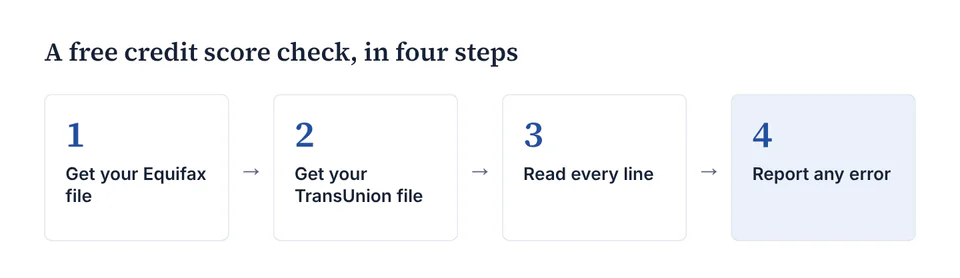
A free credit score check, in four steps
It costs nothing and usually has no effect on your score. Set aside time to read your file, not just glance at the number.
Get your Equifax file
Request your free credit report and score from Equifax Canada. According to FCAC, this option exists everywhere in Canada.
Get your TransUnion file
Request your TransUnion credit report as well. If you live in Ontario, your TransUnion score is also free.
Read every line
Go through your accounts, payment history, addresses and inquiries. Note anything you do not recognize.
Report any error
Contact the bureau whose file contains the error; each explains its process on its website. An error in one file may also appear in the other, so check both.
In plain terms: a free check of your credit report costs nothing, usually leaves your score untouched, and is the simplest way to catch an error before a lender sees it.
Why checking your own file is safe
Many people avoid looking at their credit for fear of lowering their score. Checking your own credit report usually has no effect on your score. What can leave a mark is different: a credit application with a lender can leave an inquiry on your file, and lenders who later look at that file will see it.
So the order matters. Look at your own report first, at no cost, and apply for credit only once you know what a lender will find.
How to read your score
There is no single official scale of “good” and “poor”. According to Equifax Canada, scores generally fall into these bands:
- 300 to 559: poor;
- 560 to 659: fair;
- 660 to 724: good;
- 725 to 759: very good;
- 760 to 900: excellent.
TransUnion uses other cut-offs, and each lender sets its own bands. Treat these as a rough guide to where you stand, not as the answer a lender will give.
Why your two scores do not match
If your Equifax score and your TransUnion score are different, nothing is necessarily wrong. Each bureau calculates its score with its own formula, and those formulas are not public. The two files may also not contain exactly the same information. A gap between the two numbers matters less than the accuracy of what each report says about you.
What to look for in your credit report
- An account you do not recognize;
- A payment shown as late when it was made on time;
- An address where you have never lived;
- An inquiry linked to credit you never applied for.
If you find an error, report it to the bureau that holds the file. An account you never opened can also be a sign of identity theft: report it to the Canadian Anti-Fraud Centre.
Once you know your score
Your score is one of the things a lender considers, alongside your income and the debts you already carry. Knowing it before a lender does helps you read its answer. If your score is low, we explain what lenders look at when your credit score is low, and why, whatever your score, the APR on a personal loan cannot exceed 35% in Canada.
Frequently asked questions
- Is the Equifax free credit report really free?
- Yes. According to FCAC, Equifax Canada gives you a free credit report and a free credit score, wherever you live in Canada. You do not need to buy a product to see your own file.
- Can I get my TransUnion credit score free outside Ontario?
- According to FCAC, TransUnion's free score is offered in Quebec and Ontario. In British Columbia, Alberta, Saskatchewan and Manitoba, you can still get your TransUnion credit report free of charge, and Equifax gives you a free score.
- How often should I check my credit report?
- Once or twice a year with each bureau is a reasonable habit, and again before you apply for credit. Checking your own file usually has no effect on your score, so there is no penalty for looking.
Sources
- Credit report and score basics, Financial Consumer Agency of Canada (checked on October 21, 2026)
- Equifax Canada, Equifax Canada (checked on October 21, 2026)
- TransUnion Canada, TransUnion Canada (checked on October 21, 2026)
- Canadian Anti-Fraud Centre, Government of Canada (checked on October 21, 2026)
If you are considering a loan
- Bad credit loansWhat lenders look at when your credit score is low.
- All our guidesPlain-English guides to borrowing in Ontario, BC, Alberta, Saskatchewan and Manitoba: the 35% cap, credit scores, payday loan rules, licence checks.
Related pages
- How to increase your credit score in CanadaHow to increase your credit score in Canada: the four factors FCAC names, habits that help, building credit from scratch and repair offers to avoid.
- How to check a lender's licence: a step-by-step guide by provinceHow to check a lender's licence in Ontario, BC, Alberta, Saskatchewan and Manitoba: the official tools, step by step, and the red flags to watch for.
- Criminal interest rate in Canada: the 35% cap since 2025The criminal interest rate in Canada has been 35% APR since January 1, 2025. The old limit, the payday loan exception and each province's high-cost tier.
Where to get help, free of charge
These organizations are non-profit or public bodies, separate from us.
- Credit Counselling CanadaFind a non-profit credit counsellor near you
- Financial Consumer Agency of Canada (FCAC)Tools to make a budget and understand your credit
- Canadian Anti-Fraud CentreReport a request for fees before a loan
The getaloannow.ca editorial team
Writing and fact-checking · Official sources, cited and dated · Regularly updated content
Our guides are written and checked against official sources (provincial regulators, FCAC, Canada.ca), cited and dated on every page. They explain how borrowing works in Canada and are not personalized financial advice.
Published November 26, 2026 · Updated November 26, 2026