Apps like KOHO Cover: other options for a small advance
By the getaloannow.ca editorial team · Writing and fact-checking
Updated November 26, 2026 · Written from the sources listed at the bottom of the page
If you are searching for apps like KOHO Cover, it may be because you do not want to move your deposits to a KOHO account, because the Cover limit is too low, or because you would rather not pay a monthly subscription. KOHO describes Cover, on its pages consulted on October 30, 2026, as a cash advance of up to $250 inside a KOHO account, with no interest, through a subscription “for as little as $2 / month”. This page sets out what the other apps covered in this section describe, and the options outside apps.
getaloannow.ca is not a lender, does not offer advances and has no commercial relationship with any app. This page only describes apps whose own terms are covered in this section.
Bree describes the closest product: a small advance with no interest, sent to the bank account you already have, with optional rather than subscription fees.
Nyble describes a credit-building line of credit of $30 to $250, reported to Equifax Canada. It is not designed as an advance on your pay.
Overdraft protection, a line of credit, a small loan from your bank or credit union, or an advance from your employer may suit a short gap.
What makes KOHO Cover particular
Three features of Cover, as KOHO describes them, often lead people to look elsewhere:
- It lives inside a KOHO account: the Cover balance is used when your available KOHO balance reaches zero, and any money added to the account repays Cover first.
- It requires a subscription, whose price varies with the tier, paid each month you keep it.
- Its limit, from $20 up to $250, is set automatically from your KOHO account activity, and you cannot ask for an increase.
If none of those is a problem for you, Cover may already be the closest fit. If one of them is, the options below work differently.
Bree: an advance to your existing bank account
Bree's help centre and website describe an “interest-free line of credit of up to $750”. The main differences from KOHO Cover, according to Bree:
- Advances are sent to your own bank account, by direct deposit or e-Transfer.
- Costs are optional: a tip, an express fee if you want the money faster, and a membership at CA$2.99 a month after a one-month free trial, which Bree says is not required.
- A first advance is often between $20 and $50, with a limit that grows as you repay on time.
- Repayment is taken automatically on your next payday; each draw has a term of up to 90 days.
Bree says it does not run a credit check and bases approval on your income and deposits; it asks for about two months of regular deposits and a minimum monthly income it sets. Its Google Play listing and blog say it is not accepting new customers in Quebec, Saskatchewan, Nova Scotia or New Brunswick.
Bree describes a free standard transfer in 1 to 3 business days and an express transfer “in under 5 minutes” for a fee. For what happens on the bank's side when money is sent by transfer, see our page on how e-Transfer payouts reach your account.
Nyble: a credit-building line, not an advance
Nyble is often listed with KOHO Cover, but its official pages describe a credit-building line of credit of $30 to $250 at 0%, with payments reported to Equifax Canada, on time and late. Its optional membership costs $11.99 a month. Its website says there are no late or processing fees, while its agreement mentions a $15 payment fee. If you need money before payday, Nyble's own description does not match that need; if you want to build credit, it does.
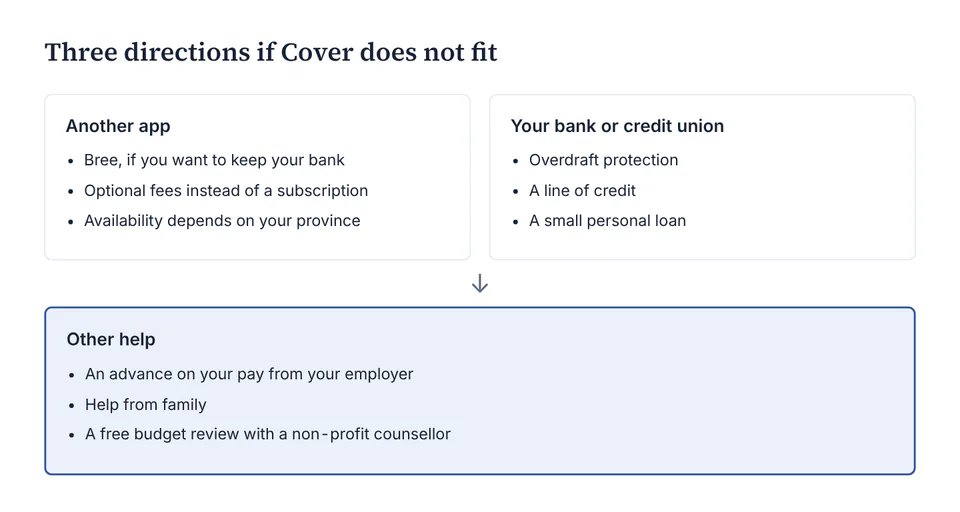
Three directions if Cover does not fit
Based on the companies' own pages and on the alternatives listed by the FCAC and the federal Office of Consumer Affairs.
Another app
- Bree, if you want to keep your bank
- Optional fees instead of a subscription
- Availability depends on your province
Your bank or credit union
- Overdraft protection
- A line of credit
- A small personal loan
Other help
- An advance on your pay from your employer
- Help from family
- A free budget review with a non-profit counsellor
In plain terms: if the KOHO account or the subscription is what bothers you, another app or your own bank may offer a short-term solution. If the gap comes back every month, the budget is the place to start.
What a short gap can cost at the bank
The Financial Consumer Agency of Canada (FCAC) gives an example for $300 borrowed over 14 days: $42 as a payday loan, against $5.92 on a line of credit, $7.42 with overdraft protection and $7.65 as a credit card cash advance. The figures rest on the FCAC's assumptions; they do not include app subscriptions, but they show that a bank product can cost only a few dollars for two weeks. For each of these options in more detail, see our guide to borrowing for less than a payday loan.
When advances become a habit
A small advance each month can feel manageable, but subscriptions and automatic withdrawals add up, and the gap stays. If you are juggling an advance, a card and a loan at the same time, a debt-to-income calculator shows how much of your monthly income already goes to debt payments.
If the share is high, a free conversation with a non-profit credit counsellor can help you find where the money goes. Credit Counselling Canada keeps a directory of its member agencies.
For a larger, planned expense, an instalment loan repaid over months can be easier to plan than a series of advances. Our page on personal instalment loans explains how the payment and the total repaid are calculated.
Questions to ask any app
- What does it cost in dollars each month, including months I do not use it?
- Where does the money go: my bank, or an account with the company?
- When, and from which account, is the repayment taken?
- Is it available in my province?
- Does it report to a credit bureau, and when?
Frequently asked questions
- Is there an app like KOHO Cover that does not require a new account?
- Among the apps covered in this section, Bree sends advances to your own bank account, by direct deposit or e-Transfer, according to its help centre.
- Is there an app like KOHO Cover without a subscription?
- Bree says its costs are optional: a tip, an express fee and a membership it says is not required. Check the fees shown in the app before you accept an advance.
- Is Nyble like KOHO Cover?
- Not according to Nyble's current pages, which describe a credit-building line of credit reported to Equifax Canada rather than a cash advance.
Sources
- KOHO Cover, KOHO (company website) (checked on October 30, 2026)
- How do Cover limits work?, KOHO (company help centre) (checked on October 30, 2026)
- Bree help centre: eligibility and how Bree works, Bree (company help centre) (checked on October 30, 2026)
- Bree app listing, Google Play (listing published by Bree) (checked on October 30, 2026)
- Build credit, Nyble (company website) (checked on October 30, 2026)
- Payday loans, Financial Consumer Agency of Canada (checked on October 30, 2026)
If you are considering a loan
- Fast loansWhat decides how long a loan takes, and what no one can promise.
- Personal loansInstalment loans repaid over months, and how the total repaid is calculated.
- Cash advance apps in Canada: how they work and what they costWhat cash advance apps are, how they differ from payday loans, and what to check on fees, withdrawals and availability.
Related pages
- Apps like Bree: other options for a small advance in CanadaOther options if Bree does not fit: KOHO Cover, Nyble as a different kind of product, and the options outside apps.
- Apps like Nyble: other ways to build credit or cover a gapIf Nyble does not fit: what Bree and KOHO Cover say about credit reporting, and the options outside apps to build credit or cover a gap.
Where to get help, free of charge
These organizations are non-profit or public bodies, separate from us.
- Credit Counselling CanadaFind a non-profit credit counsellor near you
- Financial Consumer Agency of Canada (FCAC)Tools to make a budget and understand your credit
- Canadian Anti-Fraud CentreReport a request for fees before a loan
The getaloannow.ca editorial team
Writing and fact-checking · Official sources, cited and dated · Regularly updated content
Our guides are written and checked against official sources (provincial regulators, FCAC, Canada.ca), cited and dated on every page. They explain how borrowing works in Canada and are not personalized financial advice.
Published November 26, 2026 · Updated November 26, 2026