Cash advance vs payday loan: how the costs and the rules differ
By the getaloannow.ca editorial team · Writing and fact-checking
Updated November 26, 2026 · Written from the sources listed at the bottom of the page
Cash advance vs payday loan: both give you a small amount before payday and take it back from your next pay, so they are easy to confuse. Their cost structure and their legal frame are not the same. This page explains how each is priced, which rules apply to payday loans in the provinces that regulate them, how cash advance apps describe themselves, and what to weigh in dollars before using either.
getaloannow.ca is not a lender and does not offer cash advances. We have no commercial relationship with any app named here.
A payday loan charges a fee per $100 borrowed, capped at $14 per $100 in the provinces that regulate payday loans. A cash advance app usually charges no interest, but may charge a subscription, a tip or a fee for faster delivery.
Payday lenders are licensed and supervised by the provinces. Cash advance apps describe their products in their own terms; how each is supervised depends on the province and on how the product is set up.
Count the cost of each in dollars for the amount and the number of days you need, and check what will be left in your account on repayment day.
One word, three products
“Cash advance” can mean three different things, which is part of the confusion:
- A cash advance from an app, such as the ones offered by Bree or KOHO Cover: a small amount advanced against your next deposit.
- A credit card cash advance: cash drawn on your credit card. The Financial Consumer Agency of Canada (FCAC) notes that interest starts right away, on top of the cash advance fee.
- A payday loan: a short-term loan from a lender licensed by the province, usually repaid in one payment.
This page focuses on the first and the third. Both are repaid from your next pay, but they are priced and regulated differently.
How a payday loan is priced and regulated
Under the Criminal Code, a payday loan escapes the 35% criminal rate only if it is $1,500 or less, for 62 days or less, and made by a lender licensed in a province designated for that purpose. Since January 1, 2025, the total cost of such a loan is capped at $14 per $100 advanced by federal regulation. The FCAC puts $14 per $100 over 14 days at about 365% a year, and it gives this example: $300 for 14 days costs $42 as a payday loan.
The FCAC itself does not regulate payday lenders: the provinces do. In Ontario, for example, the province says you have two business days to cancel a payday loan without penalty, rollovers are prohibited, and a lender must show its Ontario licence, even online. Each province has its own rules, set out in our page on payday loan rules by province, and our overview of payday loans explains how they work.
Quebec has not requested the payday loan exemption, so any payday loan offered there is subject to the 35% criminal rate, as explained in our page on the criminal interest rate in Canada.
How a cash advance app is priced
The apps price their advances differently, according to their own pages consulted on October 30, 2026:
- Bree says its advances carry 0% APR, and that its only costs are optional: a tip, an express fee for faster delivery and a membership at CA$2.99 a month after a free month.
- KOHO says Cover charges no interest and is available through a monthly subscription “for as little as $2 / month”, varying with the tier.
- Nyble, often listed among these apps, describes a credit-building line of credit at 0% with an optional $11.99 membership, rather than a cash advance.
No interest does not mean no cost. A monthly fee on a small advance can be a large share of the amount: with round numbers, $3 on an advance of $50 is 6% of what you received. Over a year of subscriptions, the total can be more than the advances you actually used.
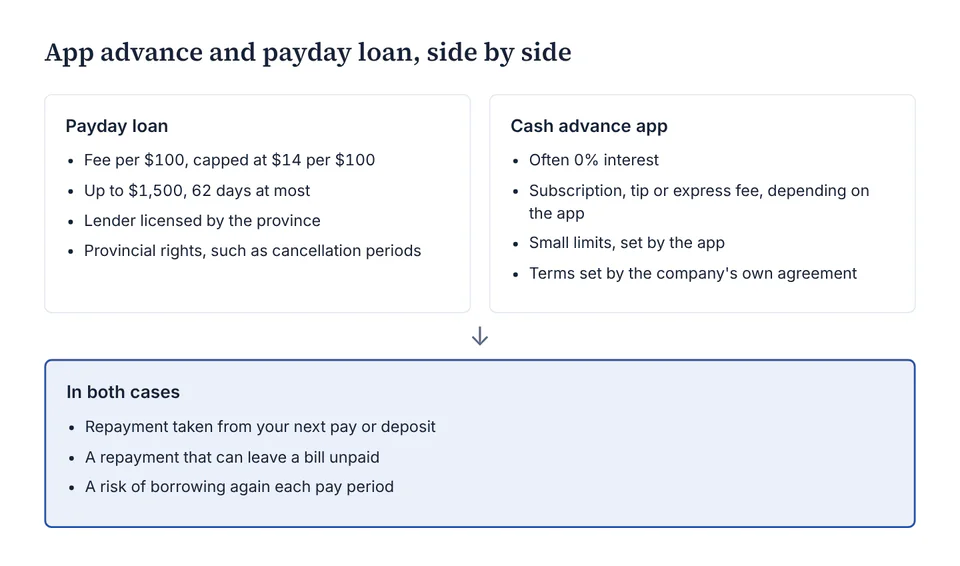
App advance and payday loan, side by side
The structure of each, as described by the rules and by the companies.
Payday loan
- Fee per $100, capped at $14 per $100
- Up to $1,500, 62 days at most
- Lender licensed by the province
- Provincial rights, such as cancellation periods
Cash advance app
- Often 0% interest
- Subscription, tip or express fee, depending on the app
- Small limits, set by the app
- Terms set by the company's own agreement
In both cases
- Repayment taken from your next pay or deposit
- A repayment that can leave a bill unpaid
- A risk of borrowing again each pay period
In plain terms: a payday loan has a regulated price per $100; an app has its own fees, often fixed per month. Count both in dollars for the same amount and the same number of days.
The legal frame for apps
Cash advance apps do not present themselves as payday lenders. Bree speaks of an interest-free line of credit, KOHO of a cash advance attached to its account, Nyble of a credit-building line of credit. Whether, and how, a given app falls under provincial consumer rules depends on the province and on how the product is set up. We do not attribute to any regulator a position it has not published.
If you have a question about an app's practices or a complaint, your provincial consumer protection office is the place to ask. If you have a complaint about a payday lender, the same office handles it, and it can confirm whether the lender holds a licence.
Setting the two against each other in dollars
For a payday loan, the arithmetic is fixed: $14 per $100. Our payday loan cost calculator gives the total for any amount up to the legal maximum.
For an app, add every amount you would pay: subscription for each month you keep it, express fee if you choose it, tip if you leave one. Then look at the limit you are actually offered: a first advance of $20 to $50, as Bree describes it, may not cover the need.
Neither may be the cheapest option. In the same FCAC example, $300 for 14 days costs $5.92 on a line of credit, $7.42 with overdraft protection and $7.65 as a credit card cash advance. Our guide to cheaper ways to cover a short gap goes through those options and free budget help.
Frequently asked questions
- Is a cash advance app a payday loan?
- The apps do not describe themselves that way. Payday loans are made by lenders licensed by the province, at a capped cost per $100. Apps describe their products as cash advances or lines of credit under their own terms.
- Which is cheaper, a cash advance app or a payday loan?
- It depends on the amount, the number of days and the app's fees. Count both in dollars. A payday loan costs at most $14 per $100 in the provinces that regulate it; an app may charge a monthly subscription or other fees instead of interest.
- Can I cancel a cash advance like a payday loan?
- Provincial cancellation rights apply to payday loans: in Ontario, two business days without penalty, for example. For an app, read its agreement; Bree, for instance, says you can repay early without fees.
- What about a credit card cash advance?
- It is a different product. The FCAC notes that interest on a credit card cash advance starts right away, on top of the fee. In its $300 over 14 days example, it costs $7.65.
Sources
- Payday loans, Financial Consumer Agency of Canada (checked on October 30, 2026)
- Criminal Interest Rate Regulations (SOR/2024-114), Canada Gazette, Part II (checked on October 30, 2026)
- Payday loans: your rights, Government of Ontario (checked on October 30, 2026)
- Instant cash advance, Bree (company website) (checked on October 30, 2026)
- KOHO Cover, KOHO (company website) (checked on October 30, 2026)
- Build credit, Nyble (company website) (checked on October 30, 2026)
If you are considering a loan
- Payday loansHow payday loans work, what they cost and the rules in each province.
- Personal loansInstalment loans repaid over months, and how the total repaid is calculated.
- Cash advance apps in Canada: how they work and what they costWhat cash advance apps are, how they differ from payday loans, and what to check on fees, withdrawals and availability.
Related pages
- Bree vs Nyble: how the two apps differBree and Nyble side by side: an interest-free cash advance line and a credit-building line of credit, from each company's own pages.
- Nyble vs KOHO Cover: how the two apps differNyble and KOHO Cover side by side: a credit-building line of credit and a small cash advance paid for by subscription.
- Bree vs KOHO Cover: how the two cash advances differBree and KOHO Cover side by side: two small cash advances with no interest, paid for and repaid in different ways.
Where to get help, free of charge
These organizations are non-profit or public bodies, separate from us.
- Credit Counselling CanadaFind a non-profit credit counsellor near you
- Financial Consumer Agency of Canada (FCAC)Tools to make a budget and understand your credit
- Canadian Anti-Fraud CentreReport a request for fees before a loan
The getaloannow.ca editorial team
Writing and fact-checking · Official sources, cited and dated · Regularly updated content
Our guides are written and checked against official sources (provincial regulators, FCAC, Canada.ca), cited and dated on every page. They explain how borrowing works in Canada and are not personalized financial advice.
Published November 26, 2026 · Updated November 26, 2026