Apps like Nyble: other ways to build credit or cover a gap
By the getaloannow.ca editorial team · Writing and fact-checking
Updated November 26, 2026 · Written from the sources listed at the bottom of the page
People who search for apps like Nyble are usually after one of two things: a way to build their credit, or a small amount of money before payday. Nyble's official pages, consulted on October 30, 2026, describe the first: a credit-building line of credit of $30 to $250 at 0%, with payments reported to Equifax Canada. This page explains what the other apps covered in this section say about their products, and the options outside apps for each of those two needs.
getaloannow.ca is not a lender and has no commercial relationship with any app. This page only describes apps whose own terms are covered in this section.
Of the apps covered here, only Nyble describes its product as a way to build credit. Bree and KOHO Cover describe small cash advances.
The FCAC names payment history, how much of your credit you use, the length of your history and your inquiries among the factors that affect your score. Any credit account repaid on time works on those factors.
For a short gap, an app advance, overdraft protection or a line of credit can work. Count the cost of each in dollars.
First, decide what you need
Nyble's “build credit” page invites you to “open a credit building line of up to $250 at 0% and withdraw funding”. Nyble says it reports payments to Equifax Canada, on time and late, and provides a free Equifax score. Its optional membership costs $11.99 a month; its website says there are no late or processing fees, while its line of credit agreement mentions a $15 payment fee.
If you are looking for something like Nyble, the right alternative depends on which part of that description matters to you: the credit building, or the access to a small amount.
If your goal is to build credit
Neither Bree nor KOHO Cover describes its advance as a credit-building product. According to their own pages:
- Bree says it does not report to credit bureaus. On-time repayment of a Bree advance would therefore not appear on your file, by Bree's own statement.
- KOHO's pages differ on reporting; the Cover FAQ, the more cautious statement, says balances outstanding for more than three months may be reported to credit bureaus at KOHO's discretion. That describes a possible negative mark, not a way to build credit.
Outside apps, the logic is the same as with Nyble: a first credit product, used modestly and repaid on time, starts to build your history. The Financial Consumer Agency of Canada (FCAC) names four factors among those that affect your score: your payment history, how much of your available credit you use, the length of your credit history and your credit inquiries. Our guide on raising your credit score step by step explains each one.
Before you open any new account, look at what your file already shows. Both Equifax Canada and TransUnion Canada give free access to your credit report online, and checking your own report does not affect your score, according to the FCAC. Our page on getting your credit report for free explains how.
If your goal is to cover a short gap
If what you need is a small amount before payday, Nyble's own description does not match that need, and the apps that describe cash advances may be closer:
- Bree describes an interest-free line of credit of up to $750, with a first advance often between $20 and $50, repaid automatically on your next payday. Its costs, according to Bree, are optional: a tip, an express fee and a CA$2.99 monthly membership after a free month. Bree's Google Play listing and blog say it is not accepting new customers in Quebec, Saskatchewan, Nova Scotia or New Brunswick.
- KOHO describes Cover as a cash advance of up to $250 inside a KOHO account, with no interest, through a subscription “for as little as $2 / month”. Money added to the account repays Cover first.
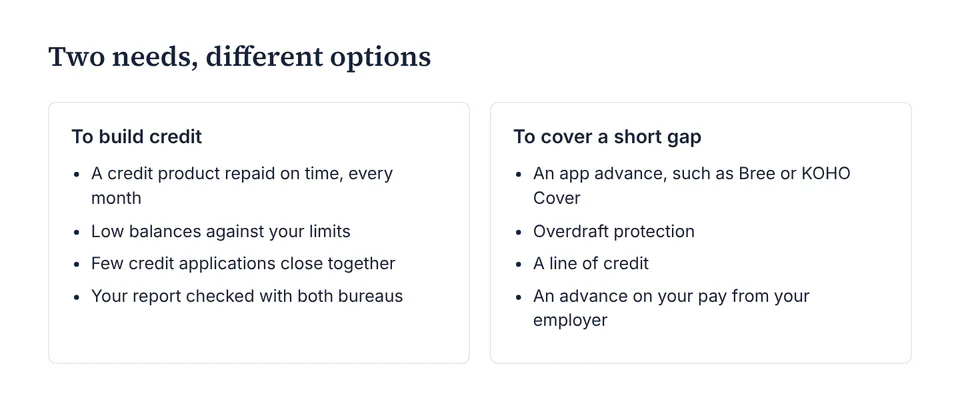
Two needs, different options
Options described by the companies themselves, and options listed by the FCAC and the federal Office of Consumer Affairs.
To build credit
- A credit product repaid on time, every month
- Low balances against your limits
- Few credit applications close together
- Your report checked with both bureaus
To cover a short gap
- An app advance, such as Bree or KOHO Cover
- Overdraft protection
- A line of credit
- An advance on your pay from your employer
In plain terms: Nyble is described as a credit-building tool. If that is what you need, the habits matter more than the app. If you need money before payday, other products are designed for that.
What a short gap can cost elsewhere
The FCAC gives an example for $300 borrowed over 14 days: $42 as a payday loan, against $5.92 on a line of credit, $7.42 with overdraft protection and $7.65 as a credit card cash advance. Those figures rest on the FCAC's assumptions, but they show that some bank products cost little for a short period.
If your credit is already damaged
If late payments or collections already weigh on your file, a credit-building line is only one part of the answer. Lenders that consider a low score look at other things too, as explained in our page on borrowing with a low credit score.
If your debts have become hard to manage, the priority is your budget, not your score. Non-profit credit counselling organizations can help you review it; Credit Counselling Canada keeps a directory of its member agencies, and the FCAC offers a free guide to making a budget.
Be wary of paid credit repair
You do not need to pay anyone to get your credit report or to report an error on it: you can do both directly with Equifax Canada and TransUnion Canada. Accurate information about late payments is part of your history; what changes it over time is how you repay from now on.
Frequently asked questions
- Is there another app like Nyble for building credit?
- Among the apps covered in this section, only Nyble describes its product as credit building. Bree says it does not report to credit bureaus, and KOHO describes Cover as a cash advance.
- Does Bree or KOHO Cover build credit?
- Bree says it does not report to credit bureaus. KOHO's Cover FAQ says balances outstanding for more than three months may be reported at its discretion, which describes a possible negative mark rather than credit building.
- Does checking my own credit report lower my score?
- No, according to the FCAC: ordering your own credit report has no effect on your score. Only hard inquiries, such as a credit application with a lender, can affect it.
Sources
- Build credit, Nyble (company website) (checked on October 30, 2026)
- Plans, Nyble (company website) (checked on October 30, 2026)
- Instant cash advance, Bree (company website) (checked on October 30, 2026)
- KOHO Cover, KOHO (company website) (checked on October 30, 2026)
- Credit report and score basics, Financial Consumer Agency of Canada (checked on October 30, 2026)
- Payday loans, Financial Consumer Agency of Canada (checked on October 30, 2026)
If you are considering a loan
- Bad credit loansWhat lenders look at when your credit score is low.
- Personal loansInstalment loans repaid over months, and how the total repaid is calculated.
- Cash advance apps in Canada: how they work and what they costWhat cash advance apps are, how they differ from payday loans, and what to check on fees, withdrawals and availability.
Related pages
- Apps like KOHO Cover: other options for a small advanceIf KOHO Cover does not fit: what Bree and Nyble describe, and the options outside apps for a short gap.
- Apps like Bree: other options for a small advance in CanadaOther options if Bree does not fit: KOHO Cover, Nyble as a different kind of product, and the options outside apps.
Where to get help, free of charge
These organizations are non-profit or public bodies, separate from us.
- Credit Counselling CanadaFind a non-profit credit counsellor near you
- Financial Consumer Agency of Canada (FCAC)Tools to make a budget and understand your credit
- Canadian Anti-Fraud CentreReport a request for fees before a loan
The getaloannow.ca editorial team
Writing and fact-checking · Official sources, cited and dated · Regularly updated content
Our guides are written and checked against official sources (provincial regulators, FCAC, Canada.ca), cited and dated on every page. They explain how borrowing works in Canada and are not personalized financial advice.
Published November 26, 2026 · Updated November 26, 2026