Are cash advance apps safe? Six checks before you sign up
By the getaloannow.ca editorial team · Writing and fact-checking
Updated November 26, 2026 · Written from the sources listed at the bottom of the page
Are cash advance apps safe? There is no single answer, because safety depends on the company, on what you allow it to access and on whether the repayment fits your budget. This guide gives six checks you can run yourself before signing up, with examples from what Bree, KOHO and Nyble publish on their own pages, consulted on October 30, 2026, and the official warnings that apply.
getaloannow.ca is not a lender, does not offer advances and has no commercial relationship with any app. We do not rate apps as safe or unsafe: we explain what to look at.
Know who you are dealing with, what access you give to your bank account, what you will pay in dollars and when the app will take its money back.
In March 2018, the Financial Consumer Agency of Canada (FCAC) warned that giving your banking login details to a third-party service may breach your account agreement and leave you liable for unauthorized transactions.
Anyone who asks you to pay a fee up front to receive an advance or a loan: stop and report it to the Canadian Anti-Fraud Centre.
Check 1: who is the company?
Before you hand over any personal information, find the legal name of the company in its terms of use and its privacy policy. The examples below show why it is worth reading:
- Nyble's line of credit agreement, terms and privacy policy name Fincentify Inc., which does business as Nyble.
- Bree's documents use several names: Bree Technologies Inc. and Bree Inc. in its terms of use, Bree Technologies Ltd. in its privacy policy. The agreement shown in the app tells you which one you contract with.
- KOHO's security pages say customer deposits are held at Peoples Trust, a federally regulated institution.
Download the app only from the official app store listing published by the company, and reach its website by typing the address yourself. That way you avoid a copycat site or app imitating a known brand.
Check 2: what access do you give to your bank account?
Cash advance apps base their decision on your deposits, so they need information about your bank account. Bree, for example, says approval is based on your income and deposit history, and asks for a Visa or Mastercard debit card with its CVV. Ask each app how it reads your account, for how long, and what it keeps.
If you are asked to enter your online banking username and password on a third party's portal, remember the FCAC warning of March 2018: sharing those login details with a third-party service may breach the agreement you have with your financial institution, and you could be held liable for losses from unauthorized transactions. Read your account agreement first. Our guide to instant bank verification explains what that kind of connection shares, and if your income comes from benefits, see what bank verification shows about benefit deposits.
Check 3: what permissions does the app ask for?
On your phone, look at the permissions the app requests: contacts, location, files, notifications. Ask yourself whether each one is needed for a cash advance. You can usually refuse or remove a permission in your phone's settings; if the app then stops working, you have learned something about what it relies on.
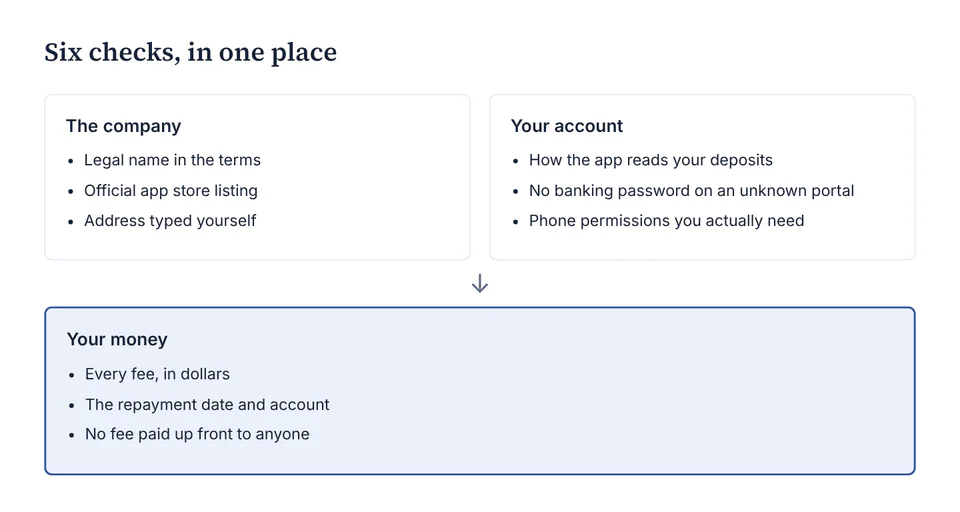
Six checks, in one place
Run them before you enter your personal information.
The company
- Legal name in the terms
- Official app store listing
- Address typed yourself
Your account
- How the app reads your deposits
- No banking password on an unknown portal
- Phone permissions you actually need
Your money
- Every fee, in dollars
- The repayment date and account
- No fee paid up front to anyone
In plain terms: an app can be run by a real company and still be a poor fit for your budget. Safety is about who you deal with, what you share and whether the repayment leaves you able to pay your bills.
Check 4: what will it cost, in dollars?
Interest is not the only cost. According to their pages, Bree charges 0% APR but lists an optional tip, an optional express fee and an optional CA$2.99 monthly membership after a free month; KOHO Cover requires a subscription “for as little as $2 / month”; Nyble has an optional $11.99 monthly membership, and its agreement mentions a $15 payment fee. Write down every amount before you accept.
Check 5: when does the app take its money back?
Repayment is automatic. Bree takes it on your next payday; with KOHO Cover, any money added to your KOHO account repays Cover first. Find out the date and the account, and check that your rent and other automatic payments still fit that week. An app that empties your account on payday can push you to draw again, which is how a small advance becomes a recurring cost.
Check 6: what happens to your data?
Read the privacy policy: what the company collects, who it shares it with, how long it keeps it and how to ask for it to be deleted. If you stop using the app, cancel any subscription and remove its access to your account.
Signs of a scam
Some offers that look like cash advances are not what they seem. Be suspicious if someone:
- Asks you to pay a fee, buy a gift card or send an e-Transfer before you receive the money.
- Contacts you first, by text or social media, with an offer you did not ask for.
- Presents itself as a lender but cannot show a provincial licence for payday lending.
A legitimate lender does not ask for fees before paying out a loan. Ontario also warns about websites that present themselves as online lenders but collect personal information to sell it, with a risk of identity theft. If you deal with a payday lender, our page on verifying a lender's provincial licence explains where to look it up. Report any suspicious request to the Canadian Anti-Fraud Centre. Ads that promise approval for everyone deserve the same caution, as explained in our page on loans advertised as guaranteed.
Frequently asked questions
- Are cash advance apps legal in Canada?
- The apps covered in this section are offered by companies operating in Canada under their own terms. How a given app falls under provincial consumer rules depends on the province and on how the product is set up; your provincial consumer protection office can answer questions about a specific company.
- Should I give an app my online banking password?
- Think carefully first. The FCAC warned in March 2018 that sharing banking login details with a third-party service may breach your account agreement and leave you liable for unauthorized transactions. Read your agreement and ask the app whether another method is possible.
- How do I stop an app from withdrawing money?
- Repay what you owe, cancel any subscription in the app and remove its access to your account. If a withdrawal is taken that you did not authorize, contact your financial institution.
Sources
- FCAC reminds consumers of the risks of sharing banking information with third-party online services (March 2018), Financial Consumer Agency of Canada (French version) (checked on October 30, 2026)
- Payday loans: your rights, Government of Ontario (checked on October 30, 2026)
- Canadian Anti-Fraud Centre, Canadian Anti-Fraud Centre (checked on October 30, 2026)
- Terms of use and privacy policy, Bree (company website) (checked on October 30, 2026)
- Security, KOHO (company website) (checked on October 30, 2026)
- Privacy policy, Nyble (company website) (checked on October 30, 2026)
If you are considering a loan
- Personal loansInstalment loans repaid over months, and how the total repaid is calculated.
- Payday loansHow payday loans work, what they cost and the rules in each province.
- Cash advance apps in Canada: how they work and what they costWhat cash advance apps are, how they differ from payday loans, and what to check on fees, withdrawals and availability.
Related pages
- Cash advance apps with “no credit check”: what they still verifyWhat the apps say about credit checks, what they look at instead, and why skipping a credit check never means skipping the review.
- How cash advance apps work: limits, fees and repaymentStep by step: how a cash advance app reviews your account, sets a limit, sends the money and takes its repayment.
- “Instant cash advance” by e-Transfer: what the apps actually sayHow an advance reaches you by e-Transfer, the delivery times each app states, and what Interac says about timing.
Where to get help, free of charge
These organizations are non-profit or public bodies, separate from us.
- Credit Counselling CanadaFind a non-profit credit counsellor near you
- Financial Consumer Agency of Canada (FCAC)Tools to make a budget and understand your credit
- Canadian Anti-Fraud CentreReport a request for fees before a loan
The getaloannow.ca editorial team
Writing and fact-checking · Official sources, cited and dated · Regularly updated content
Our guides are written and checked against official sources (provincial regulators, FCAC, Canada.ca), cited and dated on every page. They explain how borrowing works in Canada and are not personalized financial advice.
Published November 26, 2026 · Updated November 26, 2026