“No credit check” payday loans: what lenders still verify
By the getaloannow.ca editorial team · Writing and fact-checking · updated November 26, 2026
Ads for “no credit check” payday loans speak to people who need a small sum before payday and expect a refusal elsewhere. A payday lender may put less weight on your credit file than a bank would, but it still verifies something: usually your pay, your bank deposits and whether the loan fits within the limits your province sets.
Before going further: getaloannow.ca is not a lender and decides nothing. You can send a request; if your profile fits, it may be forwarded to lenders and financial partners who may be able to respond. The licence and the agreement of the lender that makes you an offer are what count, and Ontario advises borrowers not to take a payday loan without seeing an Ontario licence number, online included.
getaloannow.ca is not a lender. We are a loan matching service. We do not lend money and make no credit decisions. Our role
- Two minutesAbout two minutes to fill in the request.
- No SIN requiredWe never collect your social insurance number.
- Your credit file is not affectedFilling in our form does not touch your credit file. A lender that reviews your request may check it.
- Free for youWe never charge you anything.
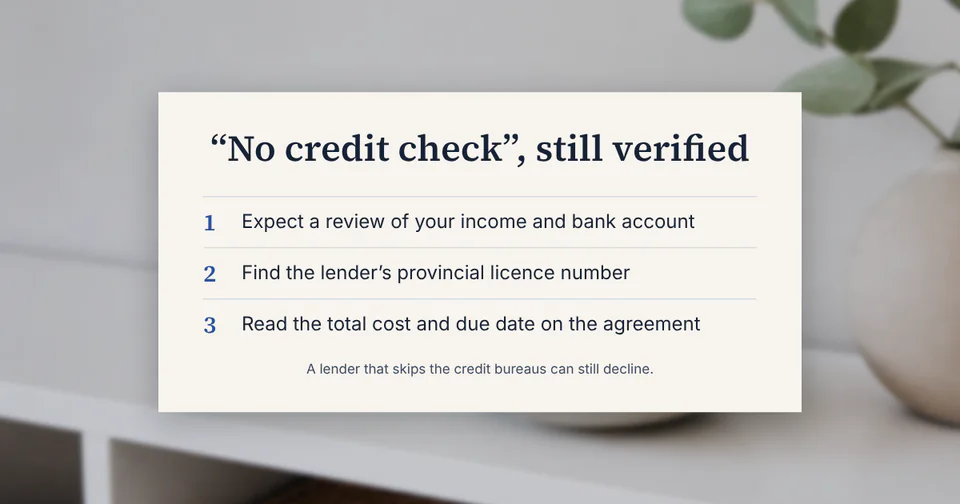
A payday lender that skips the credit bureaus still reviews your income and your bank account, and it can decline.
In the five provinces covered here, a payday loan of $1,500 or less, for 62 days or less, from a licensed lender costs at most $14 per $100 advanced (Criminal Code, s. 347.1; SOR/2024-114).
Find the lender's provincial licence number, then read the total cost and the due date on the agreement.
What a payday lender looks at instead
A payday loan is repaid from your next pay, so the lender's main question is simple: will that pay arrive, how regularly, and how much of it is already spoken for? To answer it, a lender typically looks at:
- Proof of regular income, from a job or from benefits.
- Recent bank statements, or a bank verification through a third-party portal.
- The payments that already leave your account each month.
- Whether you already have a payday loan outstanding.
Some payday lenders also check your credit file; others rely on these documents alone. Ask before you agree. A loan application checked with a credit bureau can leave a hard inquiry on your report, and a review based on bank data does not.
When your income comes from benefits, the deposits show up in that review like any other. Our guide on what a bank verification reveals when you receive benefits explains what a lender sees, and what it can and cannot do with it.
Limits your province sets, whatever your credit file says
Provincial law caps how much a payday lender can advance relative to your pay. In Ontario, the advance cannot exceed 50% of your net income. In British Columbia, the limit is 50% of your net pay, and in Saskatchewan half of your take-home pay. In Manitoba, a payday loan is limited to 30% of your net pay as calculated under the province's rules. A lender that skips the credit bureaus still has to respect these limits.
What it costs, with or without a credit check
The price of a payday loan does not depend on the type of check. Since January 1, 2025, the total cost of borrowing on a payday loan is capped at $14 per $100 advanced (Criminal Interest Rate Regulations, SOR/2024-114, s. 3). FCAC puts $14 per $100 over 14 days at about 365% APR.
What $300 for 14 days costs as a payday loan in an FCAC example, against $5.92 on a line of credit, $7.42 with overdraft protection and $7.65 as a credit card cash advance.
If your credit is already damaged, a payday loan does not repair it, and repeated loans can make the next tight month tighter. Our page on payday loans when your credit is poor looks at that situation in more detail. The full rules in each province, from cancellation periods to default charges, are in our guide to payday loan rules by province.
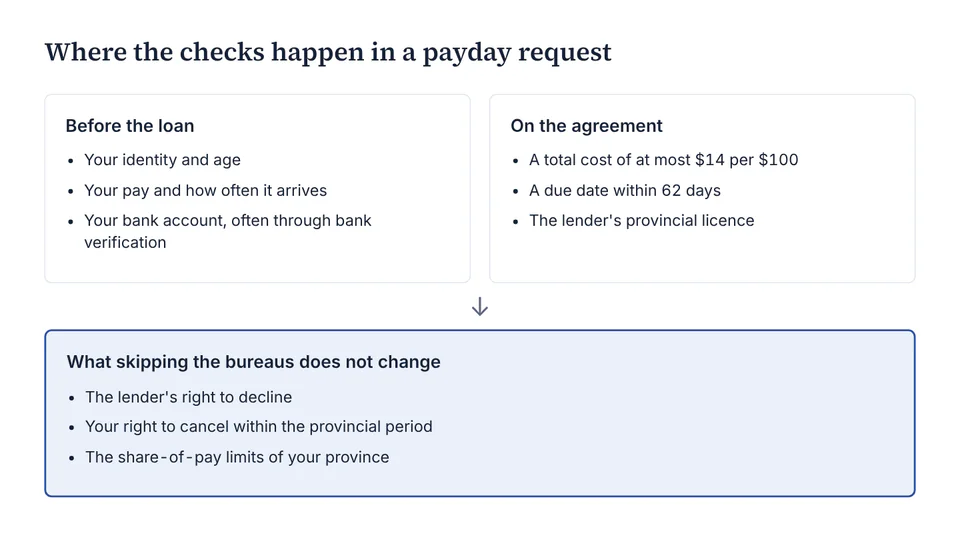
Where the checks happen in a payday request
Three moments. At each one, the lender decides and you remain free to stop.
Before the loan
- Your identity and age
- Your pay and how often it arrives
- Your bank account, often through bank verification
On the agreement
- A total cost of at most $14 per $100
- A due date within 62 days
- The lender's provincial licence
What skipping the bureaus does not change
- The lender's right to decline
- Your right to cancel within the provincial period
- The share-of-pay limits of your province
In plain terms: a payday lender that skips your credit file replaces it with your pay and your bank statements, and the cost ceiling stays exactly the same.
Be wary of payday ads that promise “no credit check” and “instant approval” together: a licensed lender still reviews your income and your account before deciding, and it can say no.
Cheaper options to look at first
For a small, short gap, a payday loan is rarely the cheapest route. FCAC lists alternatives: a line of credit, overdraft protection, a credit card cash advance (interest starts right away, on top of the advance fee), a small loan from your bank or credit union, a pay advance from your employer or help from family.
Some apps also advance very small sums based on your deposits rather than your credit file; our overview of cash advance apps sets out what each says it charges. For a larger need repaid over several months, an instalment personal loan stays under the 35% APR cap of the Criminal Code.
Check the lender before you share anything
Each province covered here requires payday lenders to hold a licence, and that includes lenders operating online. Ontario has a business licence search; Consumer Protection BC has a payday licence search; Saskatchewan uses FCAA411; Alberta's payday loans page explains how to check a business; in Manitoba, the Consumer Protection Office confirms licences by phone or email.
Ontario also warns about websites that present themselves as online payday lenders but collect personal information and sell it to a lender. getaloannow.ca is not a lender: it says so on every page and makes no decision on your loan. The licence to look for is the lender's own.
Part of: “No credit check” loans: what lenders check instead
Related pages
- “No credit check” installment loans: how lenders assess youWhy a lender looks closely before an installment loan, whatever its ad says, and how the term changes what you repay.
- “No credit check” e-Transfer loans: what happens before the money movesWhy the payout method says nothing about the credit decision, and what to watch for when a loan is sent by Interac e-Transfer.
Frequently asked questions
- Will a payday lender check my credit?
- It may or may not. Some payday lenders rely mostly on your income and bank statements; others also check your credit file. Ask before you agree: a loan application checked with a credit bureau can leave a hard inquiry on your report.
- How much can I borrow with a payday loan?
- The payday rules cover loans of $1,500 or less, for 62 days or less. Within that, your province limits the advance to a share of your pay: 50% of net income or net pay in Ontario and British Columbia, half of take-home pay in Saskatchewan, 30% of net pay in Manitoba.
- Can I cancel a payday loan after signing?
- Yes, within a short period that depends on your province: 2 business days in Ontario and in British Columbia, 2 days after signing in Alberta, 48 hours excluding Sundays and holidays in Manitoba, and until the end of the next business day in Saskatchewan. You return the money advanced.
- Does skipping the credit check make the loan cheaper?
- No. The cost ceiling is the same either way: at most $14 per $100 advanced. The type of check only changes what appears on your credit report.
Representative example: payday loan
- Amount
- $500
- Term
- 14 days
- Cost of borrowing
- $70.00
- Total to repay
- $570.00
- Rate
- 365% APR
In most provinces, a payday loan is repaid in one payment, usually on your next payday; in Alberta it runs 42 to 62 days, repaid in at least two instalments. In Ontario, British Columbia, Alberta, Manitoba and Saskatchewan, its total cost cannot exceed $14 per $100 borrowed (Criminal Interest Rate Regulations, since January 1, 2025). The example uses that maximum; actual terms are set by the lender.
Who may receive your request
To lenders and financial partners who may be able to respond, and only if your profile fits. The list of recipients will be published before any request is forwarded. Who they are, our conditions and how to check a licence
Sources
- Payday loans, Financial Consumer Agency of Canada (checked on October 30, 2026)
- Criminal Code, section 347.1 (payday loans), Justice Canada (checked on October 30, 2026)
- Criminal Interest Rate Regulations (SOR/2024-114), Justice Canada (checked on October 30, 2026)
- Payday loans: your rights, Government of Ontario (checked on October 30, 2026)
- Guide for payday lenders, Government of Ontario (checked on October 30, 2026)
- Payday loans, Consumer Protection BC (checked on October 30, 2026)
- Payday loans, Government of Alberta (checked on October 30, 2026)
- Payday loans, Manitoba Consumer Protection Office (checked on October 30, 2026)
- Borrowing from a payday lender: what you need to know, Financial and Consumer Affairs Authority of Saskatchewan (checked on October 30, 2026)
The getaloannow.ca editorial team
Writing and fact-checking · Official sources, cited and dated · Regularly updated content
Our guides are written and checked against official sources (provincial regulators, FCAC, Canada.ca), cited and dated on every page. They explain how borrowing works in Canada and are not personalized financial advice.
Published November 26, 2026 · Updated November 26, 2026
Request a payday loan
A payday lender sets its own terms within the provincial rules; reading them before you sign is your best protection.