Instant bank verification (IBV): what it shares and what to ask
By the getaloannow.ca editorial team · Writing and fact-checking
Updated November 26, 2026 · Written from the sources listed at the bottom of the page
When you apply for a loan, some lenders ask you to connect your bank account through a third-party service. This is called instant bank verification, or IBV. This guide explains what instant bank verification sends to the lender, what the Financial Consumer Agency of Canada (FCAC) has said about sharing your banking login details, the questions to ask before you agree, and what is known about the new framework for sharing banking data in Canada.
With IBV, you log in to your bank through a third party's portal, and the lender receives a copy of your statements and transactions.
In March 2018, the FCAC warned that sharing your banking login details with a third-party service may breach your account agreement and could leave you liable for unauthorized transactions.
Consumer-driven banking, often called open banking, has a new framework under Bill C-15, which received royal assent on March 26, 2026. Oversight and accreditation fall to the Bank of Canada.
What instant bank verification is
Before lending, a lender wants a picture of your income and your regular expenses. It can ask for pay stubs or statements you download yourself, or it can ask you to go through instant bank verification.
With IBV, the lender sends you to the portal of a specialized third-party provider. There, you choose your bank or credit union and enter your online banking login details. The provider then reads your accounts and sends the lender a copy of your statements and transactions.
How much history is shared depends on the provider and on what the lender asks for. There is no standard length, so it is worth asking before you agree. Whether a lender calls them IBV loans or simply asks you to verify your account, using bank verification remains your choice.
What the lender can see
A copy of your statements says much more than a pay stub. Depending on the period shared, the lender can see:
- Deposits from your employer or your other sources of income, and how regular they are;
- The payments that go out each month: rent, other loans, credit cards, subscriptions;
- Your account balances over the period;
- The detail of each transaction, including your everyday spending.
The lender uses this to confirm your identity, check your income and estimate what you have left once your regular payments are made. A lender that gives less weight to your credit report has to look at something else, and bank statements are often part of it. Our page on bad credit loans explains what lenders look at when your credit score is low.
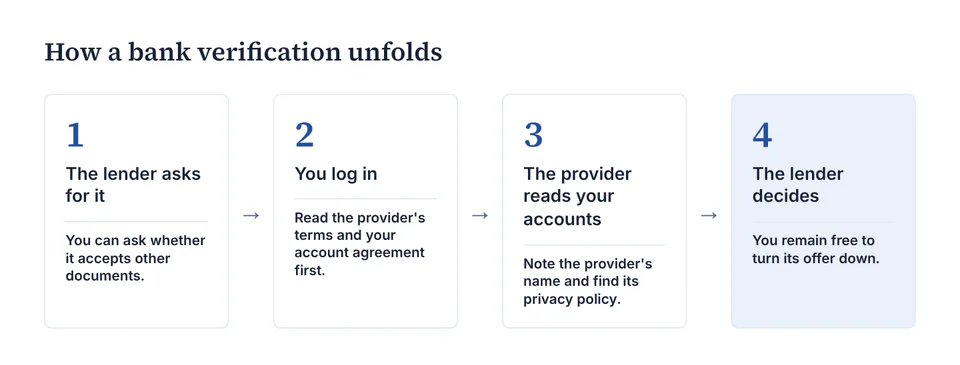
How a bank verification unfolds
Four steps, from the lender's request to its decision. You can stop at any of them.
The lender asks for it
After your application, it sends you a link to a provider's portal.
You can ask whether it accepts other documents.
You log in
On that portal, you choose your financial institution and enter your login details.
Read the provider's terms and your account agreement first.
The provider reads your accounts
It sends the lender a copy of your statements and transactions, over a period that depends on the provider.
Note the provider's name and find its privacy policy.
The lender decides
It assesses your situation, then makes you an offer, or not.
You remain free to turn its offer down.
In plain terms: IBV can speed up the review of your application, but it gives a third party access to your accounts through your login details. Whether to allow it is your decision, made knowing what it involves.
Be wary of a loan advertised with “no credit check”, as if no review at all were involved: every lender looks at your situation, through your credit report, your bank statements or both, and can say no.
What the FCAC says about your login details
In March 2018, the Financial Consumer Agency of Canada warned consumers about the risks of sharing their banking information with third-party online services. Its main points:
- Giving your banking login details to a third party may breach the agreement you have with your financial institution;
- If it does, you could be liable for losses from unauthorized transactions;
- It is therefore prudent to read your account agreement before you agree.
That warning does not target any particular provider. It applies to any service that asks for your login details in order to read your accounts on your behalf.
Before you agree: questions to ask
- Who is the provider, and where will your data be stored?
- How much account history will be sent to the lender, and for what purpose?
- How long will the lender and the provider keep the copy of your statements?
- Does access to your accounts end once the verification is done?
- Will the lender accept other documents instead, such as statements you download yourself?
If a lender also asks you for a payment before the loan is paid out, stop there. A legitimate lender does not ask for fees before paying out a loan, as government warnings about fake lenders point out. Report any such request to the Canadian Anti-Fraud Centre, and check the lender's licence with your provincial regulator before going further.
What is coming: consumer-driven banking
Canada is putting in place a framework for sharing banking data at the customer's request, known as consumer-driven banking or open banking. Bill C-15, which received royal assent on March 26, 2026, sets out that framework and gives oversight and accreditation to the Bank of Canada.
The practical details and the timetable are not all known as of the date of this page, so we do not speculate on what the framework will change for bank verification as it works today. In the meantime, the FCAC warning remains the safest guide.
What we ask for, and what we do not
getaloannow.ca does not ask for your online banking login details, your account numbers or your social insurance number. We do not work with any bank verification provider and do not recommend one.
If a lender offers you a bank verification, it is the lender's request, on its own terms. You can decline. The lender may then review your application another way, or decline it in turn.
Frequently asked questions
- Can I refuse instant bank verification?
- Yes. Nothing requires you to connect your account. The lender may then ask for other documents, review your application another way or decline it: that decision is its own.
- Does IBV replace a check of my credit report?
- Not necessarily. Bank verification reads your accounts, not your credit report. A lender may do one, the other or both for the same application, so ask what it plans to do. Checking your own credit report usually has no effect on your score, while a credit application with a lender can leave an inquiry on your file.
- Does the lender keep my statements?
- That depends on its privacy policy and on the provider's, which may be separate. Ask how long the copy will be kept before you agree, and read both policies.
Sources
- Financial Consumer Agency of Canada, Financial Consumer Agency of Canada (checked on October 21, 2026)
- Credit report and score basics, Financial Consumer Agency of Canada (checked on October 21, 2026)
- Canadian Anti-Fraud Centre, Canadian Anti-Fraud Centre (checked on October 21, 2026)
If you are considering a loan
- Bad credit loansWhat lenders look at when your credit score is low.
- Fast loansWhat decides how long a loan takes, and what no one can promise.
- “No credit check” loans: what lenders check insteadWhat lenders review when they skip a hard credit check, what stays true either way, and how to borrow without surprises.
Related pages
- Soft vs hard credit check: what each one does to your fileWhich credit checks show on your report and affect your score, which do not, and how to see your own inquiries.
Where to get help, free of charge
These organizations are non-profit or public bodies, separate from us.
- Credit Counselling CanadaFind a non-profit credit counsellor near you
- Financial Consumer Agency of Canada (FCAC)Tools to make a budget and understand your credit
- Canadian Anti-Fraud CentreReport a request for fees before a loan
The getaloannow.ca editorial team
Writing and fact-checking · Official sources, cited and dated · Regularly updated content
Our guides are written and checked against official sources (provincial regulators, FCAC, Canada.ca), cited and dated on every page. They explain how borrowing works in Canada and are not personalized financial advice.
Published November 26, 2026 · Updated November 26, 2026