“No credit check” e-Transfer loans: what happens before the money moves
By the getaloannow.ca editorial team · Writing and fact-checking · updated November 26, 2026
Ads for “no credit check” e-Transfer loans join two separate things in one phrase. Interac e-Transfer is a way to send money between accounts at participating Canadian banks and credit unions. The credit check, or its absence, belongs to the lender's decision, which happens earlier. A lender that pays out by e-Transfer still reviews your request first, and the transfer only comes after it has said yes.
getaloannow.ca is not a lender and sends no money. You can send a request; if your profile fits, it may be forwarded to lenders and financial partners who may be able to respond; a lender decides, sets its terms and chooses how it pays out.
getaloannow.ca is not a lender. We are a loan matching service. We do not lend money and make no credit decisions. Our role
- Two minutesAbout two minutes to fill in the request.
- No SIN requiredWe never collect your social insurance number.
- Your credit file is not affectedFilling in our form does not touch your credit file. A lender that reviews your request may check it.
- Free for youWe never charge you anything.
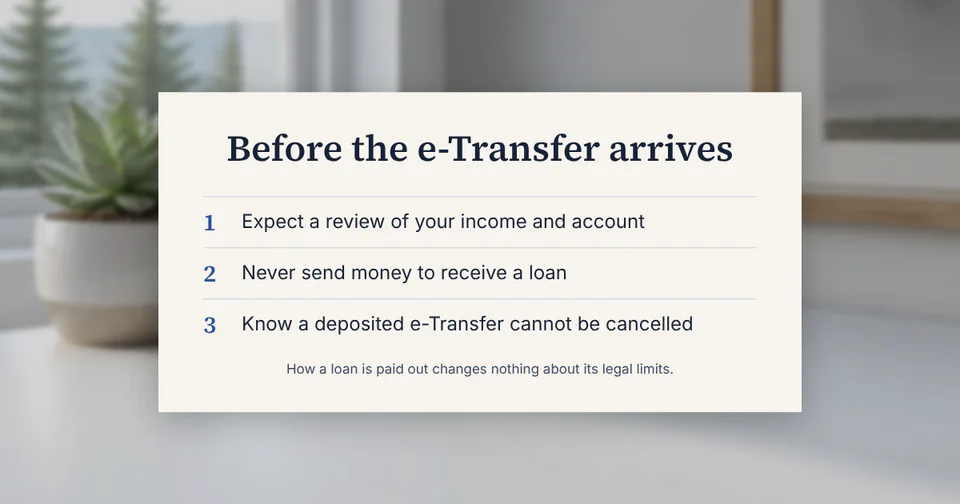
The e-Transfer is the last step. Before it, the lender assesses your income and your account, with or without your credit file.
How a loan is paid out changes nothing about its limits: an instalment loan cannot exceed 35% APR (Criminal Code, s. 347).
Never send money to receive a loan. A legitimate lender does not ask for a fee before paying out, and a deposited e-Transfer cannot be cancelled.
Two steps, not one
Every loan paid by e-Transfer goes through the same order. First, the lender reviews your request and decides. Then, if it approves, it sends the money. The phrase in the ad bundles both steps as if they were one, but they are separate, and only the second involves Interac.
Step one: the review
A lender that puts less weight on your credit file looks elsewhere: your income, the deposits in your account, the payments already leaving it. Some lenders gather that through a bank verification, where you log in to your bank through a third-party portal. Others also check your credit file. The Financial Consumer Agency of Canada (FCAC) explains that a hard inquiry appears on your credit report and affects your score, while a soft inquiry only appears on the version you can see and does not. Ask which kind the lender runs.
Step two: the transfer
Once a loan is approved and the agreement signed, the lender sends the funds. Interac says that an e-Transfer usually arrives within minutes, sometimes up to 30 minutes, depending on the institution. What usually takes longer is the review itself: most lenders pay out within 24 to 48 hours after approval. How the whole process unfolds is set out step by step in our guide on how e-Transfer loans work.
If speed is the main reason you are looking, our page on what “same-day” loans really involve explains what decides the timing and what no lender can promise.
What Interac says about the transfer itself
- Each bank or credit union sets its own e-Transfer limits and its own fees.
- With autodeposit, the money goes into your account without a security question, after the institution's usual fraud checks.
- Once an e-Transfer has been deposited, it cannot be cancelled.
That last point matters most when money is going the other way. If you send an e-Transfer to someone who promised you a loan, you cannot take it back.
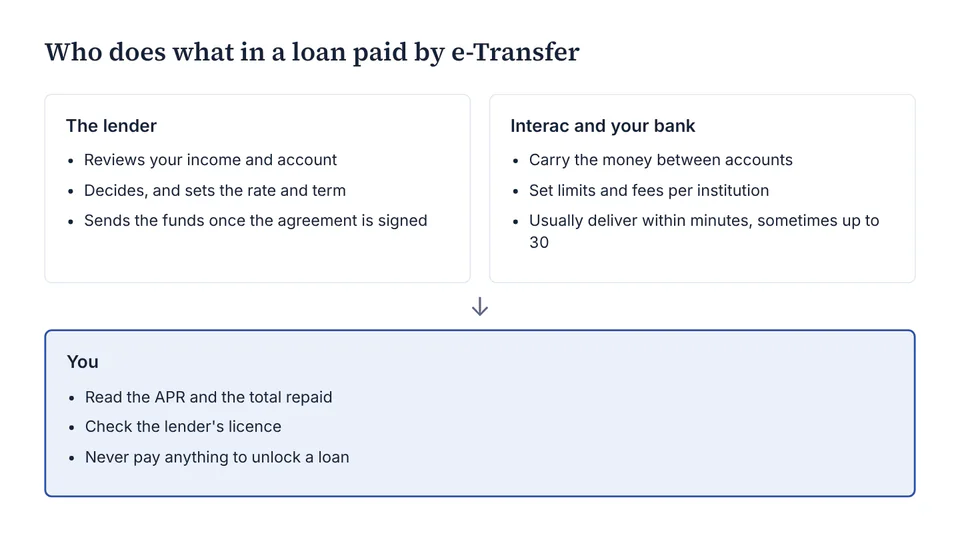
Who does what in a loan paid by e-Transfer
Three parties, three roles. Only the lender decides whether you get a loan.
The lender
- Reviews your income and account
- Decides, and sets the rate and term
- Sends the funds once the agreement is signed
Interac and your bank
- Carry the money between accounts
- Set limits and fees per institution
- Usually deliver within minutes, sometimes up to 30
You
- Read the APR and the total repaid
- Check the lender's licence
- Never pay anything to unlock a loan
In plain terms: the e-Transfer only moves money that a lender has already agreed to lend. It neither replaces the review nor makes the decision faster.
Be wary of ads that promise “no credit check” e-Transfer loans with “instant approval”: the transfer can be quick, but the lender's review comes first, and it can end in a refusal.
The scam that runs on e-Transfers
Fake lenders know that people in a hurry will pay a small sum to get a larger one. The pattern is familiar: the loan is approved at once, then a fee, a deposit or an “insurance” payment is requested by e-Transfer before the money can be released. A legitimate lender does not ask for a fee before paying out a loan. Because a deposited e-Transfer cannot be cancelled, money sent this way is very hard to recover. Do not pay, and report it to the Canadian Anti-Fraud Centre.
If the lender's answer is no
A refusal from a lender that skipped your credit file usually comes from what it did see: irregular income, or a budget with no room for a new payment. Sending many more requests at once will not change that, and each one checked with a credit bureau can leave a hard inquiry. Our page on borrowing when your credit score is low explains what lenders weigh and how to keep the amount and term in check. If you are already behind on several payments, a non-profit credit counsellor can review your budget with you: Credit Counselling Canada lists member agencies by province.
To see how e-Transfer payouts fit among other options, our overview of e-Transfer loans sets out what lenders ask for and what the agreement should show.
Part of: “No credit check” loans: what lenders check instead
Related pages
- “No credit check” payday loans: what lenders still verifyWhat a payday lender checks when it skips your credit file, what the loan costs, and how to check the lender first.
- “No credit check” installment loans: how lenders assess youWhy a lender looks closely before an installment loan, whatever its ad says, and how the term changes what you repay.
Frequently asked questions
- Is a loan paid by e-Transfer approved faster?
- Not necessarily. The transfer usually arrives within minutes, sometimes up to 30 minutes, depending on the institution, but the lender's review comes first. Most lenders pay out within 24 to 48 hours after approval.
- Do I need autodeposit to receive the money?
- No. Autodeposit only means the money goes into your account without a security question, after your institution's usual fraud checks. Without it, you accept the transfer yourself.
- A lender wants me to send an e-Transfer first. Should I?
- No. A legitimate lender does not ask for a fee before paying out a loan, and a deposited e-Transfer cannot be cancelled. Do not pay, and report it to the Canadian Anti-Fraud Centre.
- Does an e-Transfer loan cost less because the payout is cheaper?
- No. The cost depends on the rate, the amount and the term on your agreement, not on how the funds are sent. An instalment loan still cannot exceed 35% APR.
Who may receive your request
To lenders and financial partners who may be able to respond, and only if your profile fits. The list of recipients will be published before any request is forwarded. Who they are, our conditions and how to check a licence
Representative example
- Amount
- $2,000
- Term
- 24 months
- Monthly payment
- $111.78
- Total repaid
- $2,682.83
- Cost of borrowing
- $682.83
- Rate
- 29.96% APR
The annual percentage rate (APR) includes the cost of borrowing. The annual rate of a personal loan cannot exceed 35% APR (Criminal Code). In British Columbia and Manitoba, a lender also needs a high-cost credit licence above 32% (32% or more in Alberta): see your province page. Actual terms are set by the lender.
Sources
- Interac e-Transfer: frequently asked questions, Interac Corp. (checked on October 30, 2026)
- Credit report and score basics, Financial Consumer Agency of Canada (checked on October 30, 2026)
- Criminal Code, section 347 (criminal interest rate), Justice Canada (checked on October 21, 2026)
- Find a credit counsellor, Credit Counselling Canada (checked on October 21, 2026)
- Canadian Anti-Fraud Centre, Government of Canada (checked on October 21, 2026)
The getaloannow.ca editorial team
Writing and fact-checking · Official sources, cited and dated · Regularly updated content
Our guides are written and checked against official sources (provincial regulators, FCAC, Canada.ca), cited and dated on every page. They explain how borrowing works in Canada and are not personalized financial advice.
Published November 26, 2026 · Updated November 26, 2026
Request a personal loan
The lender decides and chooses how to pay out; you decide whether its terms suit you.