Soft vs hard credit check: what each one does to your file
By the getaloannow.ca editorial team · Writing and fact-checking
Updated November 26, 2026 · Written from the sources listed at the bottom of the page
Soft vs hard credit check: the difference sounds technical, but it decides whether a look at your credit file leaves a trace that other lenders will see. This guide explains both kinds of inquiry as the Financial Consumer Agency of Canada (FCAC) defines them, which requests usually lead to each, why too many applications can weigh on your score, and how to see the inquiries in your own file at Equifax Canada and TransUnion Canada, for free.
A credit check that appears on your credit report and affects your credit score. Credit and loan applications are typical examples.
A credit check that only appears on the version of your report you can see. It does not affect your score.
Ordering your own credit report has no effect on your score. You can get it free online from both Equifax Canada and TransUnion Canada.
Two kinds of inquiry
Each time someone looks at your credit file, the credit bureau records it as an inquiry. FCAC sorts inquiries into two groups, and the line between them is about visibility and impact.
Hard inquiries, or hard hits
In FCAC's words, hard inquiries, also called hard hits, are credit checks that appear on your credit report, and they affect your credit score. Lenders who consult your file later can see them. A hard inquiry tells them that you have recently asked for credit somewhere.
Soft inquiries, or soft hits
Soft inquiries, also called soft hits, only appear on the version of your credit report that you can see. They do not affect your credit score, and lenders who look at your file do not see them. They exist in the record, but they do not count against you.
Which requests usually lead to a hard inquiry
FCAC gives examples of situations that usually lead to a hard inquiry:
- An application for a credit card.
- An application for a mortgage.
- An application for a loan or another form of credit.
- Some rental applications and some job applications.
The common thread is a decision about you that depends on your credit: someone weighs whether to extend credit, rent you a home or, in some cases, hire you. If you are not sure which kind of check a business plans to run, ask before you give your consent. It is a fair question, and the answer tells you whether the request will show on your report.
Checking your own file
Ordering your own credit report has no effect on your score. That makes reading your file the safest first step before any application: you see what a lender would see, including the hard inquiries already recorded, without adding one. In 2017, FCAC recommended ordering your report from both bureaus at least once a year. Our guide to getting your credit score free in Canada shows the options in each province.
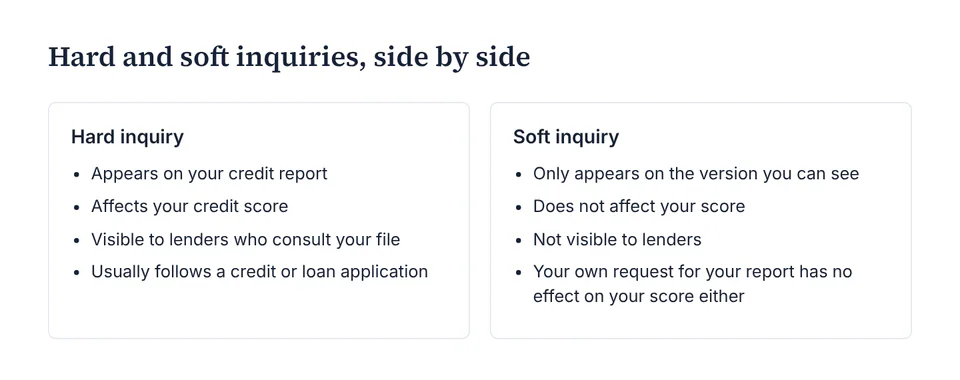
Hard and soft inquiries, side by side
Based on FCAC's definitions. The bureaus do not publish how much each inquiry weighs in their formulas.
Hard inquiry
- Appears on your credit report
- Affects your credit score
- Visible to lenders who consult your file
- Usually follows a credit or loan application
Soft inquiry
- Only appears on the version you can see
- Does not affect your score
- Not visible to lenders
- Your own request for your report has no effect on your score either
In plain terms: a hard inquiry is a trace other lenders can read; a soft inquiry is a note only you will find.
Be wary of ads that present “no credit check” as if no review took place: at most, a lender may avoid a hard inquiry, but it still assesses your situation, through your bank statements, your income or both, and it can say no.
Why many applications in a short time can hurt
FCAC notes that too many credit applications can hurt your score. The bureaus keep their formulas private, so nobody outside them can tell you exactly how much one inquiry weighs or for how long. What you can control is the number. Send applications only when you are ready to borrow, and avoid spreading the same request across many places in the same week.
Inquiries are only one factor. FCAC also names your payment history, how much of your available credit you use and the length of your credit history. Our guide on what actually raises a credit score goes through each one and the habits that help.
How to see your inquiries for free
Both bureaus give access to your credit file without charge. Each report includes the inquiries recorded in your file.
| Bureau | Online | By phone or mail |
|---|---|---|
| Equifax Canada | Free report through a myEquifax account; Equifax also provides a free score | Automated phone line 1-800-465-7166, or by mail with two pieces of ID |
| TransUnion Canada | Free consumer disclosure online; the free score is included only for residents of Quebec and Ontario | 1-800-663-9980, or by mail; in-person service in Burlington ended on July 1, 2026 |
Read the inquiries line by line. A hard inquiry from a business you never dealt with, or for credit you never asked for, is worth raising with the bureau that holds the file. Each bureau explains on its website how to report an error.
When a lender asks to check your credit
A lender that reviews a loan request may run a hard inquiry, a soft one, a bank verification, or several of these. You can ask which before you agree. If your score is already low, the question matters even more, because each extra hard inquiry adds to what lenders see. Our page on what lenders weigh when your credit score is low explains how the rest of your file counts alongside the score.
Frequently asked questions
- Does checking my own credit score lower it?
- No. Ordering your own credit report has no effect on your score, according to FCAC. It is the safest way to see what lenders see.
- Can lenders see my soft inquiries?
- No. According to FCAC, soft inquiries only appear on the version of your credit report that you can see. Hard inquiries appear on the report that lenders consult.
- How many points does a hard inquiry cost?
- Nobody outside the bureaus can say. Equifax Canada and TransUnion Canada keep their formulas private. FCAC only states that hard inquiries affect your score and that too many credit applications can hurt it.
- Is a loan application always a hard inquiry?
- Not always. FCAC lists loan applications among the typical examples of hard inquiries, but some lenders rely mostly on other information, such as your bank statements and income. Ask the lender which kind of check it plans before you consent.
Sources
- Credit report and score basics, Financial Consumer Agency of Canada (checked on October 30, 2026)
- Improving your credit score, Financial Consumer Agency of Canada (checked on October 30, 2026)
- Ordering your credit report and credit score, Financial Consumer Agency of Canada (checked on October 30, 2026)
- How to get a free credit report, Equifax Canada (checked on October 30, 2026)
- Consumer disclosure, TransUnion Canada (checked on October 30, 2026)
If you are considering a loan
- Bad credit loansWhat lenders look at when your credit score is low.
- “No credit check” loans: what lenders check insteadWhat lenders review when they skip a hard credit check, what stays true either way, and how to borrow without surprises.
Related pages
- Instant bank verification (IBV): what it shares and what to askInstant bank verification gives a lender a copy of your bank statements. What it shares, the FCAC warning on your login details and what to ask first.
Where to get help, free of charge
These organizations are non-profit or public bodies, separate from us.
- Credit Counselling CanadaFind a non-profit credit counsellor near you
- Financial Consumer Agency of Canada (FCAC)Tools to make a budget and understand your credit
- Canadian Anti-Fraud CentreReport a request for fees before a loan
The getaloannow.ca editorial team
Writing and fact-checking · Official sources, cited and dated · Regularly updated content
Our guides are written and checked against official sources (provincial regulators, FCAC, Canada.ca), cited and dated on every page. They explain how borrowing works in Canada and are not personalized financial advice.
Published November 26, 2026 · Updated November 26, 2026