“No credit check” loans in British Columbia: licences and checks
By the getaloannow.ca editorial team · Writing and fact-checking · updated November 26, 2026
Ads for “no credit check” loans in British Columbia often reach people who have been turned down before and want to avoid another refusal. A lender may well rely on your income and bank account more than on your credit file. In BC, though, the most useful thing to check is not the lender's credit policy but its licence: above 32%, a lender needs one from Consumer Protection BC, and it must show it on its website.
getaloannow.ca is not a lender. You can send a request; if your profile fits, it may be forwarded to lenders and financial partners who may be able to respond; a lender reviews it and decides on its own terms. The loan presented here is an instalment loan, repaid in regular payments.
getaloannow.ca is not a lender. We are a loan matching service. We do not lend money and make no credit decisions. Our role
- Two minutesAbout two minutes to fill in the request.
- No SIN requiredWe never collect your social insurance number.
- Your credit file is not affectedFilling in our form does not touch your credit file. A lender that reviews your request may check it.
- Free for youWe never charge you anything.
A lender in British Columbia that skips your credit file still assesses your income and budget, and it can decline.
Above 32% APR or annual interest rate, a lender needs a high-cost credit grantor licence (since May 1, 2022). No personal loan can exceed 35% APR (Criminal Code).
Find the licence on the lender's website, confirm it in Consumer Protection BC's search, then read the APR and the total repaid.

The band between 32% and 35%
British Columbia defines high-cost credit as a credit product for personal, family or household purposes with an APR or annual interest rate above 32%. Since May 1, 2022, a business offering it needs a high-cost credit grantor licence from Consumer Protection BC. The federal cap of 35% APR, in force since January 1, 2025, still applies on top. In practice, a licensed high-cost lender works in a narrow band: above 32%, but below 35%.
A lender that relies less on your credit file may price for more risk, which can put its offer in this band. That makes the licence the first thing to look for, before you share any document.
Who needs the licence, and who does not
- A licence is issued for each location and is valid for up to 3 years.
- The licence must also be displayed on the lender's website.
- Banks, credit unions and extraprovincial trust corporations are exempt.
- Payday lenders need their own payday licence to lend to BC residents, wherever they are located, online and by phone included.
Consumer Protection BC's licence search covers high-cost credit grantors, and a separate payday licence search covers payday lenders. Search under the exact business name shown on the agreement.
What the lender reviews instead of your credit file
Skipping the credit file does not mean skipping the assessment. A lender that puts less weight on Equifax or TransUnion looks at your income, the deposits in your account and the payments already leaving it, sometimes through a bank verification on a third-party portal. Others still check your file, and the type of check matters: the Financial Consumer Agency of Canada (FCAC) explains that a hard inquiry appears on your credit report and affects your score, while a soft inquiry does not.
For British Columbia residents, Equifax Canada offers a free credit report and score. TransUnion Canada's free consumer disclosure includes the report but not the score, which TransUnion offers through a paid subscription. The report is what matters most: read it line by line before a lender does.
The rules at a glance
- Regulator: Consumer Protection BC, which licenses payday lenders and high-cost credit grantors and handles complaints.
- Licence: above 32%, the lender needs a high-cost credit grantor licence (since May 1, 2022).
- Limits: no personal loan above 35% APR (Criminal Code); above 32%, the loan is high-cost credit.
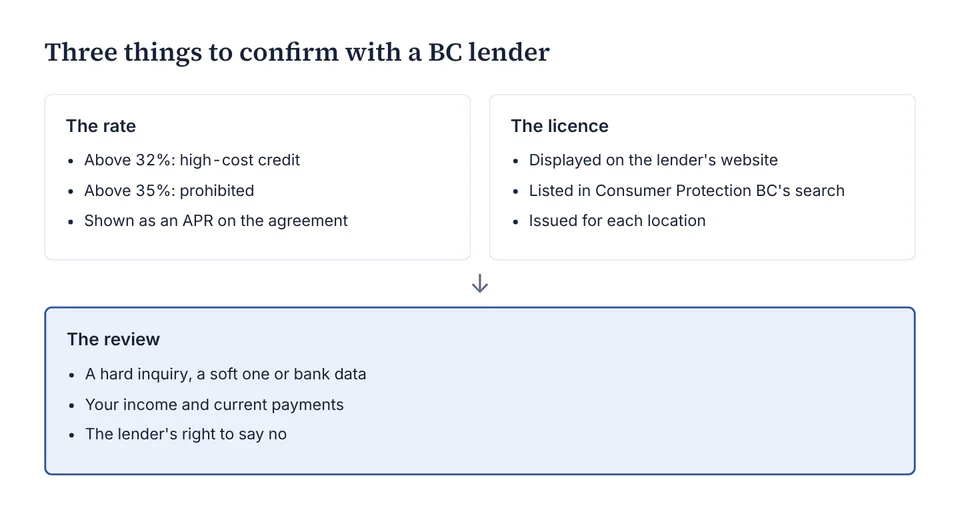
Three things to confirm with a BC lender
Whatever check it runs, these answers tell you whether the loan is within the rules.
The rate
- Above 32%: high-cost credit
- Above 35%: prohibited
- Shown as an APR on the agreement
The licence
- Displayed on the lender's website
- Listed in Consumer Protection BC's search
- Issued for each location
The review
- A hard inquiry, a soft one or bank data
- Your income and current payments
- The lender's right to say no
In plain terms: in British Columbia, a loan priced above 32% comes from a licensed high-cost lender or should not be offered at all, whatever the lender says about your credit.
Be wary of BC ads that promise “no credit check” loans “for everyone”: a licensed lender still reviews your situation before deciding, and it can say no.
Related options in British Columbia
If a low score is behind your search, our page on bad credit loans in British Columbia looks at what lenders in the province weigh besides the score. If speed is the concern, our page on e-Transfer loans in British Columbia explains when the funds move and why the review comes first. The wider provincial picture, from payday rules to complaints, is on our page on borrowing in British Columbia.
Non-profit help with debt in BC
If debts are already piling up, advice may help more than a new loan. The Credit Counselling Society is a non-profit organization in British Columbia that describes itself as an accredited charity and a member of Credit Counselling Canada; it can be reached at 1-888-527-8999 or through nomoredebts.org. A legitimate lender never asks for a fee before paying out a loan: if one does, report it to Consumer Protection BC and to the Canadian Anti-Fraud Centre.
Part of: “No credit check” loans: what lenders check instead
In other provinces
- “No credit check” loans in Alberta: what to verify firstWhat an Alberta lender reviews when it skips your credit file, the licence at 32% or more, and where to check a business.
- “No credit check” loans in Ontario: what lenders still checkWhat an Ontario lender reviews when it skips your credit file, the rules that apply, and where to get help.
- “No credit check” loans in Manitoba: the rules that still applyWhat a Manitoba lender reviews when it skips your credit file, the licence above 32%, and how to confirm it with the province.
Frequently asked questions
- What counts as high-cost credit in British Columbia?
- A credit product for personal, family or household purposes with an APR or annual interest rate above 32%. The lender needs a high-cost credit grantor licence from Consumer Protection BC, and the loan still cannot exceed 35% APR.
- Do credit unions need a high-cost credit licence?
- No. Banks, credit unions and extraprovincial trust corporations are exempt from the BC high-cost credit licence.
- Is my TransUnion score free in British Columbia?
- TransUnion's free consumer disclosure gives you the report; its score is offered through a paid subscription. Equifax Canada provides a free report and score. Ordering your own report has no effect on your score.
- Can a BC lender decline me without checking my credit?
- Yes. It can decline based on your income, your bank statements or what you already pay each month.
Who may receive your request
To lenders and financial partners who may be able to respond, and only if your profile fits. The list of recipients will be published before any request is forwarded. Who they are, our conditions and how to check a licence
Representative example
- Amount
- $2,000
- Term
- 24 months
- Monthly payment
- $111.78
- Total repaid
- $2,682.83
- Cost of borrowing
- $682.83
- Rate
- 29.96% APR
The annual percentage rate (APR) includes the cost of borrowing. The annual rate of a personal loan cannot exceed 35% APR (Criminal Code). In British Columbia and Manitoba, a lender also needs a high-cost credit licence above 32% (32% or more in Alberta): see your province page. Actual terms are set by the lender.
Sources
- High-cost credit granting, Consumer Protection BC (checked on October 21, 2026)
- High-cost credit products, Consumer Protection BC (checked on October 21, 2026)
- Check a licence, Consumer Protection BC (checked on October 30, 2026)
- The risks of borrowing money from unlicensed lenders, Consumer Protection BC (checked on October 30, 2026)
- Credit report and score basics, Financial Consumer Agency of Canada (checked on October 30, 2026)
- Consumer disclosure, TransUnion Canada (checked on October 30, 2026)
- Criminal Code, section 347 (criminal interest rate), Justice Canada (checked on October 21, 2026)
The getaloannow.ca editorial team
Writing and fact-checking · Official sources, cited and dated · Regularly updated content
Our guides are written and checked against official sources (provincial regulators, FCAC, Canada.ca), cited and dated on every page. They explain how borrowing works in Canada and are not personalized financial advice.
Published November 26, 2026 · Updated November 26, 2026
Request a personal loan in British Columbia
A BC lender sets its own terms within the licence rules; reading them is your decision to make.