E-transfer loans: an instalment loan paid by Interac e-Transfer
By the getaloannow.ca editorial team · Writing and fact-checking · updated November 26, 2026
An e-transfer loan is an ordinary instalment loan: you borrow a set amount and repay it in regular payments over a fixed term. The only difference is how the money reaches you. Once the lender has approved the loan and you have signed the agreement, it sends the funds by Interac e-Transfer to your email address or mobile number, instead of a cheque or a direct deposit.
That detail matters less than the ads suggest. The delivery method does not change the rate, the total you repay, the checks the lender runs or the rules of your province. This page explains what an e-transfer loan is, what the transfer itself can and cannot speed up, and how to spot the scams that use e-transfers as bait.
getaloannow.ca is not a lender. We are a loan matching service. We do not lend money and make no credit decisions. Our role
- Two minutesAbout two minutes to fill in the request.
- No SIN requiredWe never collect your social insurance number.
- Your credit file is not affectedFilling in our form does not touch your credit file. A lender that reviews your request may check it.
- Free for youWe never charge you anything.
Watch
Read the transcript
E-transfer loans: what actually changes when a loan is paid by Interac e-Transfer? Less than the ads suggest. Let me explain.
First, a common mix-up. An e-transfer loan isn't a special kind of loan. It's usually an ordinary instalment loan: you borrow a set amount and repay it in regular payments, so you know from the start when the loan ends and what it costs in total. E-transfer only describes how the money reaches you.
And that's the last of five steps. You send a request. The lender verifies your information. It approves or declines. You read and sign the agreement. Only then does it send the e-transfer.
So, two different delays. According to Interac, a transfer is almost instant, but can take up to 30 minutes, depending on the bank. Before that, most lenders pay out within 24 to 48 hours after approval. That's not a guarantee. And each bank sets its own e-transfer limits, so a lender may need another way to send a larger amount.
What the e-transfer doesn't change: the lender's decision, the cost, and your rights. Under the Criminal Code, the APR still can't go above 35%. And in British Columbia and Manitoba above 32%, or in Alberta at 32% or more, the lender also needs a high-cost credit licence. Your province's rules and your agreement apply exactly as they would for a loan paid by direct deposit.
E-transfers are also popular with fraudsters. The classic trap: a so-called lender says your loan is approved, then asks you to send a fee by e-transfer first. The Canadian Anti-Fraud Centre says asking for an upfront fee is illegal in most provinces. And Interac notes that once a transfer is deposited, it can't be reversed.
In short: an e-transfer loan is only as fast as the lender's approval, and only as affordable as its total repaid. The way the money arrives changes neither. getaloannow.ca is not a lender. We're a free loan matching service.
“E-transfer” describes how the money is delivered, not the kind of loan. The approval, the rate and the repayment are decided exactly as for any personal loan.
Everywhere in Canada, a personal loan cannot exceed 35% APR (Criminal Code, s. 347, since January 1, 2025). In British Columbia and Manitoba above 32%, and in Alberta at 32% or more, the lender also needs a provincial high-cost credit licence.
Check the lender's licence where your province requires one, read the APR and the total repaid, and never pay a fee to “release” a loan.
What an e-transfer loan is
Lenders that advertise e-transfer loans usually offer instalment loans: a lump sum repaid in equal payments, so you know from the start when the loan ends and what it costs in total. Requests sent through getaloannow.ca are for this kind of loan, from $1,000 to $15,000, repaid over several months or years. getaloannow.ca is not a lender: if your profile fits, your request may be forwarded to lenders and financial partners who may be able to respond; a lender makes its own decision and chooses how it pays out.
A payday loan sent by e-transfer is a different product. It is short, capped by law at $1,500, repaid out of your next pay and priced per $100 borrowed. If you are weighing that option, our page on payday loans paid by e-transfer sets out its own rules and costs.
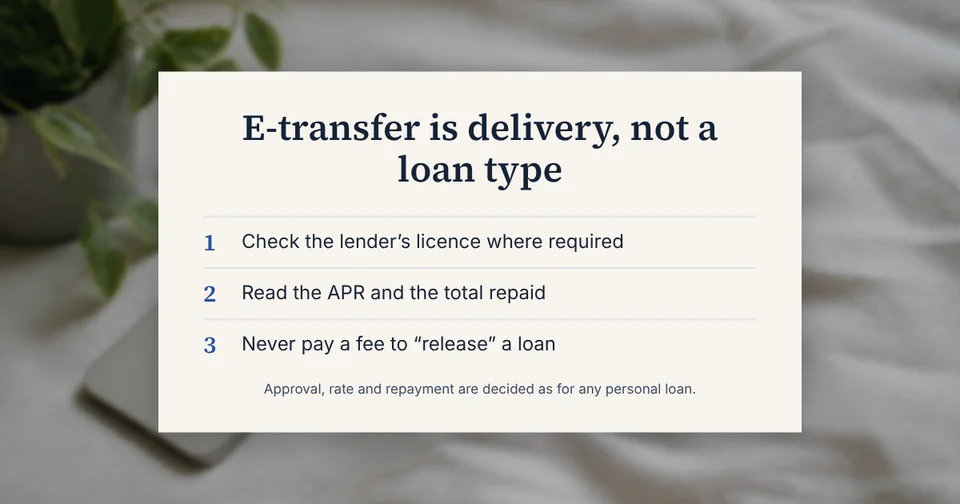
What the e-transfer changes, and what it does not
Interac e-Transfer is a service for moving money between accounts at participating Canadian banks and credit unions. For a borrower, it changes one thing: the last step, when approved funds travel from the lender to your account.
- It does not change the decision. The lender still checks your identity, your income and what you already owe, often with your credit report and sometimes with a bank verification.
- It does not change the cost. The APR, the cost of borrowing and the total repaid are the same whatever the delivery method.
- It does not change your rights. Your province's rules and your agreement apply exactly as for a loan paid by direct deposit.
Some advertisements also promote cash advances sent by e-transfer through mobile apps. These are small advances with their own terms, not instalment loans; our guide to app advances sent by e-transfer explains how they differ.
Timing, honestly
The e-transfer is usually the fastest part of the process, and it is also the part that comes last. According to Interac, funds usually arrive within minutes, sometimes up to 30 minutes, depending on the institution. If you have set up Autodeposit, the money is deposited without a security question, after the usual fraud checks.
Everything before that step depends on the lender: reviewing your request, possibly asking for documents, making an offer and waiting for your signature. Most lenders pay out within 24 to 48 hours after approval, with no guarantee. Each bank or credit union also sets its own limits for e-transfers, so ask the lender how it will send the full amount of your loan.
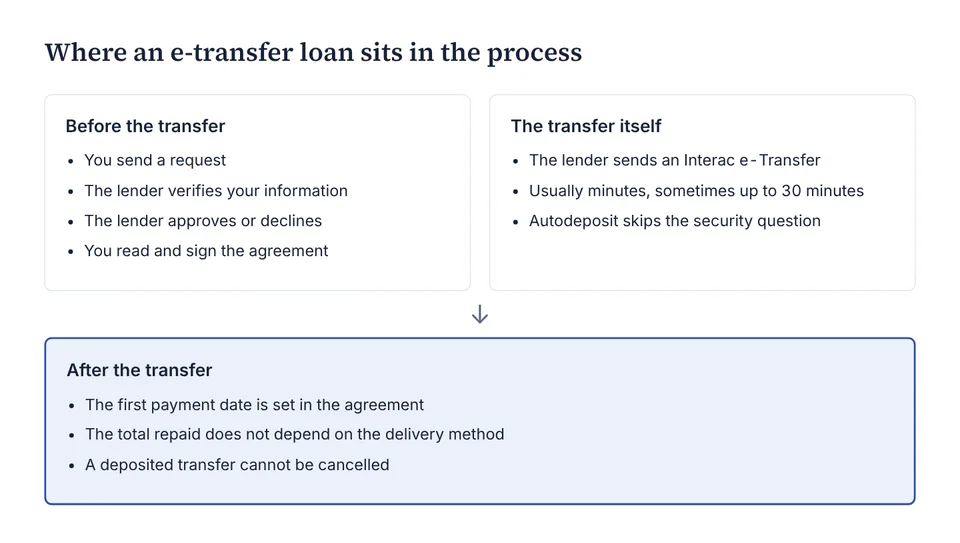
Where an e-transfer loan sits in the process
The transfer is one step among five. The four before it decide when it happens.
Before the transfer
- You send a request
- The lender verifies your information
- The lender approves or declines
- You read and sign the agreement
The transfer itself
- The lender sends an Interac e-Transfer
- Usually minutes, sometimes up to 30 minutes
- Autodeposit skips the security question
After the transfer
- The first payment date is set in the agreement
- The total repaid does not depend on the delivery method
- A deposited transfer cannot be cancelled
In plain terms: an e-transfer loan is only as fast as the lender's approval, and only as affordable as its APR and total repaid.
Be wary of ads for “instant e-transfer loans”: Interac describes how quickly a transfer moves once it is sent, but no one can promise in advance when a lender will approve a loan and send it.
Staying safe: the scams that use e-transfers
E-transfers are convenient for scammers too, because the money moves quickly and, according to Interac, a deposited transfer cannot be cancelled. The most common trap for borrowers is the advance-fee scam: a “lender” announces that your loan is approved, then asks you to send an e-transfer for insurance, a deposit or an administration fee before releasing the money. The loan never arrives.
A legitimate lender does not ask you to pay a fee before paying out the loan, as government warnings about fake lenders point out. If anyone asks, stop, send nothing, and report it to the Canadian Anti-Fraud Centre and to your bank. Interac also advises confirming an unexpected transfer notification through another channel and not clicking links from senders you do not know.
The surest protection is to confirm who you are dealing with before you share anything. Our guide on how to check a lender's licence in your province shows the official tool in each province, step by step.
E-transfer loans by province
The delivery method is the same everywhere; the licences, regulators and tools to check a lender are not. Choose your province.
Ontario, British Columbia, Alberta, Manitoba and Saskatchewan
Each page sets out which licence applies in the province, where to check it, and who to contact if something goes wrong.
- E-transfer loans in Ontario: what to check before you sign
Instalment loans paid by e-transfer in Ontario: the rate cap, the provincial lookup tool and the Consumer Beware List.
- E-transfer loans in British Columbia: licences and safe borrowing
Instalment loans paid by e-transfer in BC: the 32% line, the licence a lender must display online, and how to check it.
- E-transfer loans in Alberta: the licence, the rate and your checks
Instalment loans paid by e-transfer in Alberta: the licence required at 32% or more, the lookup tools and the consumer alerts.
- E-transfer loans in Manitoba: licences, contacts and safe borrowing
Instalment loans paid by e-transfer in Manitoba: the licence above 32%, issued per location, and how to confirm it.
- E-transfer loans in Saskatchewan: the rules and how to check a lender
Instalment loans paid by e-transfer in Saskatchewan: the federal cap, the FCAA411 lookup and what to read on the agreement.
Part of: Fast loans: a decision in minutes
Related pages
- “Same-day” loans: what can and cannot happen in a dayWhat can realistically happen within a day, and which steps depend on the lender, the verification and your bank.
- Weekend loans: what happens to a request sent on a SaturdayYou can send a request on a Saturday; what happens next depends on the lender's hours and on how it pays out.
Frequently asked questions
- Is an e-transfer loan easier to get than another loan?
- No. The way the funds are sent does not change how the lender reviews your request. It still looks at your income, your current payments and, most of the time, your credit report, and it can decline.
- How long does the e-transfer take once my loan is approved?
- According to Interac, funds usually arrive within minutes, sometimes up to 30 minutes, depending on the institution. Before that, the lender has to approve the loan and receive your signed agreement: most lenders pay out within 24 to 48 hours after approval, with no guarantee.
- Do I need Autodeposit?
- No. Without Autodeposit, you accept the transfer by answering a security question or following your bank's steps. With Autodeposit, Interac says the money is deposited automatically after the usual fraud checks.
- A lender wants an e-transfer from me before sending my loan. Is that normal?
- No. A legitimate lender does not ask for a fee before paying out a loan. Do not send anything, and report the request to the Canadian Anti-Fraud Centre and to your bank.
Who may receive your request
To lenders and financial partners who may be able to respond, and only if your profile fits. The list of recipients will be published before any request is forwarded. Who they are, our conditions and how to check a licence
Representative example
- Amount
- $2,000
- Term
- 24 months
- Monthly payment
- $111.78
- Total repaid
- $2,682.83
- Cost of borrowing
- $682.83
- Rate
- 29.96% APR
The annual percentage rate (APR) includes the cost of borrowing. The annual rate of a personal loan cannot exceed 35% APR (Criminal Code). In British Columbia and Manitoba, a lender also needs a high-cost credit licence above 32% (32% or more in Alberta): see your province page. Actual terms are set by the lender.
Sources
- Interac e-Transfer: frequently asked questions, Interac Corp. (checked on October 30, 2026)
- Safely receive money with Interac e-Transfer Autodeposit, Interac Corp. (checked on October 30, 2026)
- Protecting personal payments, Interac Corp. (checked on October 30, 2026)
- Criminal Code (R.S.C. 1985, c. C-46), section 347, Justice Laws Website (checked on October 21, 2026)
- Canadian Anti-Fraud Centre, Canadian Anti-Fraud Centre (checked on October 21, 2026)
The getaloannow.ca editorial team
Writing and fact-checking · Official sources, cited and dated · Regularly updated content
Our guides are written and checked against official sources (provincial regulators, FCAC, Canada.ca), cited and dated on every page. They explain how borrowing works in Canada and are not personalized financial advice.
Published November 26, 2026 · Updated November 26, 2026
Request a personal loan
The request takes about two minutes. The decision, and how the funds are sent, belong to the lender.