Emergency loans: what to try first, and how to borrow safely
By the getaloannow.ca editorial team · Writing and fact-checking
Updated November 26, 2026 · Written from the sources listed at the bottom of the page
When a bill lands that you cannot cover, an emergency loan is not always the first answer, and it is rarely the cheapest. If you are thinking “I need money now”, a short delay from the business you owe, a session with a non-profit credit counsellor, or a product you already hold at your own bank may solve the problem at a lower cost. This guide sets out the options open to people in Ontario, British Columbia, Alberta, Saskatchewan and Manitoba, in the order worth trying them, with what each one asks of you and what it does not fix.
Read the transcript
Emergency loans: what can you try before you borrow? When a bill lands that you can’t cover, a loan can feel like the only way out. Sometimes it is. But the Financial Consumer Agency of Canada lists other options worth knowing. Let me walk you through them.
The first is time. The FCAC suggests asking for more time to pay your bills, or asking a lender to defer a payment.
The second is what you may already have. The agency mentions cashing in vacation days, asking your employer for a pay advance, or borrowing from family or friends. At your own bank or credit union, there may be a loan, a line of credit, or overdraft protection on your chequing account. A cash advance on a credit card is on the list too.
The third is advice. The FCAC points to an accredited credit counsellor among the people who can help. And it notes that no reputable credit counselling agency will charge you for the first meeting.
And if a loan is still the answer? Then look at the total cost, not just the payment. Since January 1, 2025, the annual percentage rate on a personal loan can’t go above 35%. Payday loans are capped differently, at 14% of what you borrow, which the FCAC says can work out to an annual rate of roughly 365% over two weeks.
Two last warnings from official sources. The FCAC says to beware of unlicensed lenders, and to check that a lender is licensed in your province. And the Canadian Anti-Fraud Centre reminds that in most provinces, it’s illegal to ask for a fee before you receive your loan.
So, to sum up: before an emergency loan, there may be time to ask for, options you already have, and advice whose first meeting is free. And if you borrow, know the total cost first. And just so you know: getaloannow.ca is not a lender. We’re a free loan matching service.
Before you borrow, see whether the expense can be delayed, spread out or covered another way. If a loan is still needed, take one whose total cost you know before you sign.
Across Canada, a personal loan with an annual percentage rate (APR) above 35% is prohibited by the Criminal Code (s. 347), since January 1, 2025. Urgency does not change that limit.
A “lender” that asks you to pay a fee before it sends the money, whatever the reason given, is showing the classic mark of a scam.
First, buy yourself some time
An emergency pushes you to decide fast. Yet many pressing bills can wait a few weeks if you speak up before the due date. Those weeks can be enough to find something cheaper than a new loan, or to realize that a smaller sum will do.
Talk to the people you owe
Call your landlord, your utility, your phone provider or your credit card issuer before the payment is due. Explain what happened and ask for a payment arrangement or a short extension. Nothing obliges them to agree, but the question is easier to ask before a missed payment than after one. Write down what was agreed, with the date and the name of the person you spoke to.
Get budget help from a non-profit
Non-profit credit counselling agencies help you sort out what is truly urgent, what can wait, and whether borrowing makes sense at all. They have no connection with us. The Credit Counselling Canada directory lists agencies across the country. Depending on where you live, you can also contact:
- Credit Canada, in Ontario;
- Credit Counselling Society, in British Columbia and Saskatchewan;
- Money Mentors, in Alberta;
- Community Financial Counselling Services, in Manitoba.
If you want to work through the numbers on your own first, the Financial Consumer Agency of Canada (FCAC) offers a budget planner that shows where your money goes each month.
Look at what you already have
Your bank or credit union
If you already have a line of credit, check its rate and the room left on it: you know the institution and its terms. You can also ask your bank or credit union for a line of credit, a higher limit or a personal loan. Like any lender, they review your file and can say no, but asking costs nothing.
An advance on your pay
Some employers agree to pay part of a salary early. It is not an obligation and the practice varies from one workplace to the next, so ask your manager or your payroll department. An advance shrinks your next pay by the same amount: plan for it, or the same gap will open again a month later.
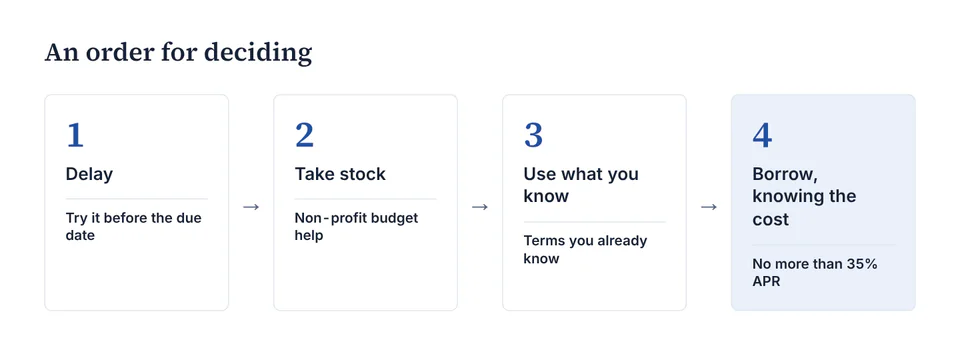
An order for deciding
Four steps, from the least binding to the most. Stop as soon as one of them solves the problem.
Delay
Ask the business you owe for an extension or a payment arrangement.
Try it before the due date
Take stock
Book a budget session with a non-profit credit counselling agency.
Non-profit budget help
Use what you know
An existing line of credit, the bank or credit union where you already have an account, a pay advance if your employer offers one.
Terms you already know
Borrow, knowing the cost
A personal loan from a lender licensed where required in your province, with the APR and the total repaid in writing.
No more than 35% APR
In plain terms: start with what costs little or nothing, a delay or budget advice, then with what you already know, and only borrow from a new lender once you know the full cost.
Be wary of ads that promise “money in 30 minutes” or “instant funds”: most lenders pay out within 24 to 48 hours after approval, and no timeline is ever guaranteed.
If a loan is still the answer
A personal loan can cover an expense the other options do not. An instalment loan is repaid in equal payments over a set term, so you know from the start when it ends. Before you sign, check three things:
- The lender's licence, where your province requires one: in British Columbia and Manitoba above 32%, and in Alberta at 32% or more, a lender offering high-cost credit needs a provincial licence;
- The annual percentage rate (APR), which cannot exceed 35% anywhere in Canada;
- The total you will repay, not only the amount of each payment.
Urgency does not speed up a lender's checks. A lender still looks at your income, your current payments and, most of the time, your credit report before making an offer. We explain what decides how fast a loan is paid out, and which parts of that timeline are in the lender's hands.
The highest APR a personal loan to an individual can carry in Canada since January 1, 2025 (Criminal Code, s. 347). Above it, the loan is prohibited.
Payday loans: the costly shortcut
A payday loan is a small, short loan you repay out of your next pay. It is often the first thing people see when they search for quick money, and it is a costly way to borrow over a short period. Payday loans follow their own rules: in provinces with their own payday loan regime, they are exempt from the 35% cap (Criminal Code, s. 347.1) but cannot cost more than $14 per $100 borrowed, under the federal regulation in force since January 1, 2025.
Ontario, British Columbia, Alberta and Saskatchewan each have their own payday loan rules. In Saskatchewan, for example, a payday loan is limited to 50% of your net pay, one loan at a time. Because the whole amount is due within a short time, a payday loan can leave you short again on the next payday. The FCAC's page on payday loans explains the costs and the alternatives. We do not handle payday loans.
Scams that target people in a hurry
Fake lenders know that people who need money quickly check less. Watch for these signs:
- You are told the loan is approved before anyone has looked at your situation;
- You are asked for an “application fee”, “insurance” or a deposit before the money is sent;
- The business shows no licence or address you can check with your province's regulator.
A legitimate lender does not ask you to pay fees before it pays out the loan: government warnings about fake lenders make this point. If it happens to you, do not pay, and report it to the Canadian Anti-Fraud Centre.
Frequently asked questions
- How quickly can I get an emergency loan?
- It depends on the lender, not on how urgent your need is. Most lenders pay out within 24 to 48 hours after approval, and the approval itself depends on how quickly your information can be checked. No timeline is guaranteed, so plan for a delay when you speak to the people you owe.
- What can a non-profit credit counsellor do for me?
- A counsellor helps you look at your whole budget: what comes in, what goes out, which bills are most pressing and whether a loan would make things better or worse. Credit Canada, Credit Counselling Society, Money Mentors and Community Financial Counselling Services are non-profit agencies; the Credit Counselling Canada directory lists others. Ask about any cost when you book.
- Can I borrow if my credit score is low?
- Some lenders review requests from people with a low score, often at a higher rate, and none can promise to accept you. Whatever your score, the APR cannot exceed 35%. Check your own credit report first: it usually has no effect on your score, while a credit application with a lender can leave an inquiry on your file.
Sources
- Criminal Code (R.S.C. 1985, c. C-46), section 347, Justice Laws Website (checked on October 21, 2026)
- Criminal Interest Rate Regulations (SOR/2024-114), Justice Laws Website (checked on October 21, 2026)
- Payday loans, Financial Consumer Agency of Canada (checked on October 21, 2026)
- Make a budget, Financial Consumer Agency of Canada (checked on October 21, 2026)
- Find a credit counsellor, Credit Counselling Canada (checked on October 21, 2026)
- Canadian Anti-Fraud Centre, Canadian Anti-Fraud Centre (checked on October 21, 2026)
If you are considering a loan
- Fast loansThe real timeline of a request, and what the lender controls.
- Personal loansWhat a loan really costs, beyond the monthly payment.
Related pages
- How fast can you get a loan? Each step, and who controls itThe five steps from request to funding, who controls each one, and the delays you can avoid.
- How e-transfer loans work: Interac e-Transfer, Autodeposit and fraudWhat happens when a lender pays you by Interac e-Transfer: timing, Autodeposit, why a deposit is final, and the scams to recognize.
Where to get help, free of charge
These organizations are non-profit or public bodies, separate from us.
- Credit Counselling CanadaFind a non-profit credit counsellor near you
- Financial Consumer Agency of Canada (FCAC)Tools to make a budget and understand your credit
- Canadian Anti-Fraud CentreReport a request for fees before a loan
The getaloannow.ca editorial team
Writing and fact-checking · Official sources, cited and dated · Regularly updated content
Our guides are written and checked against official sources (provincial regulators, FCAC, Canada.ca), cited and dated on every page. They explain how borrowing works in Canada and are not personalized financial advice.
Published November 26, 2026 · Updated November 26, 2026