How fast can you get a loan? Each step, and who controls it
By the getaloannow.ca editorial team · Writing and fact-checking
Updated November 26, 2026 · Written from the sources listed at the bottom of the page
How fast can you get a loan? The honest answer is that it depends less on you than on the lender and the banks, and that nobody can give you a firm time before your file has been reviewed. What can be described precisely is the path itself: five steps, from the request to the money in your account, each controlled by a different party. Knowing who controls which step shows you where time is really lost, and which delays you can avoid on your own.
A request takes minutes; the lender's review takes from minutes to several days; most lenders pay out within 24 to 48 hours after approval. None of it is guaranteed.
Speed never changes the limits. A personal loan cannot exceed 35% APR anywhere in Canada (Criminal Code, s. 347, since January 1, 2025).
A business that promises a payout time before it has looked at your situation, or asks for a fee to speed things up, is not describing a real lending process.
The five steps, and who controls each one
1. The request: you
This is the only step that is entirely in your hands. An online request usually takes a few minutes: the amount, your province, your employment and income, your contact details. On a matching service like getaloannow.ca, the request is about two minutes long. We are not a lender: we review the request and, if your profile fits, may forward it to lenders and financial partners who may be able to respond. Our page on how a request travels from our form to a lender describes that hand-off in detail.
2. Verification: the lender, with your help
Before deciding, the lender confirms three things: who you are, what you earn and what you already owe. It may check your credit report, ask for a pay stub or a recent statement, or offer an online bank verification, where you log into your bank through a third-party portal and the lender receives a copy of your transactions. Our guide to how instant bank verification works explains what is shared and what to read first. This step can take minutes or several days, depending on the lender and on how complete your file is.
3. Approval: the lender alone
The decision belongs to the lender, and so does its timing. Some lenders reply within minutes, others within a few business days. The reply can be a yes, a no, or a request for more information, which sends you back to step 2.
4. Signature: you
If the lender makes an offer, you receive an agreement to read and sign, usually online. You decide how long this takes, and it is the one step worth slowing down: the APR, the total repaid, the number of payments and the date of the first one are all on that document.
5. Funding: the lender, then the banks
Once the agreement is signed, the lender sends the money. Most lenders pay out within 24 to 48 hours after approval. The method matters for the last stretch: by Interac e-Transfer, according to Interac, funds usually arrive within minutes, sometimes up to 30 minutes, depending on the institution; other methods follow the lender's and your bank's own processing times.
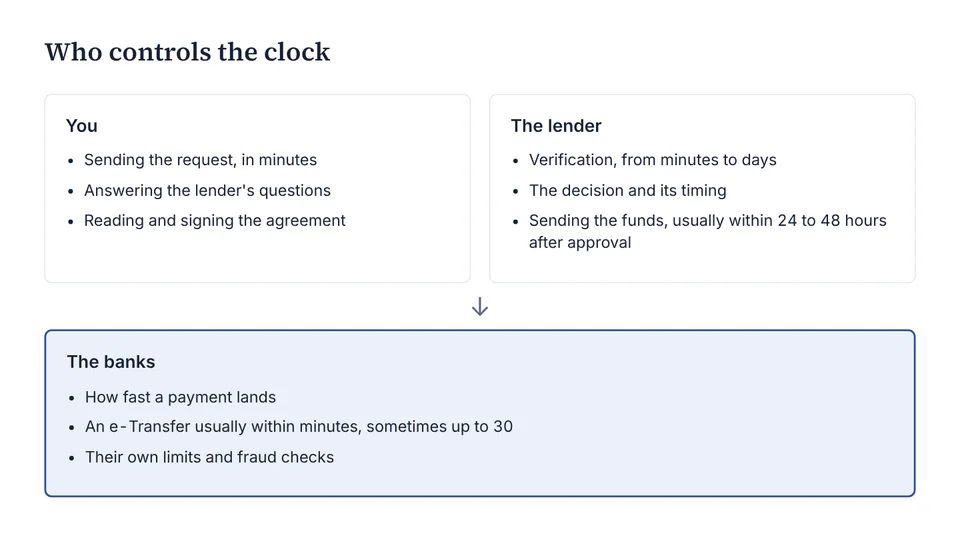
Who controls the clock
The same five steps, sorted by who decides how long they take.
You
- Sending the request, in minutes
- Answering the lender's questions
- Reading and signing the agreement
The lender
- Verification, from minutes to days
- The decision and its timing
- Sending the funds, usually within 24 to 48 hours after approval
The banks
- How fast a payment lands
- An e-Transfer usually within minutes, sometimes up to 30
- Their own limits and fraud checks
In plain terms: you control the start and the signature, the lender controls the middle, and the banks control the last few minutes or hours.
Be wary of ads that promise “money in 30 minutes” or “instant approval”: the steps a lender must take cannot be timed in advance, and most lenders pay out within 24 to 48 hours after approval, with no guarantee.
What slows things down
Most delays come from a file the lender has to complete. These are the ones you can prevent:
- An income that does not match the documents. Declare what you actually receive, not a rounded-up figure.
- Missing or expired documents. Have a valid photo ID and your latest pay stub or proof of benefits ready.
- An unanswered message. Use an email address and phone number you check, and look in your spam folder.
- Payments left out of your request. The lender will see them in your credit report or bank statements, and will come back to you.
- Asking for more than your income supports. A lender may come back with a smaller offer, or decline.
Other delays are outside your control: the lender's working hours, a weekend or holiday, a manual review, your bank's own checks. Plan for them by giving yourself a margin before the date you need the money.
Faster is not always cheaper
The products that pay out fastest are not necessarily the least expensive. Payday loans are short loans repaid out of your next pay, often marketed for their speed, and a costly way to borrow: the federal cap of $14 per $100 borrowed works out to about 365% APR over 14 days, according to the Financial Consumer Agency of Canada. Our page on payday loans and the rules in each province sets out how they work.
An instalment loan takes the same verification steps but spreads repayment over months, at an APR that cannot exceed 35%. Whatever you choose, the cost depends on the rate, the amount and the term, never on how quickly the money arrived. Before you sign, our loan calculator shows what a given rate and term add up to in total.
When speed becomes a risk
Urgency is what scams rely on. A “lender” that says your loan is approved and asks you to pay a fee to release it, by e-transfer or otherwise, is not a lender. A legitimate lender does not ask for fees before paying out a loan, as government warnings about fake lenders point out. If it happens, send nothing and report it to the Canadian Anti-Fraud Centre.
Frequently asked questions
- What is the fastest realistic timeline for a loan?
- When every step goes smoothly, a request can be reviewed, approved, signed and paid out within a day or two. Most lenders pay out within 24 to 48 hours after approval, and the approval itself depends on how quickly your information can be verified. Nobody can promise a timeline in advance.
- Does a bank verification make the process faster?
- It can, because it replaces sending documents by email. Read what you are agreeing to first: the Financial Consumer Agency of Canada has reminded consumers that sharing banking credentials with a third-party service may go against their account agreement.
- Why did the lender ask me for more documents?
- Usually because something in the request could not be confirmed: an income that differs from the pay stub, a payment that appears in the credit report, or an ID that has expired. Sending what is asked quickly is the best way to get the review moving again.
- Does applying through a matching service add time?
- Our part is short: we review the request and, if your profile fits, may forward it to lenders and financial partners who may be able to respond. The lender's review and payout timing are its own. We do not lend money and make no credit decisions.
Sources
- Interac e-Transfer: frequently asked questions, Interac Corp. (checked on October 30, 2026)
- Payday loans, Financial Consumer Agency of Canada (checked on October 30, 2026)
- Risks of sharing banking information with third-party online services, news release of March 2018 (French version), Financial Consumer Agency of Canada (checked on October 21, 2026)
- Criminal Code (R.S.C. 1985, c. C-46), section 347, Justice Laws Website (checked on October 21, 2026)
- Criminal Interest Rate Regulations (SOR/2024-114), Justice Laws Website (checked on October 21, 2026)
- Canadian Anti-Fraud Centre, Canadian Anti-Fraud Centre (checked on October 21, 2026)
If you are considering a loan
- Personal loansHow an instalment loan works and what it costs in total.
- Fast loans: a decision in minutesFast loans in Ontario, BC, Alberta, Saskatchewan and Manitoba: a reply sometimes within minutes, never guaranteed. What we control, what the lender does.
Related pages
- How e-transfer loans work: Interac e-Transfer, Autodeposit and fraudWhat happens when a lender pays you by Interac e-Transfer: timing, Autodeposit, why a deposit is final, and the scams to recognize.
- Emergency loans: what to try first, and how to borrow safelyNeed money now? Before an emergency loan, try a payment deal, non-profit budget help or your own bank. Then borrow only at a known total cost.
Where to get help, free of charge
These organizations are non-profit or public bodies, separate from us.
- Credit Counselling CanadaFind a non-profit credit counsellor near you
- Financial Consumer Agency of Canada (FCAC)Tools to make a budget and understand your credit
- Canadian Anti-Fraud CentreReport a request for fees before a loan
The getaloannow.ca editorial team
Writing and fact-checking · Official sources, cited and dated · Regularly updated content
Our guides are written and checked against official sources (provincial regulators, FCAC, Canada.ca), cited and dated on every page. They explain how borrowing works in Canada and are not personalized financial advice.
Published November 26, 2026 · Updated November 26, 2026