How e-transfer loans work: Interac e-Transfer, Autodeposit and fraud
By the getaloannow.ca editorial team · Writing and fact-checking
Updated November 26, 2026 · Written from the sources listed at the bottom of the page
To understand how e-transfer loans work, separate the loan from the transfer. The loan is an agreement with a lender: an amount, a rate, a repayment schedule. The transfer is how the lender delivers the money once that agreement is signed, using Interac e-Transfer, the same service people use to send money to a friend. This guide explains the transfer side, relying only on what Interac itself states, and the fraud warnings that matter most when money moves this way.
An e-transfer loan is a loan paid out by Interac e-Transfer. The transfer is usually quick, but it starts only after the lender has approved the loan and you have signed.
The delivery method changes nothing about the limits: a personal loan cannot exceed 35% APR anywhere in Canada (Criminal Code, s. 347, since January 1, 2025).
A “lender” that asks you to send it an e-transfer before it pays out your loan is showing the classic mark of an advance-fee scam.
What Interac e-Transfer is
Interac e-Transfer is a service for moving money between accounts at participating Canadian banks and credit unions. To send one, the sender needs online or mobile banking at a participating institution and the recipient's email address or mobile number. The recipient gets a notification and deposits the money into their own account.
For a borrower, this means the lender does not need your account number to send the funds: an email address or phone number is enough. It also means the money arrives in the account you choose when you deposit it, unless you have set up Autodeposit.
Depositing the money: security question or Autodeposit
Without Autodeposit
You receive a notification, open it through your own online banking, answer the security question the sender set, if there is one, and choose the account. The lender should give you the answer separately.
With Autodeposit
If you have registered your email address or mobile number for Autodeposit with your bank, Interac says the money is deposited automatically into the linked account, without a security question, after the usual fraud checks. That removes a step and the risk of a mistyped answer.
How long it takes
According to Interac, funds usually arrive within minutes, sometimes up to 30 minutes, depending on the institution. Interac also says e-Transfer lets you send and receive money at any time. That timing describes the transfer once the lender sends it, not the loan as a whole: before the transfer, the lender has to review your request, verify your information, approve the loan and receive your signed agreement. Most lenders pay out within 24 to 48 hours after approval, with no guarantee.
Each bank or credit union sets its own limits on how much can be sent or received by e-Transfer, and its own fees. If the loan is larger than what a single transfer allows, ask the lender how it will send the full amount.
Why a deposited transfer is final
According to Interac, a sender can cancel an e-Transfer only until it has been deposited; once deposited, it cannot be cancelled. For a borrower receiving a loan, that is reassuring. For anyone sending money, it is the reason to be certain before you press send: if you pay a fake “lender” by e-transfer, the money is usually gone. If you think you have sent money to a fraudster, contact your bank or credit union and the Canadian Anti-Fraud Centre right away.
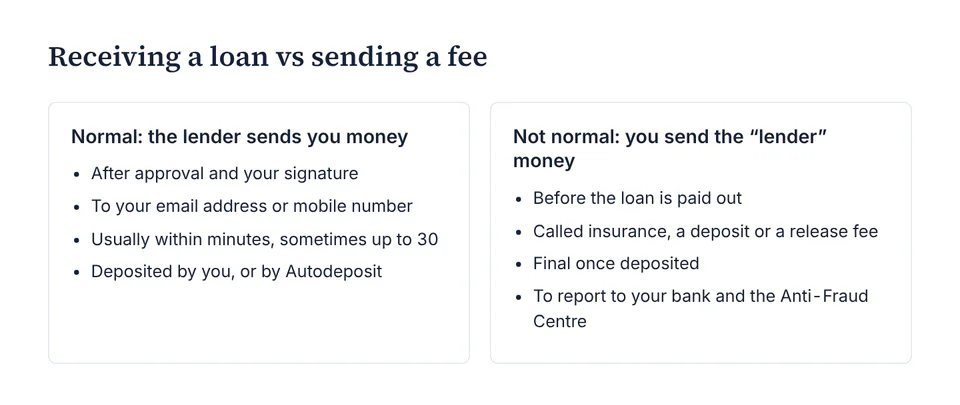
Receiving a loan vs sending a fee
The same service, used in opposite directions. Only one of them is normal when you borrow.
Normal: the lender sends you money
- After approval and your signature
- To your email address or mobile number
- Usually within minutes, sometimes up to 30
- Deposited by you, or by Autodeposit
Not normal: you send the “lender” money
- Before the loan is paid out
- Called insurance, a deposit or a release fee
- Final once deposited
- To report to your bank and the Anti-Fraud Centre
In plain terms: when you borrow, the e-transfer should only ever travel from the lender to you, until your first scheduled repayment.
Be wary of offers of “instant funds” by e-transfer: Interac describes how fast a transfer moves once sent, but no one can know in advance when a lender will approve a loan and send it.
Fraud warnings worth knowing
Interac lists advance-fee loan scams among the common frauds that use e-Transfer. The pattern is consistent: an offer that looks easy, an announcement that you are approved, then a request to pay something before the money is released. A legitimate lender does not ask for fees before paying out a loan, as government warnings about fake lenders point out.
Interac's own advice applies to borrowers as well:
- If you receive a transfer notification you did not expect, confirm it with the sender through another channel before you act.
- Do not click links in messages from senders you do not know; open your banking app or website yourself.
- Forward suspicious e-Transfer notifications to phishing@interac.ca.
- If you have been defrauded, contact your financial institution and the Canadian Anti-Fraud Centre right away.
Two further checks protect you before any money moves. First, confirm who the lender is: our guide on how to check a lender's licence in your province shows the official tool in each province. Second, read the agreement for the APR, the total repaid and the payment schedule.
Payday loans and app advances sent by e-transfer
Many products use e-transfer as their selling point. Payday loans are small, short loans repaid out of your next pay, capped at $1,500 and at $14 per $100 borrowed in provinces with their own regime; our page on payday loans paid by e-transfer explains their rules and costs. Cash advance apps send small advances with their own terms and fees; before you link one to your bank account, our guide on whether cash advance apps are safe sets out what to check.
Whatever the product, the e-transfer tells you how the money travels, not what it costs. The cost is in the APR and the total repaid, and the protection is in the lender's licence and the agreement.
Frequently asked questions
- Do I need to give the lender my bank account number to receive an e-transfer?
- Not for the transfer itself: an e-Transfer is sent to an email address or mobile number. A lender may still ask for banking information for other reasons, such as setting up repayments or verifying your income, so read what you are agreeing to.
- What is Autodeposit, and should I use it?
- Autodeposit lets e-Transfers sent to your registered email address or mobile number go straight into a chosen account, without a security question, after the usual fraud checks, according to Interac. It is a convenience, not a requirement: you can receive a loan either way.
- Can a lender take back an e-transfer once I have deposited it?
- According to Interac, an e-Transfer can be cancelled only until it is deposited. Once you have deposited the loan, your obligations are those of the agreement: the repayment schedule, and any early repayment terms it sets out.
- Why has my e-transfer not arrived?
- According to Interac, a transfer usually arrives within minutes but can take up to 30 minutes depending on the institution. If it takes longer, check your spam folder for the notification, confirm with the lender that it was sent and to which address, and contact your bank.
Sources
- Interac e-Transfer: frequently asked questions, Interac Corp. (checked on October 30, 2026)
- Interac e-Transfer 101: everything you need to know about sending and receiving money, Interac Corp. (checked on October 30, 2026)
- Send and receive money with Interac e-Transfer, Interac Corp. (checked on October 30, 2026)
- Safely receive money with Interac e-Transfer Autodeposit, Interac Corp. (checked on October 30, 2026)
- Protecting personal payments, Interac Corp. (checked on October 30, 2026)
- Interac e-Transfer: the smart, secure way to send your own money (fraud brochure), Interac Corp. (checked on October 30, 2026)
- Canadian Anti-Fraud Centre, Canadian Anti-Fraud Centre (checked on October 21, 2026)
If you are considering a loan
- Personal loansHow an instalment loan works and what to read on the agreement.
- Fast loans: a decision in minutesFast loans in Ontario, BC, Alberta, Saskatchewan and Manitoba: a reply sometimes within minutes, never guaranteed. What we control, what the lender does.
Related pages
- Emergency loans: what to try first, and how to borrow safelyNeed money now? Before an emergency loan, try a payment deal, non-profit budget help or your own bank. Then borrow only at a known total cost.
- How fast can you get a loan? Each step, and who controls itThe five steps from request to funding, who controls each one, and the delays you can avoid.
Where to get help, free of charge
These organizations are non-profit or public bodies, separate from us.
- Credit Counselling CanadaFind a non-profit credit counsellor near you
- Financial Consumer Agency of Canada (FCAC)Tools to make a budget and understand your credit
- Canadian Anti-Fraud CentreReport a request for fees before a loan
The getaloannow.ca editorial team
Writing and fact-checking · Official sources, cited and dated · Regularly updated content
Our guides are written and checked against official sources (provincial regulators, FCAC, Canada.ca), cited and dated on every page. They explain how borrowing works in Canada and are not personalized financial advice.
Published November 26, 2026 · Updated November 26, 2026