How to check a lender's licence: a step-by-step guide by province
By the getaloannow.ca editorial team · Writing and fact-checking
Updated November 26, 2026 · Written from the sources listed at the bottom of the page
Knowing how to check a lender's licence takes a few minutes and can spare you a costly mistake. Each province has its own regulator and its own tool, and the licence to look for depends on the kind of loan and its rate. This guide gives you the steps for Ontario, British Columbia, Alberta, Saskatchewan and Manitoba, the official lender licence lookup in each province, and the red flags that should make you stop before you sign.
Read the transcript
Is that lender licensed? In Canada, you can check it yourself. Here’s how, in one minute.
Start with the lender’s exact business name, as it appears on the agreement or the website. Then note the type of loan and its rate. That tells you which licence to look for.
Payday lenders need a provincial licence. In Ontario, the province says not to take a payday loan unless you see an Ontario licence number, and it offers an online search tool. For other high-cost loans, the line is above 32% in British Columbia and Manitoba, and 32% or more in Alberta, which has its own tool to find a licensed business.
Can’t find the lender? The Canadian Anti-Fraud Centre suggests contacting your provincial consumer protection agency to confirm it’s legitimate. And if someone asks for a fee before you get your loan, its rule is simple: never send money first. getaloannow.ca is not a lender.
Write down the lender's exact business name, find out what kind of loan and what rate you are being offered, then look the business up with your province's official tool.
Everywhere in Canada, a loan's APR cannot exceed 35%. British Columbia and Manitoba require a high-cost credit licence above 32%, Alberta at 32% or more, and payday lenders need a provincial licence.
A lender that asks for a fee before paying out the loan, or that you cannot find with the regulator, is a reason to stop.
Before you search: three things to note
A licence search only works if you search for the right thing. Before you open your province's tool, gather three pieces of information from the offer, the website or the agreement:
- The lender's exact business name, as it appears on the agreement or the website. The brand name in an advertisement is not always the legal name.
- The address of the location you are dealing with, if there is one. In Saskatchewan, a payday lender needs a licence for each location, and in Manitoba a high-cost credit licence is also issued per location.
- The kind of loan and its annual percentage rate (APR): a payday loan, or an instalment loan repaid over months, and at what rate. That tells you which licence to look for.
Which licence to look for
The Criminal Code sets the outer limit everywhere: since January 1, 2025, a loan with an APR above 35% is prohibited. Below that cap, the provinces add their own requirements:
- British Columbia: above 32% (APR or annual interest rate), a high-cost credit grantor licence from Consumer Protection BC, required since May 1, 2022. Payday lenders have their own licence.
- Alberta: at 32% or more, a high-cost credit business licence, under the High-Cost Credit Regulation in force since January 1, 2019. Payday loans have their own regime.
- Manitoba: above 32%, a high-cost credit licence from the Consumer Protection Office, required since September 1, 2016.
- Ontario: no provincial high-cost credit licence. Payday lenders need a licence under the Payday Loans Act, 2008.
- Saskatchewan: no provincial high-cost credit licence. Payday lenders need a licence under The Payday Loans Act.
Banks and credit unions are exempt from the high-cost credit licences in British Columbia and Manitoba, along with extraprovincial trust corporations in British Columbia and other lenders regulated elsewhere in Manitoba. If you are dealing with one of them, do not expect to find it in these searches. Our page on personal loans explains how an instalment loan works and what to read on the agreement.
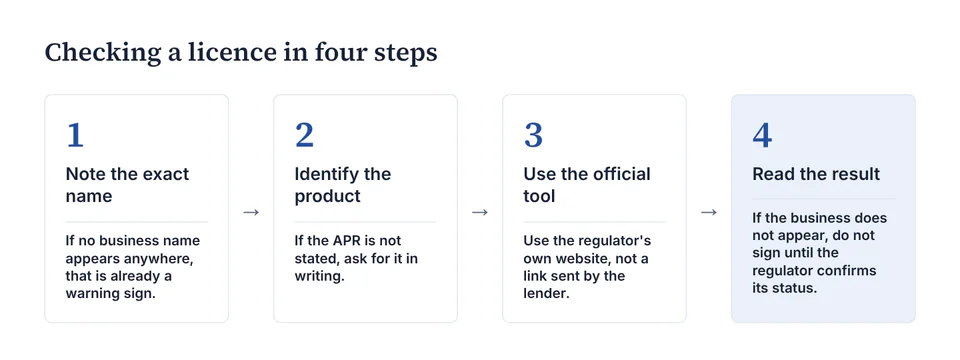
Checking a licence in four steps
The same method works in every province. Only the tool changes.
Note the exact name
Copy the business name from the agreement or the website, and the location's address if there is one.
If no business name appears anywhere, that is already a warning sign.
Identify the product
Payday loan or instalment loan, and at what APR: this decides which licence applies.
If the APR is not stated, ask for it in writing.
Use the official tool
Search with your province's regulator, or contact it directly in Manitoba.
Use the regulator's own website, not a link sent by the lender.
Read the result
Check that the licence is valid and matches the product you are offered.
If the business does not appear, do not sign until the regulator confirms its status.
In plain terms: a licence check tells you whether a business may offer the loan it is offering you. It does not tell you whether the loan fits your budget: that is for you to judge from the APR and the total you will repay.
Be wary of a website that presents a list of “trusted lenders” without any licence details: only your provincial regulator can tell you whether a business is licensed, and a licence is not a judgment on whether an offer suits you.
Province by province
Ontario
- Open Ontario's business licence, registration or appointment search. You can search by name, by city or by licence number.
- For a payday loan, the business must appear with a valid licence under the Payday Loans Act, 2008.
- For an instalment loan, there is no provincial high-cost credit licence to find. Check instead that the APR on the agreement is no higher than 35%, and look the business up on Ontario's Consumer Beware List.
British Columbia
- Use Consumer Protection BC's licence search. For a payday lender, use its payday lender licence search.
- If the rate is above 32%, confirm that the lender holds a valid high-cost credit grantor licence.
- Look at the lender's website as well: in British Columbia, a high-cost credit grantor must display its licence there, not only at its place of business.
Alberta
- On the Government of Alberta's consumer protection page, use the “Find out if a business is licensed” search.
- If the rate is 32% or more, confirm that the business holds a valid high-cost credit business licence. Remember that 32% itself already counts.
- You can also consult the province's list of licensed businesses, published as open data.
Saskatchewan
- Look the business up in FCAA411, the public lookup tool of the Financial and Consumer Affairs Authority.
- A payday lender must hold a licence for each location, and that includes online lenders based outside the province.
- For an instalment loan, confirm that the APR does not exceed 35%. If anything is unclear, contact the FCAA before you sign.
Manitoba
- Note the business name and the address of its Manitoba location: the licence is issued for each location.
- Contact the Consumer Protection Office and ask whether the business holds a valid high-cost credit licence.
- Whatever the answer, the APR on the agreement must not exceed 35%.
Red flags
- You are asked to pay a fee, an insurance premium or a deposit before the loan is paid out. A legitimate lender does not ask for fees before paying out a loan, as government warnings about fake lenders point out.
- In British Columbia, an online offer above 32% with no licence shown on the lender's website.
- The business name on the agreement is not the one you looked up, or no business name appears at all.
- The agreement shows a payment but no APR, or an APR above 35%.
- You are pressed to sign before you have had time to check.
If something does not add up
Do not sign and do not pay anything. If someone asked you for money before paying out a loan, report it to the Canadian Anti-Fraud Centre, and let your provincial regulator know: it is the body that can act on an unlicensed business.
We hold ourselves to the same test. The conditions every recipient must meet before it can receive a request through getaloannow.ca, starting with the licences required where it operates, are set out on our page who may receive your request.
Frequently asked questions
- Do banks and credit unions need a provincial high-cost credit licence?
- No. In British Columbia and Manitoba, banks and credit unions are exempt from the high-cost credit licence, so they will not appear in those searches. The 35% APR cap of the Criminal Code still applies to every loan.
- What if I cannot find the lender in my province's search?
- Do not sign yet. Ask the lender for its exact legal name and its licence number, then search again. If it still does not appear, contact your provincial regulator before going further: the absence of a result is a reason to wait, not to trust.
- Does a valid licence mean the loan is a good choice for me?
- No. A licence means the business may offer that kind of loan in your province. It says nothing about whether the payments fit your budget. Read the APR, the total cost of borrowing and the total you will repay before you decide.
Sources
- Search for a business licence, registration or appointment, Government of Ontario (checked on October 21, 2026)
- Check a licence, Consumer Protection BC (checked on October 21, 2026)
- High-cost credit business licence, Government of Alberta (checked on October 21, 2026)
- Licensed businesses, charities and fundraisers, Government of Alberta, open data (checked on October 21, 2026)
- FCAA411, Financial and Consumer Affairs Authority of Saskatchewan (checked on October 21, 2026)
- Consumer Protection Office, Government of Manitoba (checked on October 21, 2026)
- Canadian Anti-Fraud Centre, Canadian Anti-Fraud Centre (checked on October 21, 2026)
If you are considering a loan
- Personal loansHow an instalment loan works and what to read on the agreement.
- Bad credit loansWhat lenders look at when your credit score is low.
- All our guidesPlain-English guides to borrowing in Ontario, BC, Alberta, Saskatchewan and Manitoba: the 35% cap, credit scores, payday loan rules, licence checks.
Related pages
- Free credit score in Canada: how to get yoursHow to get a free credit score and credit report in Canada from Equifax and TransUnion, what each shows, and why checking your own file is safe.
- Criminal interest rate in Canada: the 35% cap since 2025The criminal interest rate in Canada has been 35% APR since January 1, 2025. The old limit, the payday loan exception and each province's high-cost tier.
- How to increase your credit score in CanadaHow to increase your credit score in Canada: the four factors FCAC names, habits that help, building credit from scratch and repair offers to avoid.
Where to get help, free of charge
These organizations are non-profit or public bodies, separate from us.
- Credit Counselling CanadaFind a non-profit credit counsellor near you
- Financial Consumer Agency of Canada (FCAC)Tools to make a budget and understand your credit
- Canadian Anti-Fraud CentreReport a request for fees before a loan
The getaloannow.ca editorial team
Writing and fact-checking · Official sources, cited and dated · Regularly updated content
Our guides are written and checked against official sources (provincial regulators, FCAC, Canada.ca), cited and dated on every page. They explain how borrowing works in Canada and are not personalized financial advice.
Published November 26, 2026 · Updated November 26, 2026