“Guaranteed approval” loans: why no lender can promise it
By the getaloannow.ca editorial team · Writing and fact-checking
Updated November 26, 2026 · Written from the sources listed at the bottom of the page
Search for “guaranteed approval” loans, or “bad credit personal loans guaranteed approval”, and you will find plenty of ads making that promise. No lender in Canada can keep it: a lender only knows whether it will lend once it has looked at your income, your current payments and, most of the time, your credit report. This guide explains why the promise cannot be true, the steps at which a request can be turned down, what these offers often hide, and what to do if you have been refused.
Read the transcript
“Guaranteed approval” loans: can anyone really promise that? No. Here’s why, in one minute.
Before lending, a lender has to see whether you can repay. According to the Financial Consumer Agency of Canada, lenders look for proof of regular income and usually check your credit. Only the lender decides, and it can always say no. So no ad can know the answer in advance.
The Canadian Anti-Fraud Centre goes further. It warns about companies that offer guaranteed loans, even with poor or no credit, sometimes for a fee. And in most provinces, asking for a fee before you receive your loan is illegal. getaloannow.ca is not a lender, and no outcome is ever guaranteed.
Every lender checks whether you can repay before it lends, and every lender can say no. An ad that promises acceptance in advance is promising something it cannot know.
Only the lender. We are a loan matching service: we do not lend money and make no credit decisions, so we cannot promise approval either.
An offer that promises approval and then asks for a payment before the money is sent has all the marks of a scam.
Why a lender cannot say yes to everyone
Lending is a bet on your ability to repay. Before making an offer, a lender wants to know whether the payments fit in your budget. To find out, it usually looks at:
- Your regular income and where it comes from;
- What already goes out each month: rent, other loans, credit card payments;
- Your credit history, for most lenders, through your file at Equifax Canada or TransUnion Canada.
If the payments would put your budget under strain, the lender has every reason not to lend, since a loan that is not repaid costs it money. A refusal in that case also protects you from a debt you could not carry.
Each lender also sets its own criteria. Two lenders can look at the same request and reach different answers. That alone makes a blanket promise impossible: whoever writes the ad does not know which lender will review your request or what that lender will decide.
What your credit score does and does not decide
A low score is the reason most people go looking for these offers. In Canada, credit scores run from 300 to 900, according to the Financial Consumer Agency of Canada (FCAC). Two credit bureaus, Equifax Canada and TransUnion Canada, each use their own formula, so your two scores can differ.
According to Equifax Canada, a score of 300 to 559 is poor, 560 to 659 fair, 660 to 724 good, 725 to 759 very good and 760 to 900 excellent. Lenders set their own bands, though: some review requests from people with a low score, often at a higher rate, and others do not. A low score narrows your choices and usually raises the price. It does not, on its own, decide the answer, and a high score does not guarantee a yes either. If your score is low, we explain what lenders look at when your credit is weak.
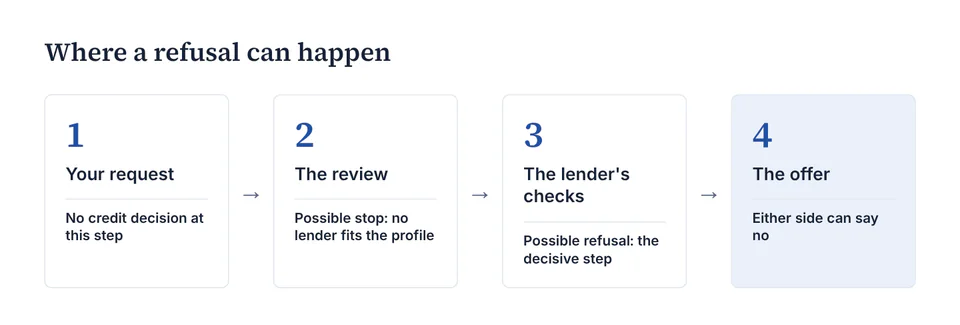
Where a refusal can happen
The path of a request, from the form to the agreement. A refusal is possible at three of the four steps, and only the lender makes a credit decision.
Your request
The amount, your province, your income and your contact details.
No credit decision at this step
The review
We review the request and, if your profile fits, may forward it to lenders and financial partners who may be able to respond.
Possible stop: no lender fits the profile
The lender's checks
The lender assesses whether you can repay, often through your credit report or your bank statements.
Possible refusal: the decisive step
The offer
The lender sets out its terms in writing. You can turn them down in your turn.
Either side can say no
In plain terms: a request can stop because no lender fits your profile, because the lender declines after its checks, or because you decline its offer. No step guarantees the next one.
Be wary of ads for “guaranteed approval” or “100% approved” loans: no serious lender can make that promise. Your request is reviewed whatever your score, each lender sets its own criteria, and no favourable answer is ever guaranteed.
What these offers often hide
Sites that promise approval with no conditions are aimed mostly at people a bank or credit union has already turned down. The offers that follow tend to be expensive, so always look at the annual percentage rate (APR) and the total you will repay before you sign, not only the size of each payment.
The highest APR a personal loan to an individual can carry in Canada since January 1, 2025 (Criminal Code, s. 347). Above it, the loan is prohibited, whatever your credit score.
Some provinces add a licence for the most expensive loans. In British Columbia, a lender charging more than 32% needs a high-cost credit grantor licence from Consumer Protection BC and must display it on its website. In Alberta, the line is 32% or more, with a high-cost credit business licence. In Manitoba, above 32%, the lender needs a licence from the Consumer Protection Office. Ontario and Saskatchewan have no such tier, so the federal cap is the line to watch there.
Some ads are not from lenders at all. Ontario's page on payday loans warns about businesses that present themselves as online lenders but are lead generators that collect requests to pass them on. Read who you are dealing with before you share anything. We say plainly what we are, and who may receive your request.
When the promise is a scam
Some of these offers are frauds. They announce that your loan is approved, then ask for a “processing fee”, “insurance” or a deposit before the money is sent. A legitimate lender does not ask you to pay fees before it pays out the loan, as government warnings about fake lenders point out. Other signs to stop at:
- Approval is announced before you have provided any information that could be checked;
- The business gives no licence number, or none you can find with your province's regulator;
- You are pushed to decide immediately, before you have read the agreement.
If you have been asked to pay before receiving a loan, do not pay, and report it to the Canadian Anti-Fraud Centre. To check a licence, use the search tool of your province: Consumer Protection BC, Alberta, Ontario or FCAA411 in Saskatchewan. In Manitoba, contact the Consumer Protection Office.
If you have been turned down
A refusal is not final. Ask the lender what it was based on. Get your credit report: Equifax Canada provides a free credit report and score everywhere in Canada, and TransUnion Canada provides a free score in Ontario. Checking your own report usually has no effect on your score. If you spot an error, contact the credit bureau that holds the file.
Then look at the reasons before applying again. A credit application with a lender can leave an inquiry on your file, so think twice before sending many requests in a short time. A non-profit credit counsellor can help you sort out your budget first: the Credit Counselling Canada directory lists agencies across the country.
Frequently asked questions
- Is there a loan with no refusal for bad credit?
- No. Some lenders review requests from people with a low credit score, often at a higher rate, but every lender checks your situation and keeps the right to decline. A low score changes the price and the number of lenders willing to look at your request, not the fact that a refusal is possible.
- Can getaloannow.ca guarantee my request will be accepted?
- No. We are a loan matching service: we review your request and, if your profile fits, may forward it to lenders and financial partners who may be able to respond. Only a lender can decide whether to make an offer, and it may not reply at all.
- Does a refusal lower my credit score?
- What can show on your file is the application, not the answer. A credit application with a lender can leave an inquiry on your file, and the FCAC lists the number of inquiries among the factors of a score. Checking your own credit report, on the other hand, usually has no effect on it.
Sources
- Credit report and score basics, Financial Consumer Agency of Canada (checked on October 21, 2026)
- Criminal Code (R.S.C. 1985, c. C-46), section 347, Justice Laws Website (checked on October 21, 2026)
- Payday loans: your rights, Government of Ontario (checked on October 21, 2026)
- Check a licence, Consumer Protection BC (checked on October 21, 2026)
- High-cost credit business licence, Government of Alberta (checked on October 21, 2026)
- Canadian Anti-Fraud Centre, Canadian Anti-Fraud Centre (checked on October 21, 2026)
If you are considering a loan
- Bad credit loansWhat lenders look at when your credit score is low.
- Personal loansWhat a loan really costs, beyond the monthly payment.
Related pages
- Loans that “approve anyone”: what lenders actually checkWhere the promise comes from, the upfront-fee scam it often hides, and what a real credit assessment looks at.
Where to get help, free of charge
These organizations are non-profit or public bodies, separate from us.
- Credit Counselling CanadaFind a non-profit credit counsellor near you
- Financial Consumer Agency of Canada (FCAC)Tools to make a budget and understand your credit
- Canadian Anti-Fraud CentreReport a request for fees before a loan
The getaloannow.ca editorial team
Writing and fact-checking · Official sources, cited and dated · Regularly updated content
Our guides are written and checked against official sources (provincial regulators, FCAC, Canada.ca), cited and dated on every page. They explain how borrowing works in Canada and are not personalized financial advice.
Published November 26, 2026 · Updated November 26, 2026