How to increase your credit score in Canada
By the getaloannow.ca editorial team · Writing and fact-checking
Updated November 26, 2026 · Written from the sources listed at the bottom of the page
If you are wondering how to increase your credit score, the honest answer is: gradually, through habits rather than tricks. Your score, a number from 300 to 900, reflects how you have used credit over time, as recorded by Equifax Canada and TransUnion Canada. This guide sets out the factors the Financial Consumer Agency of Canada (FCAC) names, the habits that move a score, how to build credit when you have little history, and where to find free, non-profit budget help in Ontario, British Columbia, Alberta, Saskatchewan and Manitoba.
No single action raises a score at once. Months of on-time payments and lower balances are what show up in your file.
FCAC names your payment history, how much of your credit you use, the length of your credit history and your credit inquiries among the factors that affect your score.
Check your credit report with both bureaus first. You can get it free, and checking it yourself usually has no effect on your score.
Where your score comes from
Your credit report records your credit accounts (cards, loans, lines of credit) and how you repay them. Two bureaus keep it: Equifax Canada and TransUnion Canada. Your credit score is calculated from that report, and each bureau has its own formula. Those formulas are not public, which is why your two scores rarely match exactly.
That has a practical consequence. Nobody outside the bureaus knows exactly how many points a given action is worth. Be wary of anyone who claims to know the weight of each factor down to the point.
The four factors FCAC names
Your payment history
Paying on time, every month, at least the minimum required. This is the habit that underpins all the others. A pre-authorized payment for the minimum avoids missed dates; if a payment is late, bring the account up to date without waiting.
How much of your credit you use
This is the share of your credit limits that you actually use. Low balances relative to your limits work in your favour; a card kept close to its limit works against you, even if you never miss a payment.
The length of your credit history
A long history tells lenders more than a recent one. Think twice before closing your oldest account, especially if it costs you nothing to keep.
Your credit inquiries
A credit application with a lender can leave an inquiry on your file. Several applications close together can lower your score. Checking your own report is different: it usually has no effect.
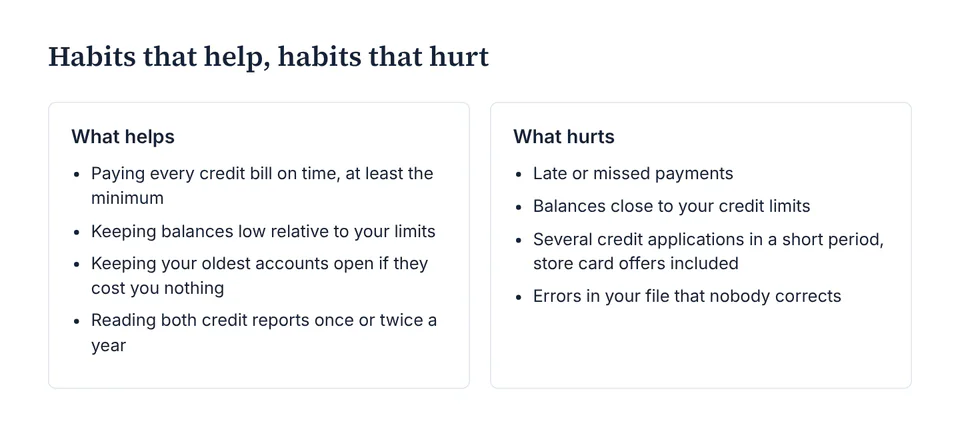
Habits that help, habits that hurt
Based on the factors FCAC names. The bureaus do not publish how much each one weighs.
What helps
- paying every credit bill on time, at least the minimum
- keeping balances low relative to your limits
- keeping your oldest accounts open if they cost you nothing
- reading both credit reports once or twice a year
What hurts
- late or missed payments
- balances close to your credit limits
- several credit applications in a short period, store card offers included
- errors in your file that nobody corrects
In plain terms: your score rewards consistency. There is no shortcut, only months of on-time payments and balances kept under control.
According to Equifax Canada, the score from which a file is generally seen as a lower risk (its “good” band runs from 660 to 724). Each lender still sets its own thresholds.
A plan you can start this month
- Get your credit report from both bureaus and read it line by line. Report any error to the bureau that holds the file.
- Set up pre-authorized payments for at least the minimum on every card and loan, so no due date slips by.
- Pay down the card whose balance is closest to its limit first: that lowers how much of your credit you use.
- Space out your credit applications, including store card offers at the checkout.
- Keep your oldest accounts open if they cost you nothing, to preserve the length of your history.
- Check both reports again once or twice a year to see your progress and catch new errors.
How to build credit from scratch
If you have little or no history, for example because you are new to Canada or have never borrowed, the problem is not a bad score but a thin file. Lenders have little to go on. A first credit product, used modestly and repaid on time, starts building that history. The same four factors apply from day one: pay on time, keep the balance low, and avoid opening several accounts at once.
Paid “credit repair” offers
Be wary of paid offers that promise to “repair” your score quickly. You can get your credit report and report an error yourself, directly with Equifax Canada and TransUnion Canada, without paying an intermediary. Accurate information about late payments is part of your history; what changes it over time is how you repay from now on.
The same caution applies to anyone who asks for money up front in exchange for a loan. A legitimate lender does not ask for fees before paying out a loan. If it happens to you, do not pay, and report it to the Canadian Anti-Fraud Centre.
When your debts are already heavy
If you are struggling to make your payments, the priority is not your score: it is your budget. Non-profit credit counselling organizations can help you review it. Credit Counselling Canada keeps a directory of its member agencies, and each of the five provinces has well-known non-profits:
- Ontario: Credit Canada;
- British Columbia and Saskatchewan: Credit Counselling Society;
- Alberta: Money Mentors;
- Manitoba: Community Financial Counselling Services.
To get a clear picture first, FCAC offers a free guide to making a budget.
If you need to borrow before your score has recovered, we explain what lenders look at when your credit score is low and how the full cost of a personal loan adds up, beyond each payment.
Frequently asked questions
- How long does it take to improve a credit score?
- No timeline can be promised. Your score reflects your habits over time: on-time payments, month after month, and lower balances eventually show in your file. Anyone who promises a set number of points by a set date cannot back it up.
- Does closing a credit card help my score?
- Not necessarily. Closing a card lowers your total available credit, which can raise the share you use, and closing your oldest account shortens your history. If the card costs you nothing, keeping it open and paid off is often the safer choice.
- Why do Equifax and TransUnion give me different scores?
- Each bureau calculates its score with its own formula, and those formulas are not public. A gap between the two is normal. What matters most is that the information in each report is accurate.
Sources
- Credit report and score basics, Financial Consumer Agency of Canada (checked on October 21, 2026)
- Make a budget, Financial Consumer Agency of Canada (checked on October 21, 2026)
- Find a credit counsellor, Credit Counselling Canada (checked on October 21, 2026)
- Canadian Anti-Fraud Centre, Government of Canada (checked on October 21, 2026)
If you are considering a loan
- Bad credit loansWhat lenders look at when your credit score is low.
- Personal loansWhat a loan really costs, beyond each payment.
- All our guidesPlain-English guides to borrowing in Ontario, BC, Alberta, Saskatchewan and Manitoba: the 35% cap, credit scores, payday loan rules, licence checks.
Related pages
- Criminal interest rate in Canada: the 35% cap since 2025The criminal interest rate in Canada has been 35% APR since January 1, 2025. The old limit, the payday loan exception and each province's high-cost tier.
- Free credit score in Canada: how to get yoursHow to get a free credit score and credit report in Canada from Equifax and TransUnion, what each shows, and why checking your own file is safe.
- How to check a lender's licence: a step-by-step guide by provinceHow to check a lender's licence in Ontario, BC, Alberta, Saskatchewan and Manitoba: the official tools, step by step, and the red flags to watch for.
Where to get help, free of charge
These organizations are non-profit or public bodies, separate from us.
- Credit Counselling CanadaFind a non-profit credit counsellor near you
- Financial Consumer Agency of Canada (FCAC)Tools to make a budget and understand your credit
- Canadian Anti-Fraud CentreReport a request for fees before a loan
The getaloannow.ca editorial team
Writing and fact-checking · Official sources, cited and dated · Regularly updated content
Our guides are written and checked against official sources (provincial regulators, FCAC, Canada.ca), cited and dated on every page. They explain how borrowing works in Canada and are not personalized financial advice.
Published November 26, 2026 · Updated November 26, 2026