E-transfer loans in British Columbia: licences and safe borrowing
By the getaloannow.ca editorial team · Writing and fact-checking · updated November 26, 2026
E-transfer loans in British Columbia are instalment loans whose approved funds are sent by Interac e-Transfer. The transfer is the last step; before it, the lender reviews your request, decides and has you sign an agreement. In British Columbia, that agreement also tells you something important: whether the loan is high-cost credit, which depends on its rate.
getaloannow.ca is not a lender. We are a loan matching service: if your profile fits, your request may be forwarded to lenders and financial partners who may be able to respond; a lender makes its own decision and sends the funds by the method it chooses. This page sets out the British Columbia rules that matter for these loans and how to check a lender before you sign.
getaloannow.ca is not a lender. We are a loan matching service. We do not lend money and make no credit decisions. Our role
- Two minutesAbout two minutes to fill in the request.
- No SIN requiredWe never collect your social insurance number.
- Your credit file is not affectedFilling in our form does not touch your credit file. A lender that reviews your request may check it.
- Free for youWe never charge you anything.
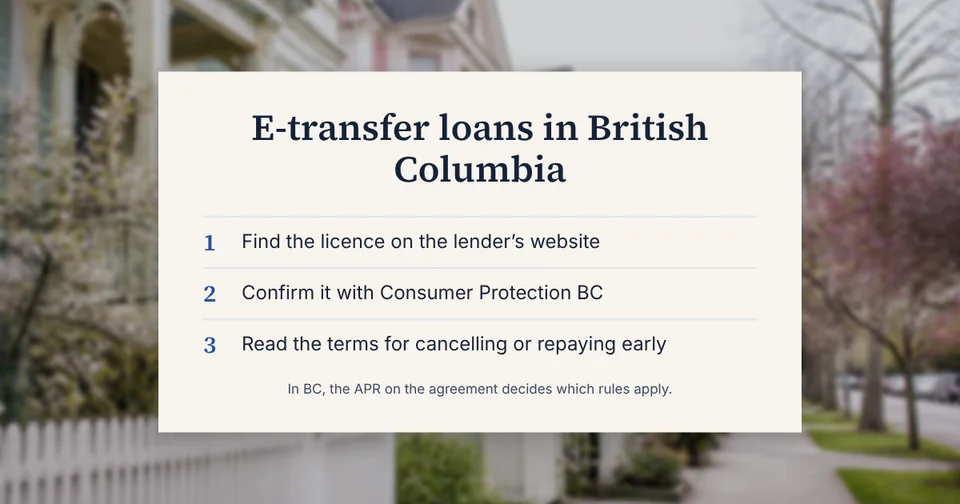
In British Columbia, the APR on the agreement decides which rules apply. Above 32%, the lender must hold a high-cost credit grantor licence.
No personal loan may exceed 35% APR (Criminal Code, s. 347). Since May 1, 2022, credit above 32% for personal use requires a licence from Consumer Protection BC, so high-cost credit sits between 32% and the 35% cap.
Check the licence with Consumer Protection BC, look for it on the lender's website, and read the agreement's terms for cancelling or repaying early.

The 32% line
British Columbia treats a credit product for personal, family or household use as high-cost credit when its APR or annual interest rate is above 32%. A business that offers it needs a high-cost credit grantor licence from Consumer Protection BC, one per location, valid for up to three years. With the federal cap of 35%, that leaves a narrow band: above 32%, but never above 35%.
At 29.96% APR, the representative example used on this site sits below that line. A lender may offer you a different rate depending on your file, so read the APR on the agreement itself: it tells you whether the licence applies to your loan.
Banks, credit unions and extraprovincial trust corporations are exempt from this licence. If one of them sends you an e-transfer loan, you will not find it in the high-cost credit search, and the 35% cap still applies.
A licence you should be able to see online
British Columbia requires a licensed high-cost credit grantor to display its licence, including on its website. For a loan you arrange online and receive by e-transfer, that is a useful first check: an offer above 32% with no licence shown on the lender's site is a reason to stop.
- Note the lender's exact business name from the agreement.
- Search it with Consumer Protection BC's licence search.
- Confirm that a high-cost credit grantor licence is active if the APR is above 32%.
- Keep a copy of the agreement before any money moves.
Our guide on how to check a lender's licence walks through these steps, and what to do if the lender does not appear.
The rules at a glance
- Regulator: Consumer Protection BC, which licenses payday lenders and high-cost credit grantors and handles complaints.
- Licence: above 32%, the lender needs a high-cost credit grantor licence (since May 1, 2022).
- Limits: no personal loan above 35% APR (Criminal Code); above 32%, the loan is high-cost credit.
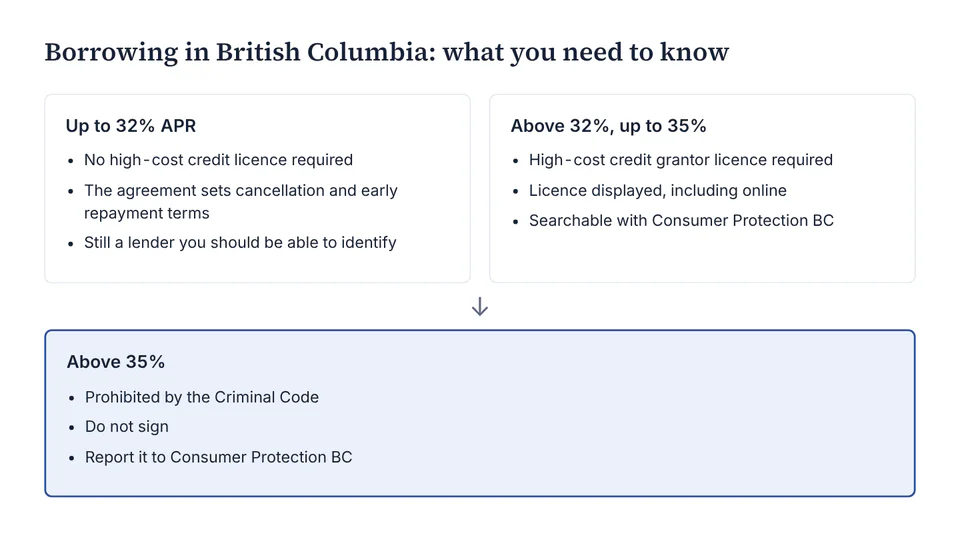
Borrowing in British Columbia: what you need to know
The rate on your agreement tells you which column you are in.
Up to 32% APR
- No high-cost credit licence required
- The agreement sets cancellation and early repayment terms
- Still a lender you should be able to identify
Above 32%, up to 35%
- High-cost credit grantor licence required
- Licence displayed, including online
- Searchable with Consumer Protection BC
Above 35%
- Prohibited by the Criminal Code
- Do not sign
- Report it to Consumer Protection BC
In plain terms: in British Columbia, a quick look at the APR tells you whether to look for a licence, and the regulator's search tells you whether it is real.
Payday loans sent by e-transfer are a different case
Payday lenders in British Columbia have their own licence and their own rules, and every lender offering payday loans to British Columbia residents must be licensed, wherever it is located, including online. Payday loans are capped at $14 per $100 borrowed, and the lender must let you cancel by the end of 2 days without charge. These are payday rights: for an instalment loan, the agreement sets the terms. Our page on payday loans in British Columbia explains that regime.
If your credit history is the concern, our page on bad credit loans in British Columbia explains what lenders still review. For an overview of borrowing rules in the province, see loans in British Columbia.
Scams and the e-transfer
Consumer Protection BC warns about the risks of borrowing from unlicensed lenders. The most common trap for borrowers is a fee demanded by e-transfer before the loan is paid out. A legitimate lender does not ask for fees before paying out a loan: if it happens, do not send anything and report it to the Canadian Anti-Fraud Centre.
Part of: E-transfer loans: an instalment loan paid by Interac e-Transfer
E-transfer loans in other provinces
- E-transfer loans in Alberta: the licence, the rate and your checksInstalment loans paid by e-transfer in Alberta: the licence required at 32% or more, the lookup tools and the consumer alerts.
- E-transfer loans in Ontario: what to check before you signInstalment loans paid by e-transfer in Ontario: the rate cap, the provincial lookup tool and the Consumer Beware List.
- E-transfer loans in Manitoba: licences, contacts and safe borrowingInstalment loans paid by e-transfer in Manitoba: the licence above 32%, issued per location, and how to confirm it.
Frequently asked questions
- Does every lender in British Columbia need a high-cost credit licence?
- No. The licence is required for credit above 32% APR for personal use. Below that rate, it does not apply, and banks, credit unions and extraprovincial trust corporations are exempt. Payday lenders have a separate licence.
- How do I check a lender's licence in British Columbia?
- Use Consumer Protection BC's licence search with the lender's exact business name, and look for the licence on the lender's website. If the APR is above 32% and you cannot find a licence, do not sign.
- How fast does the e-transfer arrive?
- According to Interac, funds usually arrive within minutes, sometimes up to 30 minutes, depending on the institution. Before that, the lender has to approve the loan and receive your signed agreement; most lenders pay out within 24 to 48 hours after approval, with no guarantee.
Who may receive your request
To lenders and financial partners who may be able to respond, and only if your profile fits. The list of recipients will be published before any request is forwarded. Who they are, our conditions and how to check a licence
Representative example
- Amount
- $2,000
- Term
- 24 months
- Monthly payment
- $111.78
- Total repaid
- $2,682.83
- Cost of borrowing
- $682.83
- Rate
- 29.96% APR
The annual percentage rate (APR) includes the cost of borrowing. The annual rate of a personal loan cannot exceed 35% APR (Criminal Code). In British Columbia and Manitoba, a lender also needs a high-cost credit licence above 32% (32% or more in Alberta): see your province page. Actual terms are set by the lender.
Sources
- High-cost credit granting licence, Consumer Protection BC (checked on October 21, 2026)
- High-cost credit products, Consumer Protection BC (checked on October 21, 2026)
- Check a licence, Consumer Protection BC (checked on October 21, 2026)
- The risks of borrowing money from unlicensed lenders, Consumer Protection BC (checked on October 30, 2026)
- Payday Loans Regulation (B.C. Reg. 57/2009), BC Laws (checked on October 30, 2026)
- Interac e-Transfer: frequently asked questions, Interac Corp. (checked on October 30, 2026)
The getaloannow.ca editorial team
Writing and fact-checking · Official sources, cited and dated · Regularly updated content
Our guides are written and checked against official sources (provincial regulators, FCAC, Canada.ca), cited and dated on every page. They explain how borrowing works in Canada and are not personalized financial advice.
Published November 26, 2026 · Updated November 26, 2026
Request a personal loan in British Columbia
About two minutes on our side. The lender's licence, rate and agreement are its own.