Debt-to-income calculator
Your debt to income ratio measures the share of your income that already goes to housing and debt payments. This calculator works out your two ratios, GDS and TDS, from three monthly figures. The calculation runs in your browser: the numbers you enter are not sent to us.
before tax and deductions, for everyone in the household who shares the costs
rent or mortgage payment, property taxes, heating…
credit cards, loans, lines of credit…
Enter your income to see your ratios.
CMHC benchmarks for mortgage insurance: GDS of no more than 39% and TDS of no more than 44%. These are mortgage standards, shown here as benchmarks only; a lender may apply other criteria.
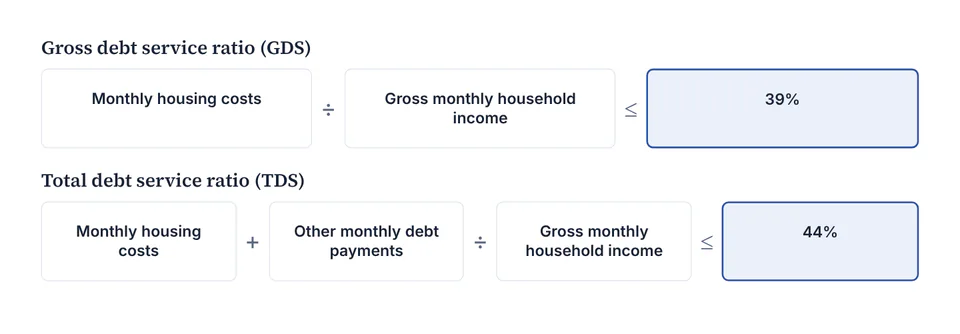
The two ratios
The gross debt service ratio (GDS) is the share of your gross monthly income that goes to housing: rent or mortgage payment, property taxes and heating.
The total debt service ratio (TDS) adds every other debt payment to those housing costs: credit cards, loans, lines of credit, car leases or car loans.
Both are calculated the same way: divide the monthly payments by gross monthly income, then multiply by 100. If your housing costs take a third of your gross income, your GDS is about 33%. If your other debts take another tenth, your TDS reaches about 43%.
For credit cards and lines of credit, use what you actually pay each month, or the minimum payment if that is all you pay. The result is only as reliable as the figures you enter.
Where the 39% and 44% benchmarks come from
These thresholds are the ones the Canada Mortgage and Housing Corporation (CMHC) uses for mortgage insurance: a GDS of no more than 39% and a TDS of no more than 44%. They are mortgage standards. We show them because they are public and widely known, not because they apply to every kind of credit.
For other types of credit, each lender applies its own criteria. These benchmarks give you a sense of how balanced your budget is: they do not tell you whether a lender would accept or decline a request.
How to read your results
A GDS well under 39% usually means housing leaves room in your budget. A TDS close to or above 44% means a large share of your income is already committed before groceries, transportation and savings.
Gross income is income before tax. What you actually take home is lower, so the share of your take-home pay that goes to housing and debts is higher than the ratio shows. If your budget already feels tight, trust that feeling over the percentage.
Your ratios also change over time. Paying down a card balance lowers your TDS; a new car payment raises it. Recalculating before taking on a new payment shows you where it would put you.
If your ratios are high
A high ratio is a signal about your budget. Before adding a new payment, it is worth taking stock of your spending and debts, with help from an independent organization if needed:
- The Financial Consumer Agency of Canada (FCAC) offers free tools to make a budget;
- Credit Counselling Canada lists non-profit credit counselling agencies across the country;
- In each province, non-profit agencies offer free budget counselling, among them Credit Canada in Ontario, the Credit Counselling Society in British Columbia and Saskatchewan, Money Mentors in Alberta and Community Financial Counselling Services in Manitoba.
These organizations are non-profit or public bodies, separate from us.
Part of: Guides: understand a loan before you borrow
Other tools and guides
- Personal loan calculatorPersonal loan calculator: estimate the monthly payment, total repaid and cost of borrowing from the amount, term and APR. For information only.