Your situation
Loans for newcomers: borrowing without a Canadian credit history
By the getaloannow.ca editorial team · Writing and fact-checking · updated November 26, 2026
Loans for newcomers raise a problem that has little to do with your income: a Canadian lender usually relies on a Canadian credit file, and yours may be short or empty. That file is built over time, as you use credit in Canada and repay it.
Whether a lender considers a request from someone new to Canada, and on what terms, is its own decision: each lender sets its own criteria, including on status in Canada. This page, written for readers in Ontario, BC, Alberta, Saskatchewan and Manitoba, explains how credit files work here, what to prepare and how to start a history.
- Free for you, no obligation
- No social insurance number required
- Filling in our form does not affect your credit file

Free for you
No fees, at any point.
No SIN
No social insurance number, no banking details.
Your credit file stays untouched
Our form does not pull your credit report.
You stay free
No obligation to accept an offer.
How credit files work in Canada
Two credit bureaus keep credit files in Canada: Equifax Canada and TransUnion Canada. Credit scores run on a scale from 300 to 900, the higher the better. Each bureau uses its own formula, so your two scores can differ.
Your file builds up as you use credit in Canada and repay it. Do not assume that your history from another country will be visible to a Canadian lender: ask the bureaus, and ask the lender which documents it accepts.
According to the FCAC, Equifax gives a free credit report and score everywhere in Canada, and TransUnion gives a free score in Quebec and Ontario. Checking your own report usually has no effect on your score. The FCAC explains the basics on its credit report and score page.
What a lender may review
With little history, a lender may rely on what it can check today: your job and income in Canada, your regular deposits and your current debts. If your status is temporary, a lender may take the end date of your permit into account, to set the term of a loan or to decide whether to lend at all. Each lender sets its own criteria.
What to have ready
- Photo ID, such as your passport.
- The document that shows your status in Canada: permanent resident card, work permit or study permit.
- Proof of address in Canada.
- Proof of income: pay stubs or a letter from your employer.
- Statements from a Canadian bank account.
Building a credit history
A history is built over time, through regular payments. A few habits help:
- Open an account at a Canadian financial institution and have your pay deposited there.
- A credit card, even with a small limit, starts a history; some institutions offer cards secured by a deposit.
- Pay every bill on time, and in full when you can.
- Use a small part of your credit limit rather than all of it.
- Avoid many credit applications in a short time: the FCAC lists the number of inquiries among the factors that affect a score.
- Check your report at least once a year to spot errors.
Points to watch
- Fees before payout. A legitimate lender does not ask for fees before paying out a loan. If someone asks, do not pay, and report it to the Canadian Anti-Fraud Centre.
- Your social insurance number. Be wary of anyone who asks for it by email or phone without a clear reason.
- The lender's licence. Each province has its own rules. Check the lender before you sign: Consumer Protection BC, Alberta's licence lookup, Saskatchewan's FCAA411, Ontario's business licence search, or Manitoba's Consumer Protection Office.
- The rate. In Canada, a loan with an APR above 35% is prohibited by the Criminal Code since January 1, 2025. British Columbia and Manitoba require a high-cost credit licence above 32%, and Alberta at 32% or more.
- The agreement. Do not sign an agreement you do not understand. Ask for the APR and the total repaid in writing, and take the time to read them.
To see how a personal loan works, what it costs and how to read an offer: Personal loans online: $1,000 to $15,000.
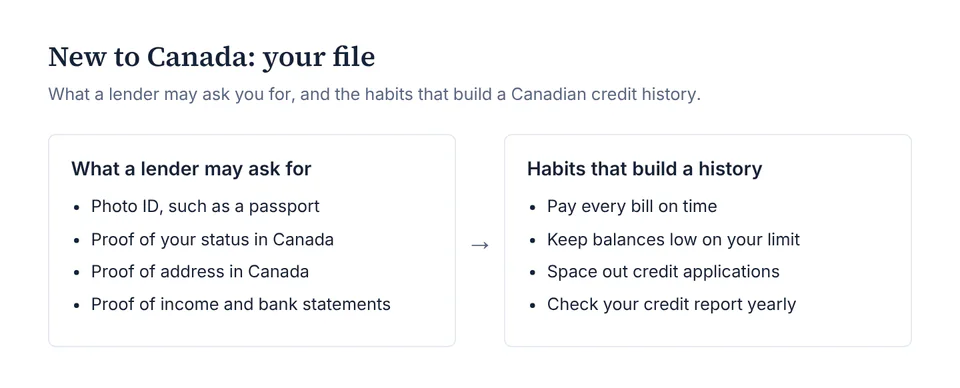
New to Canada: your file
What a lender may ask you for, and the habits that build a Canadian credit history.
What a lender may ask for
- Photo ID, such as a passport
- Proof of your status in Canada
- Proof of address in Canada
- Proof of income and bank statements
Habits that build a history
- Pay every bill on time
- Keep balances low on your limit
- Space out credit applications
- Check your credit report yearly
We have no connection with Immigration, Refugees and Citizenship Canada or any government program for newcomers. Sending a request on our site does not touch your credit file.

How it works
Your request, in three steps
You answer a few questions
The amount, your province, your situation. About two minutes.
We review your request
If your profile fits, we may forward it to lenders and financial partners who may be able to respond.
You review the offer, or not
No obligation to accept. Most lenders pay out within 24 to 48 hours after approval.
Part of: Personal loans online: $1,000 to $15,000
Other situations
- Loans for single parents: one income, one householdLoans for single parents in Ontario, BC, Alberta, Saskatchewan and Manitoba: what a lender may review on one income, and when consolidation costs less.
- Loans for self employed people: proving an income that variesLoans for self employed workers in Ontario, BC, Alberta, Saskatchewan and Manitoba: the income proof a lender may ask for and how to plan for slow months.
- Loans for unemployed people: what can count as incomeLooking for loans for unemployed people or loans with no job? The income a lender may review, what to prepare, and the steps to take before borrowing.
Frequently asked questions
- Does my credit history from my home country count in Canada?
- Do not assume it does. In Canada, credit files are kept by Equifax Canada and TransUnion Canada. Ask them, and ask the lender which documents it accepts.
- Can I send a request with a work permit?
- You can fill in our form if you live in one of the six provinces we serve. Each lender then sets its own criteria, including on status in Canada. We cannot tell you in advance what it will decide.
- Does checking my credit report lower my score?
- Checking your own report usually has no effect on your score. A credit application with a lender, on the other hand, can leave an inquiry on your file.
- Why don't you ask for my SIN?
- We do not need it to handle your request, and we never collect it. The details of our role: How it works.
The getaloannow.ca editorial team
Writing and fact-checking · Official sources, cited and dated · Regularly updated content
Our guides are written and checked against official sources (provincial regulators, FCAC, Canada.ca), cited and dated on every page. They explain how borrowing works in Canada and are not personalized financial advice.
Published November 26, 2026 · Updated November 26, 2026
Representative example
- Amount
- $2,000
- Term
- 24 months
- Monthly payment
- $111.78
- Total repaid
- $2,682.83
- Cost of borrowing
- $682.83
- Rate
- 29.96% APR
The annual percentage rate (APR) includes the cost of borrowing. The annual rate of a personal loan cannot exceed 35% APR (Criminal Code). In British Columbia and Manitoba, a lender also needs a high-cost credit licence above 32% (32% or more in Alberta): see your province page. Actual terms are set by the lender.
getaloannow.ca is not a lender. We are a loan matching service: we receive your request and may forward it to lenders and financial partners who may be able to respond. We do not lend money and make no credit decisions.
Who may receive your request
To lenders and financial partners who may be able to respond, and only if your profile fits. The list of recipients will be published before any request is forwarded. Who they are, our conditions and how to check a licence