Your situation
Loans for self employed people: proving an income that varies
By the getaloannow.ca editorial team · Writing and fact-checking · updated November 26, 2026
Loans for self employed people follow the same rules as any personal loan, with one difference: you have no pay stub. A lender has to understand your income from what you declared to the Canada Revenue Agency and from what actually reaches your bank account.
Each lender sets its own criteria, including how long you must have been in business and which documents it accepts. This page, for readers in Ontario, BC, Alberta, Saskatchewan and Manitoba, explains what a lender may try to establish, what to prepare and what to watch when your income varies.
- Free for you, no obligation
- No social insurance number required
- Filling in our form does not affect your credit file

Free for you
No fees, at any point.
No SIN
No social insurance number, no banking details.
Your credit file stays untouched
Our form does not pull your credit report.
You stay free
No obligation to accept an offer.
What a lender tries to establish
An employee can show a pay stub. You show your tax filings and your deposits. From them, a lender usually tries to answer three questions:
- Is your income steady from year to year, or does it swing widely?
- Is it enough once your business expenses are paid?
- Do your current debts leave room for a new monthly payment?
There is no common rule. One lender may want several years of filed returns, another may rely more on recent deposits, a third may set a minimum time in business. We cannot tell you in advance what a lender will decide.
Documents to prepare
Documents vary from one lender to the next. A self-employed borrower can expect to provide some of these:
- Your income tax returns for recent years, with the notices of assessment from the Canada Revenue Agency.
- Recent bank statements that show payments from your clients.
- Photo ID and proof of address.
- Depending on the case, invoices, current contracts or your business registration.
One point deserves attention. Your notice of assessment shows your net self-employment income, after the expenses you deducted. If you deduct a lot of expenses, the income on that document is lower than what passes through your account. That is still the figure a lender sees when it asks for the notice.
A lender may also offer instant bank verification: you log in to your bank through a third-party portal and the lender receives a copy of your statements and transactions. In March 2018, the FCAC warned that sharing your banking credentials with a third-party service may breach your account agreement and leave you liable for unauthorized transactions. Read the agreement first, and ask whether you can provide statements another way.
Budgeting around uneven income
- Keep business and personal needs apart. A personal loan covers personal or family needs. To finance equipment, inventory or working capital, talk to your financial institution: business financing follows other rules.
- Budget on your slowest months. If your income moves with the seasons or with contracts, measure the payment against your weakest months, not your best ones.
- Set tax aside. Self-employed people may have to pay income tax by instalments. A new loan payment should never crowd those out.
- Read the total, not only the payment. A longer term lowers the monthly payment and raises the total repaid. Ask the lender for both figures, side by side, for each term it offers.
Before you sign
Check the rate. Since January 1, 2025, a loan with an APR above 35% is prohibited by the Criminal Code. In British Columbia and Manitoba, a lender charging more than 32% needs a high-cost credit licence; in Alberta, the threshold is 32% or more. Elsewhere, read the APR on the agreement yourself.
Check the licence with your province: Consumer Protection BC, Alberta's licence lookup, Saskatchewan's FCAA411, Ontario's business licence search, or Manitoba's Consumer Protection Office. And be wary of any request for fees before the loan is paid out: a legitimate lender does not ask for them. Report it to the Canadian Anti-Fraud Centre.
A personal loan is not always the right answer to a cash-flow gap. Your current financial institution already sees your deposits and may have a product suited to your situation. If a client is late paying, an arrangement with your suppliers or creditors can cost less than a loan. And if debts are building up, a non-profit credit counsellor from Credit Counselling Canada's directory of non-profit credit counsellors can help you sort them out.
For how a personal loan works, what it costs and how terms change the total: Personal loans online: $1,000 to $15,000.
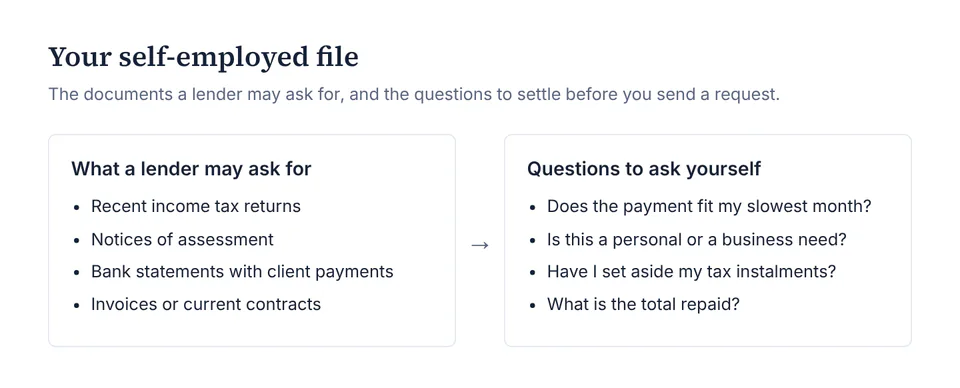
Your self-employed file
The documents a lender may ask for, and the questions to settle before you send a request.
What a lender may ask for
- Recent income tax returns
- Notices of assessment
- Bank statements with client payments
- Invoices or current contracts
Questions to ask yourself
- Does the payment fit my slowest month?
- Is this a personal or a business need?
- Have I set aside my tax instalments?
- What is the total repaid?
We have no connection with the Canada Revenue Agency or any government program for self-employed workers.

How it works
Your request, in three steps
You answer a few questions
The amount, your province, your situation. About two minutes.
We review your request
If your profile fits, we may forward it to lenders and financial partners who may be able to respond.
You review the offer, or not
No obligation to accept. Most lenders pay out within 24 to 48 hours after approval.
Part of: Personal loans online: $1,000 to $15,000
Other situations
- Loans for newcomers: borrowing without a Canadian credit historyLoans for newcomers in Ontario, BC, Alberta, Saskatchewan and Manitoba: how Canadian credit files work, what a lender may ask for, how to build a history.
- Loans for unemployed people: what can count as incomeLooking for loans for unemployed people or loans with no job? The income a lender may review, what to prepare, and the steps to take before borrowing.
- Loans for single parents: one income, one householdLoans for single parents in Ontario, BC, Alberta, Saskatchewan and Manitoba: what a lender may review on one income, and when consolidation costs less.
Frequently asked questions
- How long do I need to have been self-employed?
- There is no common rule: each lender sets its own minimum, if it has one. The longer and steadier your declared history, the easier it is for a lender to assess your income. We cannot promise you an answer: the lender decides.
- Does a lender look at my revenue or my net income?
- Your notice of assessment shows your net self-employment income, after deducted expenses, and that is the document a lender may ask for. Your bank statements show what comes into your account. Each lender decides how it reads them.
- Can I borrow for my business?
- Our service covers personal loans, for personal or family needs. To finance your business, talk to your financial institution: business financing follows other rules.
- Will a lender ask to connect to my bank account?
- Some lenders offer it, as a way to read your deposits. The FCAC has warned that sharing your banking credentials with a third-party service may breach your account agreement. You can ask the lender whether it accepts statements instead.
The getaloannow.ca editorial team
Writing and fact-checking · Official sources, cited and dated · Regularly updated content
Our guides are written and checked against official sources (provincial regulators, FCAC, Canada.ca), cited and dated on every page. They explain how borrowing works in Canada and are not personalized financial advice.
Published November 26, 2026 · Updated November 26, 2026
Representative example
- Amount
- $2,000
- Term
- 24 months
- Monthly payment
- $111.78
- Total repaid
- $2,682.83
- Cost of borrowing
- $682.83
- Rate
- 29.96% APR
The annual percentage rate (APR) includes the cost of borrowing. The annual rate of a personal loan cannot exceed 35% APR (Criminal Code). In British Columbia and Manitoba, a lender also needs a high-cost credit licence above 32% (32% or more in Alberta): see your province page. Actual terms are set by the lender.
getaloannow.ca is not a lender. We are a loan matching service: we receive your request and may forward it to lenders and financial partners who may be able to respond. We do not lend money and make no credit decisions.
Who may receive your request
To lenders and financial partners who may be able to respond, and only if your profile fits. The list of recipients will be published before any request is forwarded. Who they are, our conditions and how to check a licence